Search Ace Linguist

August 31, 2023

From Stop to Flap and back to Stop

Have you noticed that Americans pronounce words like 'kitty' and 'kiddy' the same? The 't' and 'd' both become a lighter sound - they become a flap. This is called 't-flapping', and it happens when [t] and [d] are between vowels and at the end of a stressed syllable.

There's also th-stopping - this is when 'th' [θ] and voiced 'th' [ð] become harder sounds. Voiceless 'th' [θ] becomes a [t] and voiced 'th' [ð] becomes [d]. These sounds are still different from the normal 't' and 'd' founds in words like 'darn' and 'take' because these new sounds are dentals, made with the tongue hitting the back of the teeth and not the alveolar ridge.

Examples would be 'without' becoming 'wi[t̪]out' and 'there' becoming '[d̪]ere'.

Here's the fun part: when dental fricatives get t-stopped, they can even be flapped again. Here's an example from song:

  • "You wi[ɾ]out me ain't right" - break up with your girlfriend, Ariana Grande
  • This can happen across morpheme boundaries:

  • "Dreads to the top, gold in my mouth, woah[ɾ]ere" - Wish, Denzel curry
  • "G-g-get wi[ɾ]it" - Get Wit' It, Vanilla Ice
  • This particularly form of stopping is common in African American Vernacular English (which Denzel Curry speaks and which Ariana Grande and Vanilla Ice are trying to imitate).

    In sung speech, I've even heard the flap fortitioned to [d]. This restores the [d] sound in a word like "pedal" (a Duke of York maneuver), but replaces "t" with "d" in words like "metal."

  • "This shi[d] always happen to me" - break up with your girlfriend, i'm bored , Ariana Grande
  • "pedal to the medal (metal)" - Gold Trans Am, Kesha
  • Just for fun, what if we combined all these processes... could we turn a voiceless th into a d?

    Here are the rules in a VCV environment:

    [θ] can become [t]

    [t] becomes [ɾ]

    [ɾ] can become [d]

    One word that meets these constraints is 'toothache'.

    So if we wanted to turn th into d, we'd need this sequence:

    0. th.

    We're starting with a 'th sound surrounded by two vowels.

    too[θ]ache

    1. [θ] becomes [t]

    This t is usually a dental t and unaspirated, so it isn't the same as the alveolar aspirated [t] that is normally used. This should prevent mergers.

    toothache -> too[t]ache 2. [t] becomes [ɾ]

    This might be difficult if the t is dental - a dental flap doesn't sound all that easy to me. Perhaps the [t] can drift back towards the alveolar ridge, and make itself susceptible to tapping.

    too[t]ache -> too[ɾ]ache

    3. [r] becomes [d]

    Another difficult one, since I've only encountered this in sung speech, but if you were to humor me:

    too[ɾ]ache -> too[d]ache

    So in an alternate universe, or a dialect-to-be, could you end up with 'toodache'?

    July 24, 2023

    Blog Update

    Moving to a new place this month, so no post for July. Alas, all my linguistics books are in the new place. Pray I can get settled in quickly so I can work on finishing this huge project in front of me!

    June 30, 2023

    English Errors of Metal

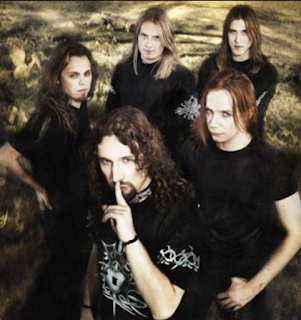
    Although Europeans dominate metal music, the lingua franca of the genre is still English. And not only is it English, but many subgenres of metal rely on specific vocabulary (fantastical and Tolkien-esque, or macabre and deathly). This leads to a lot of interesting little quirks of pronunciation and grammar. I've already documented some examples in the non-metal pop band, ABBA. I don't want to make fun of these singers or lyricists, as writing songs in a different language is difficult, and these mistakes are harmless - I just find them interesting and want to share. Here are some I've noticed from a handful of bands:

    Nightwish, a symphonic metal band from Finland: their earliest records, understandably, had more L2 errors than later ones.

  • "And the [p]ath under my bare feet... the [e]lven [p]ath" - Pronouncing the 'p' sound without aspiration makes it sound like the "elven bath." Finnish does not have aspirated consonants, so it sounds like singer Tarja is transerring Finnish rules to English.
  • "Songs as a SED-uction of sirens" - Writer Tuomas appear to have thought that 'seduction' has the stress on the first syllable, and Tarja sings it with an unexpected 'eh' vowel.
  • "The unc[e]rven path" - A spelling pronunciation from Tarja, perhaps by analogy with words like 'care' [ker].
  • "It's the honest of his words, ruled by magic and mighty s[we]rds" - Tuomas thought that 'words' and 'swords' rhyme, but they do not in modern English. Tarja also pronounces the 'w' in 'sword.' Journalist Robert Menner claims Americans still pronounced 'sword' with a 'w' sound in the first half of the 1800s, so Tarja may have fit in a little better then. The vowel still would have been [o], not [e].
  • "The moonwitch took me TO a ride on a broomstick" - The expression in English is either "took me on a ride" or "took me for a ride." There is no expression "take to a ride."
  • "You stand a[k]used of robbery" - A lack of aspiration and no 'y' sound here (a spelling pronunciation?) makes this sound like "You stand a goose of robbery."
  • Burning Witches, a power metal band from Switzerland:

  • "Just stories on tape-stries" - a spelling pronunciation dividing 'tapestry' up not as 'ta - pes - try' but as 'tape - stry.'
  • Sonata Arctica, a power metal band from Finland, has relatively good pronunciation, but the writer struggles with stylistically appropriate English.

  • "Find a barn which to sleep in, but can he hide anymore?" - The use of 'anymore' without a negative sounds odd to me, especially in a question, but some people do use the word like this. If you're a 'positive anymore' user, does this sound grammatical to you? The 'barn which to sleep in' is clumsy. Stylistically you would prefer either 'Find a barn to sleep in' (no linking word necessary).
  • "Knock on the door and scream that is soon ending" - lack of article on both 'knock' and 'scream'.
  • Share your favorite moments of L2 errors in metal or other genres in the comments!