Today I present to you a very simple example of stops becoming affricates: /t/ becoming /tʃ/ before a high vowel. This is happens commonly across languages. Those of you studying Japanese may know that historically, the sequence /ti/ became [tɕi] and /tu/ became /tsu/.
I don't know exactly how common this is in English, but I've found /t/ becoming /tʃ/ before /i/. Example from Phil Collins:
In learning you will [tʃ]eech (teach), and in [tʃ]eeching (teaching) you will learn
Example number two is from the Backstreet Boys. Notice that although there is a /tʃ/ in 'reach' before the 'to', the singer clearly stops and produces a second /tʃ/ sound for "to." I would imagine that this one is influenced by the nearby /tʃ/ in the environment (he doesn't affricate the 't' in 'two worlds' one line before), but it's still neat.
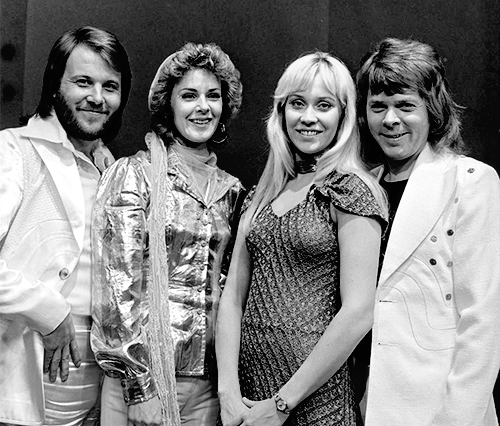
I'm curious as to whether any of the members of ABBA have any non-standard features in Swedish.
Members of ABBA. From left to right: Benny Andersson, Frida Lyngstad, Agnetha Fältskog, Björn Ulvaeus.
The two men, Björn and Benny, grew up in major cities (Goteburg and Stockholm, respectively), so I don't expect them to have anything distinct from Central Standard Swedish. Frida (the brown-haired mezzo soprano) was born in Norway, but grew up in a small Swedish town which I can't find much about.
The members of ABBA having an interview in Swedish. Do you hear anything unusual? Sounds pretty standard Stockholm Swedish to my (limited) ear.
Agnetha (the blonde soprano) grew up in Jönköping, which is a town in Småland. Småland is a region in the south of Sweden which does have some interesting phonetic features, though Jönköping lies outside of that isogloss. I have found at least one phonetic curiosity from Agnetha.
Central Standard Swedish has a process of retroflexion that occurs when an alveolar /r/ gets too close to a dental consonant like /t, d, n, l, s/. The two produce a single retroflexed (or postalveolar) consonant: [ʈ, ɖ, ɳ, ɭ, ʂ]. So a word like "förstå" (to understand) will be pronounced [fœ̞ʂˈtoː].
This retroflexion only occurs in dialects that have an alveolar /r/ sound. In Southern Swedish, the standard /r/ is a uvular [ʁ] instead. This means no assimilation happens, so no retroflexion happens.
Agnetha grew up in the Southern region of Swedish, but she does not have that uvular [ʁ] sound. Does she still do retroflexion? Well, inconsistently.
In her debut single "Jag var så kär" (I was so in love), she sings "Men nu först förstår jag" (but now I begin to understand), with two opportunities for retroflexion: "först förstår." She actually splits the difference: "först" has [ʂ] but förstår has [s].
Men nu för[ʂ]t för[s]tår jag
I was tipped off to the existence of this detail by this blog (Swedish). Apparently this is the only noteworthy Swedish-dialect pronunciation in Agnetha's discography, because nobody else has made any reference to her accent.
Why the difference between [ʂ] and [s] in these closely related words? May have to do with the syllable struct. The /st/ cluster in "först" is in the coda, or end, of the word. Meanwhile the /st/ cluster in "förstår" is at the onset: för-står.
Perhaps underlyingly, the 'r' in "förstår" being in a different syllable than the "står" means that it cannot 'travel forward' and cause the 's' to assimilate. This would predict that the assimilation shouldn't happen across syllable boundaries.
So Agnetha's assimilation rules would be a little different compared to a Jönköping-er who has a uvular 'r', and no assimilation at all. It would be interesting to see how much other people from this region with alveolar 'r' have assimilation: similar to Stockholmers (lots of assimilation), similar to Southern Swedes with uvular 'r' (no assimilation), or variable assimilation (with different rules, or assimilation is part of a word itself).
I'll give Agnetha's discography a re-listen to see if she continues to avoid assimilation. Perhaps, this being her first single, nobody gave her any accent coaching. Once she became popular, record labels may have wanted her to sound more standard, and so she may end up avoiding this in the future.
In honor of the spookiest month of the year, I've been watching the Halloween-themed video "Everybody (Backstreet's Back)" by the famous 90s band the Backstreet Boys.
Despite having listened to it for several years, this week was the first time I noticed that the chorus was not, in fact, "everybody (yeah) rock your body (yeah)", but in fact had a phantom 'yeah' added in: "Everybody yeah (yeah) rock your body yeah (yeah)." I checked several lyrics sites to confirm this and yes, these are the official lyrics. How did I miss this yeah for so long?
Well, the introduction of the song has a very clear extra yeah.
Everybody, yeah. Rock your body, yeah.
ɛvrɪbadɪ jɛə. rɑk jo bɑdɪ jɛə
You can clearly hear that there is a 'y' in that 'yeah'. Compare how they say "body yeah" with the next section, with no 'yeah':
Rock your body right.
rɑk jo bɑdɪ rait
It turns out that this pattern of a lyrics plus a 'yeah' actually repeats in every chorus. But I had never noticed because, well, there is some pretty wild smoothing going on:
Everybodye (yeah) rock your bodye (yeah)
ɛvrɪbadɪɛ (jɛə) rɑk jo bɑdɪɛ (jɛə)
Did you catch it? [ɛvrɪbadɪ jɛə] has become [ɛvrɪbadɪɛ] or [ɛvrɪbadɪə]. The [j] has mysteriously disappeared!
It doesn't help that the Backstreet Boys use a lax-HAPPY vowel in 'everybody' and 'body,' which means there is less distance between the 'ih' in 'everybody' and the 'eh' of the swallowed yeah. I think I would have noticed it if they had used a tense HAPPY-vowel - it would have been harder to ignore the difference in vowel quality.
This particular conversion of a falling diphthong to a monophtong is called smoothing, or at least it is in the study of English. Indeed, the only other example I can think of smoothing happens in RP, where a word like 'fire' /faɪə/ can become [faə].
Is this part of some larger linguistic trend? Not that I can tell. The lax-HAPPY is definitely very typical of the period (as I shall write about soon), but I don't think smoothing of this sort was widespread. This smoothing seems to have been motivated by the meldody, which was melismatic in the first chorus ("Everybody, ye-e-ah") and then became syllabic in the following choruses ("everybody-e"). It was easier to reduce the 'yeah' to a monophthong than to try and produce the full form, especially since the full form was repeated by the backing vocals anyway.