Although Europeans dominate metal music, the lingua franca of the genre is still English. And not only is it English, but many subgenres of metal rely on specific vocabulary (fantastical and Tolkien-esque, or macabre and deathly). This leads to a lot of interesting little quirks of pronunciation and grammar. I've already documented some examples in the non-metal pop band, ABBA. I don't want to make fun of these singers or lyricists, as writing songs in a different language is difficult, and these mistakes are harmless - I just find them interesting and want to share. Here are some I've noticed from a handful of bands:
Nightwish, a symphonic metal band from Finland: their earliest records, understandably, had more L2 errors than later ones.
"And the [p]ath under my bare feet... the [e]lven [p]ath" - Pronouncing the 'p' sound without aspiration makes it sound like the "elven bath." Finnish does not have aspirated consonants, so it sounds like singer Tarja is transerring Finnish rules to English.
"Songs as a SED-uction of sirens" - Writer Tuomas appear to have thought that 'seduction' has the stress on the first syllable, and Tarja sings it with an unexpected 'eh' vowel.
"The unc[e]rven path" - A spelling pronunciation from Tarja, perhaps by analogy with words like 'care' [ker].
"The moonwitch took me TO a ride on a broomstick" - The expression in English is either "took me on a ride" or "took me for a ride." There is no expression "take to a ride."
"You stand a[k]used of robbery" - A lack of aspiration and no 'y' sound here (a spelling pronunciation?) makes this sound like "You stand a goose of robbery."
Burning Witches, a power metal band from Switzerland:
"Just stories on tape-stries" - a spelling pronunciation dividing 'tapestry' up not as 'ta - pes - try' but as 'tape - stry.'
Sonata Arctica, a power metal band from Finland, has relatively good pronunciation, but the writer struggles with stylistically appropriate English.
"Find a barn which to sleep in, but can he hide anymore?" - The use of 'anymore' without a negative sounds odd to me, especially in a question, but some people do use the word like this. If you're a 'positive anymore' user, does this sound grammatical to you? The 'barn which to sleep in' is clumsy. Stylistically you would prefer either 'Find a barn to sleep in' (no linking word necessary).
"Knock on the door and scream that is soon ending" - lack of article on both 'knock' and 'scream'.
Share your favorite moments of L2 errors in metal or other genres in the comments!
No post this month; it's been overwhelmingly busy in my personal life. I'm working on a relatively large project documenting three decades of sound change, and I've had a lot less time to devote to it recently. Some of this work has been listening to a lot of audio, and some has been programming tools to minimize the amount of work I need to do by hand. I hope to be able to release both the research itself and the tools.
Have a nice May! I hope to see you all in June. - Karen
I come today with more questions than answers. The English language, it turns out, can support a wide variety of localized pronunciations for the same word, with little clear root as to where they come from and where they go. Today we'll be looking at a car part, the 'solenoid.' A solenoid is a "coil of insulated wire carrying an electrical current and having magnetic properties", which entered the English language in 1827 from French solénoïde (via etymonline). The standard pronunciation is /sɒlənoɪd/, 'soll-uh-noid', but I've found at least two alternative pronunciations.
Passing a current through the solenoid coil creates an electromagnetic field. Image via IQSDirectory.
An example of a red solenoid coil. Image via iFixit.
In the Beach Boys Song "Cherry Cherry Coupe" (1963), Mike Love sings about a car with doors that open with the 'cellunoid' [sɛljʊnoɪd] system. You may wonder how we know that this is supposed to be the same word as 'solenoid', beyond the general consonant contours being the same, and the clue is in the car door description - solenoids were used in technology that made doors 'pop' open without the need for car handles.
Door handles are off but you know I'll never miss 'em
They open when i want with the cellunoid system
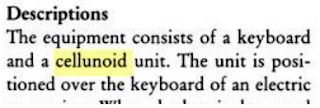
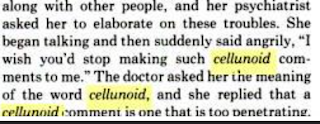
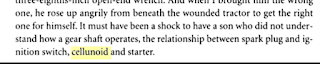
And this 1998 hit is firmly in the world of literature (Five Fingers Review).
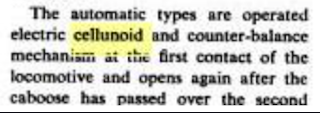
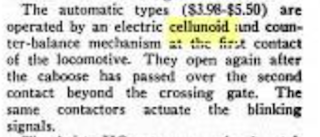
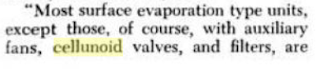
And so it seems that the cellunoid pronunciation and spelling has died out, having seen its peak in the late 50s and early 60s, and descending into obscurity by the 80s and 90s. It's not clear where this alternative pronunciation and spelling came from. It smells of being a trademark to me, but a search through the United States Patent and Trademark Office site didn't turn up any hits in patents or trademark registrations. In fact, trying to do so redirects me to patents and trademarks featuring the word celluloid instead.
Having hit the end of one mystery of history, let's start another. This is the pronunciation "silenoid" [sɪlənoɪd]. At first glance, it looks like a descendant of 'cellunoid'. The y-sound [j] in 'lyu' appears to have been dropped, meaning that the sound change called "yod-dropping" happened. It also looks like the 'eh' [ɛ] sound was raised to short 'ih' [ɪ]. I don't know if there's any sort of documented FELL-FILL merger, but English vowels tend to merge and change before L, as I've written in Pre-L Back Vowel Madness.
Further research on "silenoid" is unfortunately complicated by the fact that "silenoid" is also used to refer to flowering plants from the "Silene" genus. This tantalizingly early example of "silenoid" (1915!) is in fact a reference to carnations (Contributions by the New York Botanical Garden).
While I couldn't find any later recordings of someone using 'cellunoid', I was able to find this pronunciations of "silenoid", thanks to the folks at the Smiley Smile forums: "I did check to see if the silenoids were working."
And a more modern example from Donut Media, with "fuel silenoid and NOS silenoid".