A leak from gaming company GameFreak had a curious note that caused fans to go wild. One Pokemon character, Cyrus, was described as “自閉的”. One of the earliest machine translations of this stated that this meant that the character is "autistic." This got a lot of attention and quickly spread throughout the fandom.
He hated that he was not perfect, and before long he began hating others too. (Perfectionist, jiheiteki)
The word in contention is 自閉的 (jiheiteki).
Some Japanese speakers alleged that this word in this context cannot mean “autistic” (the syndrome) and instead means closed off or reclusive:
Wait what
I’m just know hearing about the whole “Autism” “自閉的” translation…well mistranslation.
自閉的 is not Autism/Autistic
The correct word is
自閉症 read as jiheishou
Please be careful when trusting google translate with important words and terminology like this. (source)
It’s a little complicated to explain
But basically it’s saying he is close minded because he is a perfectionist.
Both me and my husband read it as, because he is a perfectionist he is close minded against anything and anyone who doesn’t live up to that standard. (source)
It means closed-off, with maybe an added, emphasized connotation of muteness/unresponsiveness/unsociability.
Calling someone 自閉的 really does not suggest they have autism at all. (source)
But others disagreed:
Twitter is saying this the Kanji used in this context doesn’t mean autistic. But I fact checked this with a friend and they said in this context it does? So idk, things are probably getting lost in translation.Twitter is saying this the Kanji used in this context doesn’t mean autistic. But I fact checked this with a friend and they said in this context it does? So idk, things are probably getting lost in translation. (source)
I did a little investigation and found that it seems both sides have some evidence to support themselves.
Let's start with some bases. If you look up 自閉 (jihei) on jisho, you will see it means social withdrawal, schizophrenia, or autism. 的 (teki) is a suffix like -ical, meaning having the characteristics of. The component characters of 自閉 literally are "self" and "closed." We can see how this relates to social withdrawal, schizophrenia, and autism.
The most common way to refer to autism is 自閉症 (jiheishou), with 症 (shou) meaning "syndrome" or "disease." This word is also used as a modifier, such as 自閉症児 (jiheishouji) meaning autistic child (noted to be a "sensitive" term by Jisho).
Let's return to the word in contention. Is 自閉的 (jiheiteki) ever used to refer to people? Yes. It is very easy to find references to it in textbooks referring to autism.
“Incidentally, when we describe a child with autism as "autistic," we are following one of two procedures. The first is whether their behavior, particularly their attitude towards other people, gives us a subjective impression of being autistic.”
In the following example, 自閉的な子 (jiheiteki na ko) is literally glossed in the text as "autistic child."
What about the other definition offered by Japanese speakers, meaning closed-off? 自閉的 (jiheiteki) is also used to mean ‘closed off’ or something like ‘self-referential.’ I’ll provide two examples I found:
子供たちは情報化が進むなかで、テレビ・ゲームに代表される自閉的遊びに溺れ、携帯電話、 e メールなどを媒体とした表層の情報交換しかできなくなりつつある。(source)
“People are becoming engrossed in solitary activities such as watching television and playing video games, and are increasingly only able to engage in superficial information exchange through mediums like mobile phones and email.”
Here it is clear they are not referring to autism, but to the isolated nature of watching TV and gaming.
Our blind faith in multiculturalism and our overuse of art as a communication tool have left us, since 9/11, autistic and capable only of expressing differences in taste. This is precisely what constitutes race-less racism. (translation from linguee)
This example is also clearly using ‘autistic’ to mean self-referential or closed off.
I attempted to look up the etymology of the word to see when it began being used to refer to autism, and whether the metaphorical usage preceded or followed the medical usage, but I could not find any sources on this. Interestingly, this combination of characters (自閉) has been used in Classical Chinese to mean “to exclude oneself from society,” if you believe Wiktionary. Unfortunately no citations or examples are cited.
Having now established that 自閉的 (jiheiteki) means both "autistic" in the context of autism and "closed-off," let us return to the text in contention. In the leaked document, ‘自閉的’ appeared next to another word in parentheses. That word, 完璧主義者 (kanpeki shugisha) is translated as ‘perfectionistic.’ To me, appearing in a list like this suggests that it is meant to have a similarity with the other word. "Perfectionistic" in this case indicates a common trait, not a medical condition. Imagine if the text read "perfectionistic, obsessive-compulsive." Would you take this to mean that the character in question has obsessive compulsive disorder (or obsessive-compulsive personality disorder), or would you take this to mean that the condition is being used metaphorically to suggest the character has obsessive tendencies bordering on pathological? I would be more inclined towards the latter reading.
There is also a second document referring to this character which uses the word:
それなりに筋肉があり、とても自閉的な科学機械をこよなく愛している感じには見受けられない。
"Having a decent amount of muscle, he does not appear to be the type to be deeply in love with self-enclosed scientific machinery."
This one is interesting because 自閉的 (jiheiteki) is modifying 科学機械 (kagaku kikai), scientific machines. There is thus not a strong reason to believe that 自閉的 (jiheiteki) is used here to mean 'autistic' in the medical sense since, obviously, scientific machines cannot have autism. (The use of 自閉的 to describe machinery is very interesting, and I'm not quite sure how we're meant to interpret it - the machines are 'reclusive'? Is it that the machines do not involve the outside world? Or is it that they are a world unto themselves?)
The second document referring to this character shows that the authors were already comfortable using 自閉的 (jiheiteki) in a metaphorical sense, and nowhere else in these materials is any medical history mentioned. Given that 自閉的 also has an established non-clinical usage in Japanese meaning “reclusive” or “psychologically shut off,” that this sense fits the character, that multiple Japanese speakers have said a diagnostic reading feels unnatural in this context, and that the more standard term for autism, 自閉症 (jiheishou), was available but not used, I am inclined to believe that the likeliest intended reading of 自閉的 here is not an autism diagnosis, but rather “self-enclosed.”
I've been playing a most delightful little game recently, called "CrossCode." The game is set in a world where people have such advanced virtual reality technology that they can play a massive international game with total immersion. It's a love letter to MMORPGs like World of Warcraft and Runescape, and the interactions they foster. One such interaction is international, with the game having characters from France and Germany that sprinkle non-English words in for flavor. One that caught my eye was such:
I was a bit confused at first because this word looks more Swedishy to me than German, but the character otherwise uses recognizably German phrases.
Smikey
Lukas' german catchphrases
I'm around 3 hours in, and Lukas mentions what seems to be a german expression, "holerö". I looked up its meaning and I was very puzzled to see that the only notable thing I've found was a german Super Mario comic which included the word. It's kind of stupid but I've gotten very curious about what the word means. Any help?
Ernsteen [has CrossCode] Jun 18, 2019 @ 3:18pm
It's just a rather uncommon way of saying hello.
Iirc the devs said they included it as a nod to bad old Nintendo translations.
Google gives me this, where someone quotes a (now offline) interview of the translator C. Moyse. https://www.multimediaxis.de/archive/index.php/t-117725.html
Originally posted by C.Moyse:
Also "holerö" stammt von meinem Kollegen Marcus. Ich weiß allerdings auch nicht genau, wo er das herhatte. Vielleicht von Loriot oder Helge Schneider. Das fanden wir so dämlich, dass wir es auch immer verwendet haben. (So "holerö" comes from my colleague Marcus. I don't know exactly where he got it, though. Maybe from Loriot or Helge Schneider. We thought it was so stupid that we always used it.)
So apparently it was just a silly in-joke, that he added into a few games' German translations.
GFluegel [Moderator] Jun 22, 2019 @ 6:04am
Yep, it's a reference to old German Nintendo translations and silly comics that appeared in German Nintendo magazine in the 90s. :>
The German magazine in question seems to be 'Sag niemals Holerö' meaning 'never say holerö.' In the magazine, 'holerö' turns characters into blocks of cheese. You can see an example below, with an explanation from the Bomberman Wiki that Holerö is an 'informal greeting' and a running joke in the German Nintendo magazine:
C. Moyse seems fondly remembered by a certain generation of German gamers, who recognize the use of this word from Secret of Mana and Evermore.
Posted by u/Saikonte
8 months ago
To whomever did the German translation..
Thank you! It's so good to read things like "holerö" from Schneider or geek-speak and little things that I myself encountered, when I first startet playing mmos.
The Holerö quote reminded me of Cloud M. Moyse who translated lots of games for the snes (Secret of Mana, Secret of Evermore) and I couldn't stop smiling for the 3 hours I'm in the game.
Thank you!
There is also an example in the 1996 game Donkey Kong Country 3, where a world is named 'Höhlen-Holerö'.
So far, we've been tapping around the question of what holerö actually means. And truth be told, I am not sure. One user claimed it was an 'uncommon way of saying hello,' and that is how it is used in the game. But actual references to this word are rather rare.
The word seems recognizable in translations of English to German, as one user on the forum Reset Era complains about its appearance:
Hektor: I wish we had movie dubs with regional dialects like Asterix Mundart
"Surtur, sapperlot! Dich gibbet ja immanoch!"
Alice: And then I'd wanna Rick James anyone who adds Holerö.
Looking it up on Instagram, for example, there are examples of food...
Some kind of berry, perhaps? (See UPDATE below.) This quote from an 1877 book would seem to suggest so:
"aus Tannzapfen gebrannt wurde , sowie das „ Holeröl " aus den Beeren des schwarzen Hollunders . Man versekte es mit Zucker und Wasser . Es hilft gegen das Uebertrinken und ist überhaupt „ a guits Zuig . Noch einmal gebrannt , wird"
("was distilled from pine cones, as well as the" Holeröl "from the berries of the black elderberry. Add sugar and water to it. It helps against drowning and is generally "a good Zuig." Burned again, " )
I haven't yet found any citations for this word being used as any sort of greeting outside of Nintendo-related sources, so this is a curious translation mystery! Could it be some kind of regionalism?
If you'd like to hear it pronounced, Bartleby from Germany has got you covered.
UPDATE
David Marjanović, a German speaker, has offered two corrections:
"End-stressed nonsense syllable strings like this are common in yodeling." Usage is probably extrapolated from that. It is not an 'uncommon way of saying hello'!
'holeröl' is elderflower oil with no relation to 'holerö'. False positive.
I think this is the fastest an unsolved linguistic mystery on here has ever been solved. :)
Most video games with voice acting go in one of two directions: using General American accents as a default, and using Received Pronunciation for fantasy settings or for upper class characters. The 2017 game Xenoblade Chronicles 2 bucks this trend entirely and features one of the most diverse collections of accents in a video game. Most remarkably, it does this while also avoiding the stereotyping that usually accompanies accent use, resulting in positive representation for most accents.
The original Japanese version of Xenoblade Chronicles 2 was homogenous in accent use, which means that the decision to use different accents was made during localization. Why would the localization differ so drastically on this issue, when it could have done the much easier job of securing actors that all come from one country and have the same accent? And how did people react to having a game where the protagonists had accents drawing from Manchester, Wales, and Scotland?
Xenoblade Chronicles 2 presents an excellent case study for a number of things: learning to distinguish between different major English accents; understanding the social contexts that result in linguistic prejudice; market decisions that support or suppress differing linguistic voices. We're also going to take a short look at the game's predecessor, the original Xenoblade Chronicles, and how that game's unusual history paved the way for our polydialectal protagonists.
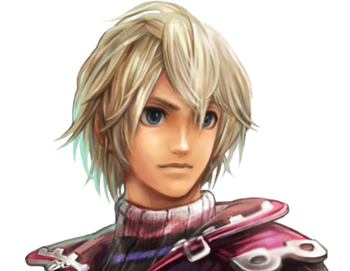
Xenoblade is a video game series developed by Monolith Soft. They are spiritual successors to the Xenosaga series and the Xenogears game, which came out on PlayStation consoles. The Xenoblade games are available exclusively on Nintendo consoles. The first Xenoblade Chronicles tells the story of a world where the only two landmasses are two giant, immobile humanoids, and all life lives on these two beings. The protagonist, Shulk, is on a quest to avenge his hometown after it is attacked by mechanical creatures from the other humanoid landmass.
Xenoblade Chronicles 2 is loosely connected to the first Xenoblade Chronicles. In this world, there are multiple giant beings called Titan, and people live on them. The groups of people living on each Titan have their own cultures, politics, and - in the English version - accents. The protagonist, Rex, is on a quest to help his newfound friend Pyra reach the mythical land of Elysium, to solve the problem of Titans dying off.
It's not necessary to be much more intimately familiar with the plot than this, and I will avoid story spoilers if you are in the middle of playing these games.
A Tour of Accents
Southern England English
Most of the cast of the first Xenoblade Chronicles game speak in Southern England English. This is distinct from Xenoblade Chronicles 2, where each world has a distinct variety of English. Some characters, like Shulk, may sound more posh than other characters, like Fiora, but overall they stay within the range of Southern England English. Both heroes and late-game villains speak in a middle-class variety of Southern England English.
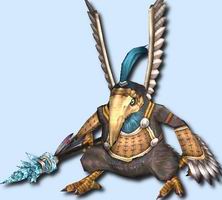
In Xenoblade Chronicles 2, the people of Tantal, the people of the historical nation of Torna, and the race of small furry bunny people called Nopon speak in this accent.
Examples of Southern England English
Non-rhotic: Like most English accents in England, Southern English does not pronounce historical 'r's after vowels.
"The fut[ə] doesn't belong to you!"
If a word ends in a vowel and the next word starts with a similar vowel, Southern English lets you insert an intrusive r to make the difference between the words clearer.
"Protect Melia-r-at all costs!"
Southern English English, and many other varieties of English English, have a three way vowel distinction between BOTHER /ɒ/, SPA /ɑ/, and THOUGHT /ɔ/. An American may use the same vowel in "monado", "mechon", and "law" ([ɔ]) but most Englishmen will use a different vowel in each: "monado" ([ɑ]) "Bionis" ([ɒ]), and "awesome" ([ɔ]).
"The Mon[ɑ]do... Bi[ɒ]nis and the Mech[ɒ]nis. That's [ɔ]some!"
"But it's starting to look like the mon[ɑ]do might be something far more significant than just a weapon for defeating Mech[ɒ]n."
"I really th[ɔ]t I'd l[ɒ]st you back then."
The TRAP-BATH split: In Southern England, words like "bath," "can't," and "laugh" are pronounced with the vowel of SPA instead of the vowel in TRAP.
"This is my ch[ɑ]nce! I c[ɑ]n’t see it clearly."
The HURRY-FURRY distinction: North Americans tend to rhyme HURRY and WORRY, but these are two distinct sounds in most English English, with HURRY having the 'uh' sound of STRUT.
"I'm more wuh-ried about you than the shell."
FEEL-FILL merger: Younger varieties of Southern English English pronounce 'feel' to sound like 'fill.' A similar merger is also occurring in white Southern American English and African American Vernacular English.
"The breeze f[ɪ]lls so good."
GOAT-fronting.: In Southern English English, the "oh" sound is made with the tongue pushed more forwards than in other varieties of English.
"[əʊ], the defense force colonel."
No yod-dropping: American English has a 'doo' in words like 'duty,' but English English preserves a 'dy' sound, so 'duty' sounds like 'dyooty.'
"I take this chance to bring vengeance to my brother and fulfill my d[j]uty."
Cockney English and Lower-class London English
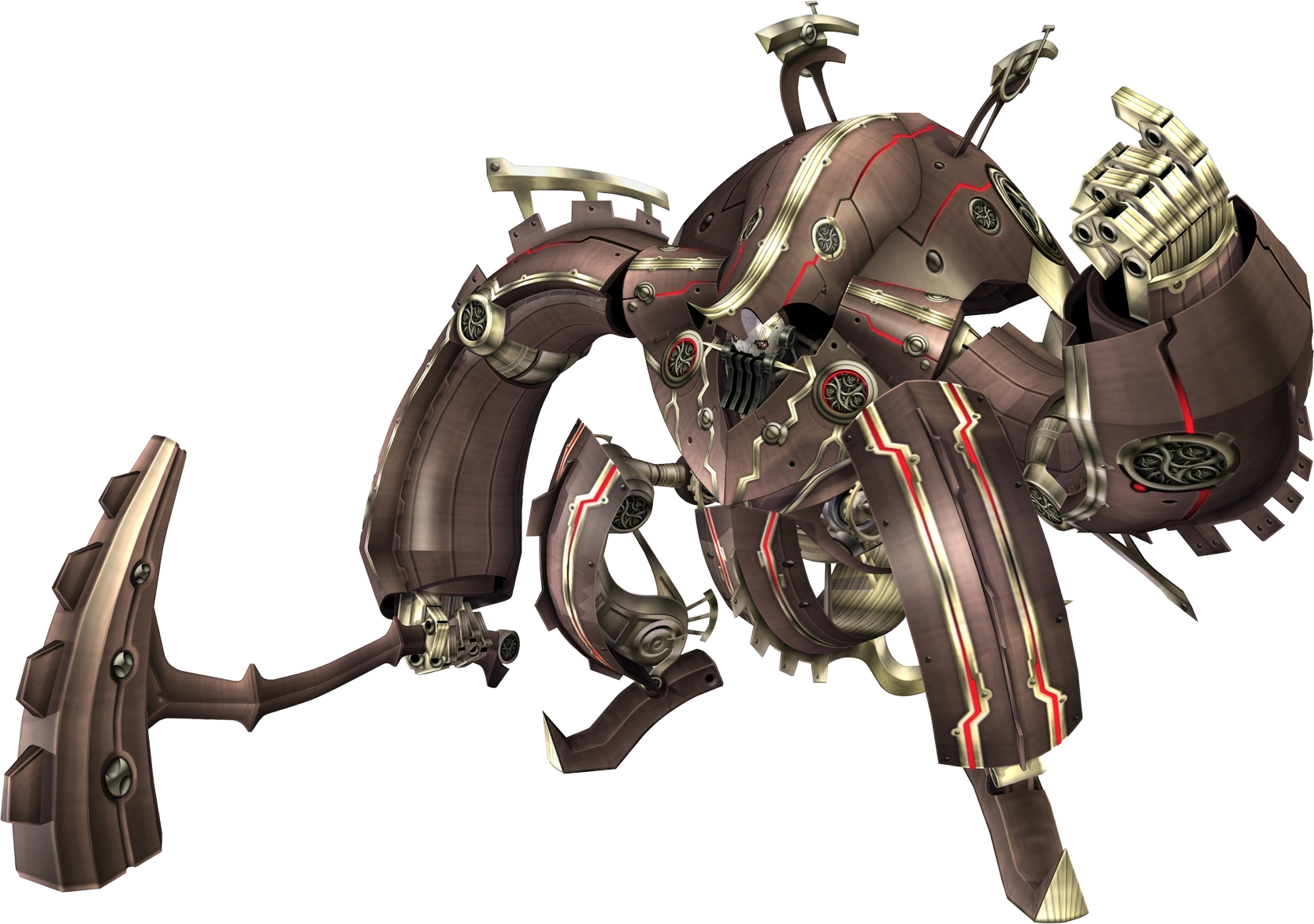
Cockney is a working class accent found in London. Quite a bit of Cockney could be head in the first Xenoblade game, most notably with the villain Bronze Face. Xenoblade 2 also had a little Cockney, with a minor enemy guard speaking in Cockney.
Cockney and Working-Class London English Characteristics
FLEECE-diphthongization: The 'ee' vowel /iː/, like in FLEECE, is pronounced as a diphthong [əi~ɐi].
"Professor Tatazo, sp[ɪi]k! Sp[ɪi]k, you give orders."
GOAT-centralization: The 'oh' vowel /o/ becomes 'au' [æ̈ʊ~ɐʊ], so 'hoes' sounds like 'house.' The vowel is more centralized than the Southern English English mentioned above.
"If productions get more sl[ɐʊ], maybe you ready for sleep time with fishes."
"Professor Tatazo, speak! Speak, you give [oʊ]ders."
STRUT-raising: the 'uh' /ʌ/ sound moves towards 'a' [ɐ̟].
"If prod[ɐ̟]ctions get more slow, maybe you ready for sleep time with fishes."
T-glottalization: Ts between vowels are replaced with the glottal stop [ʔ].
"I've been ge[ʔ]in hungry!"
H-dropping: h sounds, especially at the beginnings of words, are likely to be dropped.
"I've been getting 'ungry!"
PRICE-backing: The vowel in PRICE /aɪ/ is backed to [ɑɪ]. In more extreme versions, "price" can sound like "proise."
"He's r[ɑɪ]ght here . He's still al[ɑɪ]ve."
FACE-lowering: The /eɪ/ sound in words like 'face' and 'ate' are lowered [æɪ~aɪ].
"I [æɪ]te 'em all up."
Myself can be realized as me-self [mi].
"I just couldn't help [mi]-self."
L-vocalization: The l's at the end of words can become a [w].
"I'm not meta[w] face."
Cockney is on a continuum with other forms of London English, so some "Cockney" features also appear on characters that otherwise don't sound Cockney, like Reyn. Reyn displays h-dropping, t-glottalization, and other features of Cockney English, but he does not sound anywhere near as Cockney as Bronze Face does.
You can think of Shulk, Reyn, and Bronze Face as being on a continuum from 'very middle class' to 'in the middle' to 'straight-up Cockney.' They will all share certain features that are relevant to their region, such as non-rhoticism, GOAT-fronting, and a 3-way distinction between SPA, BOTHER, and THOUGHT. This distinguishes this group of 3 dialects from other region-based dialects, like General American English.
As you move from the 'very middle class end' towards the middle, you'll notice an increase in traits like h-dropping, t-glottalization, and PRICE-backing. At the Cockney end of the spectrum, the frequency of h-dropping and t-glottalization can increase.
Cockney and 'very middle class' London English may both have GOAT-centering, but the Cockney vowel is different (more centered) than the 'very middle class' vowel. This shows that names like 'GOAT-centering' cover a lot of different possible realizations, and these realizations may be treated differently by society.
Northern English (Leftheria)
Xenoblade 1's dialect diversity was mostly limited to class, but Xenoblade 2 introduced more region-based diversity. Each in-game world has a predominant dialect of English associated with it, and the people of each region will speak their associated accent.
For example, the main character of Xenoblade Chronicles 2, Rex, is from the in-game world of Leftheria. The Leftherians were dubbed using Northern England English. Accordingly, Rex's voice actor is from the North of England - specifically, from Manchester. Other characters from Leftheria also use Northern English English.
Because of prejudice against Northerners, Northern accents are often judged negatively by Southerners. Some English players reacted negatively when they first heard Rex's accent, with one claiming he sounded like a "farmer." Some people from outside the UK who were not familiar with Northern accents even thought Rex was using a 'fake' accent!
But not everyone reacted negatively to Rex's accent. Northern English fans did not view their own accent negatively - they seemed to enjoy being represented as the hero! Many people in and outside the UK also delighted in hearing a Northern protagonist. Today, the general fan consensus toward's Rex's accent seems mostly positive.
Northern English English characteristics
HOUSE has a centered vowel: Words like "house" and "about" with the /aʊ/ diphthong are pronounced as "hoess" or "aboat," with a vowel like [əʊ]. This is closer to how these words were pronounced in Middle English.
"Time to take you down [dəʊn]!"
Monophthongization: Vowels like "ey" [eɪ] and "oh" [oʊ] are pronounced not as two vowels, but as a single vowel: [e] and [o].
"[oke]!"
Lowered TRAP vowel: Words like "trap" are not pronounced with [æ], but with a vowel more similar to the Spanish "a": [a]
"That wasn't supposed to h[a]ppen."
My is reduced:'my' [maɪ] can reduce to 'muh' [mə], similar to in the phrase 'm'lady'.
"No worries, I bet I can learn something to help m' salvaging too."
No STRUT-FOOT split: In Southern English accents, words like "strut" have the 'uh' [ʌ] vowel and words like "foot" have the 'oo' [ʊ] vowel. In Northern English accents like Rex's, both "strut" and "foot" words have the short 'oo' [ʊ] sound. (This is because distinguishing between "strut" and "foot" sounds is actually relatively new in the English language!)
"And an[ʊ]ther one! Aw yeah, d[ʊ]n and d[ʊ]sted.
Lax happY vowel: The final vowel in words like "happy" and "exactly" are not a long [i] but more like a lax 'e' sound.
"My thoughts exactleh."
Welsh English (Gormott)
The people of the titan Gormott are voiced by Welsh actors. One of the main characters, Nia, is Gormotti and has a noticeable Welsh accent throughout the games.
The decision to have a main character with a lot of screentime have a Welsh accent was variably received, with some people unsettled that she sounded like a "Welsh grandma." But many fans enjoyed the voice actress's work and her Welsh-ness has even become memetic.
Some players didn't even realize that she was Welsh. Players from the United Kingdom are very familiar with the difference between Welsh accents and Scottish and Irish accents, but non-UK players had a hard time placing her accent.
When we listen to different varieties of English, we don't studiously notice every single realization of every single word - we rely on known patterns to be able to 'tell' someone's accent. If you lack the pattern, you have a harder time placing the accent. Non-UK players had no frame of reference for a Welsh accent, so when she uses a monopthong in 'face' and 'goat' or when she trills her r's, non-UK players may mistakenly categorize her as Scottish or Irish because those accents also share those features.
Welsh English Characteristics
STRUT-centering: The vowel of "bus" /ʌ/ is pronounced [ɜ]. This means "us" can sound more like "ehs."
"You're picking a fight with ehs [ɜs]?"
"Woo hoo, Nia the ehn-[ɜn]-stoppable!"
DRESS-lowering: The DRESS vowel /ɛ/ is a more open vowel, sounding almost (though not quite) like [æ]. Notice how the way she says "Rex" can sound like "racks."
"Make sure you've got my tail, R[æ]x."
Much like the Manchester accent above, Welsh English has TRAP-lowering. The TRAP vowel /æ/ is pronounced almost like the Spanish 'a' [a].
"Quick, while we have the adv[a]ntage."
Much like Southern English English, Welsh English tends to be non-rhotic. This means that 'r's after vowels are not pronounced. In the following clip, notice how the 'er' in 'proper' and 'swear' become weak vowels [ə].
"I'll bash you up prop[ə] next time, I swe[ə]!"
Despite being non-rhotic, 'r's that start a syllable can be tapped/trilled.
"Show us some of that Nopon spi[ɾ]it."
"We're on a [r]oll now!"
Geminated consonants: Consonants between vowels are doubled in length and held longer. This is similar to double consonants in Italian.
"C'mon, believe in me a li[t:]le."
H's at the start of words can be dropped: Notice how "here" becomes "yere", while "happening" and "heads" just lose their 'h'.
" 'ere I come, ready or Gormotti."
"Why is this 'appening? Hey over [j]ere, just me the 'eads up."
The ER vowel in NURSE is pronounced with rounded lips. Southern English would have [ɜ:], but Welsh English has [ø:].
"It's like were in puofect [pøfɛkt] sync
FACE and GOAT may have the monophthongs [e] and [o] instead of [ei] and [ou], respectively. Notice the similarity to Manchester English above.
"Healing h[e]l[o]."
Consonants at the end of words can be devoiced. For example, this leads to "d" being pronounced as [t].
"Brutal bla[t]e."
Scottish English (Mor Ardain)
The empire of Mor Ardain is voiced with Scottish accents. One of the party members, Mòrag, hails from the region, and speaks relatively neutral Edinburgh English. However, there are villainous characters from this region as well. Both will be represented in the examples below.
"Mor Ardain" is strangely translated Scottish Gaelic for "big pride". "Mor" means big and "ardain" is supposedly pride, though some sources contest this use and suggest "ardain" is really "little height" (big little height?). The adjective ordering is also suspect, since the adjective normally comes after the noun in Scottish Gaelic. It ought to be "ardain mor," similar to "cù mòr" below.
cù mòr briagha dubh dog big beautiful black
'a big beautiful black dog.' (MacAulay 1992)
Scottish English Characteristics
Trilled and tapped /r/. This trilling is more prominent than in Welsh English.
"Special inquisto[r] Mor[r]ag! ... had we but heard of your g[r]ace's visit, we could have prepa[r]d a suitable..."
"Gut it? Gut, this... c[r]eature?"
The Scottish English /u/ sound has the tongue pushed all the way towards the front, sounding more like "ew" [ʉ].
"Sublime! Your efforts have borne many fr[ʉ]ts."
BOOK and BOOT have the same vowel. Scottish English does not have a "short u" or a "long u."
"Let's p[ʉ]t that thought into practice, shall we? Ass[ʉ]me your positions."
Like Manchester and Welsh English above, FACE and GOAT vowels are the monophthongs /e/ and /o/.
"D[o]n't forget me... think you can t[e]k me?"
No FERN-NURSE merger: "Learn" is not pronounced with the same vowel as "nurse," but with a distinct "eh" vowel, so it sounds like "lairn" [lern].
"There is still much to l[e]rn."
The BIT vowel is lowered to [ë̞]. However, there is no merger: "bit" and "bet" are distinct in Scottish English.
"You won't w[ë̞]n so easily. Let me go... you p[ë̞]g!"
COT-CAUGHT merger: "COT" and "CAUGHT" are pronounced with an o-like vowel.
"Let's put that th[o]ght into practice, shall we? Show us what you've g[o]t."
There is no /æ/-/ɑː/ distinction, which means that path, trap, and palm all have the same vowel.
"Shall we d[a]nce? ... We will forge a p[a]th and none shall stand in our way... I never imagined we'd be standing here on the b[a]ttlefield side by side."
Centralized PRICE vowel: Notice how the way she says "side" [said] is almost more like "say'd by say'd" [sɜid].
"I never imaged we'd by standing here on the battlefield s[ɜi]de by s[ɜi]de."
Australian English (Uraya)
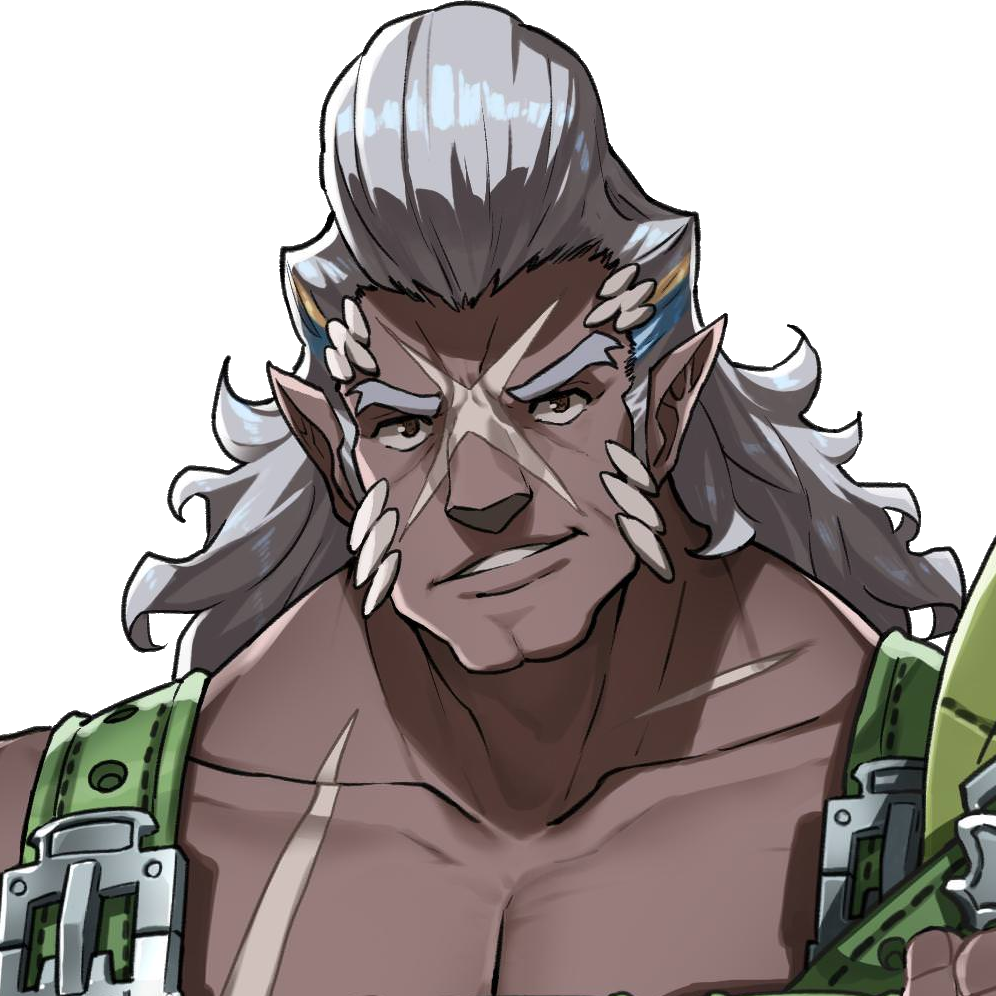
The monarchic nation of Uraya, which is located inside a whale-like titan, is represented by Australian accents. The character Vandham is from this region, and hits us with life wisdom in a broad Aussie accent.
You may notice that there is significant overlap between Australian English and Cockney. This is because Cockney English was influential in the developmnent of Australian English!
Australian English Characteristics
PRICE-backing: ai sounds like 'oy' [ɑɪ].
"We've been bl[ɑɪ]nds[ɑɪ]ded! Hold the l[ɑɪ]ne!"
FACE-lowering: the FACE vowel [eɪ] is lowered to [aɪ], so "rain" sounds like "rhine."
"Here's the m[aɪ]n course. R[ai]n, shine or snow."
Lowered and centralized GOAT: GOAT is [ɐʊ], so "hoe" sounds like "how."
"Rain, shine, or sn[ɐʊ]w."
DRESS-raising: Raised DRESS vowel to [e].
"Nia, st[e]dy on."
American English (Indol; various blades)
The nation of Indol is voiced with General American accents. It controls the distribution of the Blades species, and which is also a religious pilgrimage spot. Many of the Blades are also voiced with American accents. Notably, the antagonists of the game - the terrorist group "Torna" (not the country) - primarily have American accents.
Below are some characteristics of American English that distinguish it from other varieties of English.
American English English Characteristics
Unrounded LOT vowel: Most Americans pronounce words like "lot", "want", and "holly" with unrounded lips. This is in contrast to all the dialects listed above. Notice how Akhos uses the same vowel in "father" and "not."
"Can you do that for your grandf[ɑ]ther? ...N[ɑ]t ether?"
LOT-THOUGHT merger: An increasing number of young Americans are pronouncing words like "caught","draw", and "all" to sound like the vowels in "cot" and "doll." Unlike Scottish English above, the resulting vowel is more similar to [ɑ] than [o]. Notice how "father," "not," and "thought" all have the [ɑ] vowel in Malos's speech. In Southern English, these would all have different vowels. (Note not all Americans have this merger: the characters Jin and Amalthus do not have this merger.)
"No wonder f[ɑ]ther abandoned them! ... She's n[ɑ]t dr[ɑ]wing from the ether."
Functional LOT words like "from", "was", and "what" have the STRUT vowel. Notice how Akhos rhymes "but" with "what."
"B[ʌ]twh[ʌ]t if we were to interrupt the flow?"
Usage
One of the nice things about this game's localization choices is that is they mostly avoid leaning into stereotypes. The end result is delightfully confusing if you take it at surface value: the two leading powers in the world are the Australians and the Scottish (who have colonized the Welsh cat-people). The Americans run a neutral theocracy that also controls the flow of the Blade people. Another group of Americans runs around the world kidnapping the same Blade people and threatening globals safety. The Northern English live secluded, rural lives on an archipelago, while Received Pronunciation speakers have decided to dive underwater and never return. (Irish English is even present, but only because two of the songs were sung by Irish English speakers. No characters in the games have an Irish accent.)
None of this really matches up to any stereotypes in real life. But the accents work well at making it immediately obvious where a particular character comes from. Because English is a pluricentric language, English speakers are used to hearing a variety of accents in real life. This makes the localization decision to use different English accents, while strange in the context of video game dubbing, normal as a storytelling decision.
It helps that the original Xenoblade Chronicles game was dubbed using English English accents - RP, Estuary, and Cockney English all appeared in the first game. This wasn't for any storytelling decision, though - it was because Nintendo of Europe decided to fund the dubbing effort since Nintendo of America was not interested.
It's here that we can see one of the unfortunate stereotypes that they did fall into. Cockney English is used primarily by villains in Xenoblade Chronicles 1 and 2. Two major villains, Metal Face and Bronze Face, use it in 1, and the minor Tirkin species uses it in 2. No other accent is used so obviously to convey morality in the series, and it's a tired trope, as noted by a game reviewer: "Only the Especially Evil Robot Bad Guys miss the mark with their way-over-the-top Cockney guffawing."
Impact
The majority of games with voice acting are dubbed in American English. This contributes to a sense that American English is "the neutral" form of English. The United States is the large "first circle" English speaking nation, after all, and a huge market for game studios. The abundance of American media exported to other countries means that American English is extremely familiar, too. The next most common form is some sort of English English, usually for games that are meant for Europe or are in the fantasy genre (example: the Witcher series). Outside of those, it becomes increasingly uncommon for other varieties of English to be represented.
This leads to the unusual situation that people from these less-represented regions, upon hearing their own varieties used in media, react with confusion. It is easier to suspend disbelief for people who live on two giant beings or that anyone would go around dressing like Rex would than it is for people to think that these very same fantasies can have people who sound like them.
It's reminiscent of what Chimimanda Adichie calls "the danger of a single story." If you spend your life only hearing stories about people from England who eat apples and play in the snow, it's easy to end up writing stories like that, even if you are not from England, have never seen snow, and grow mangoes instead of apples.
Similarly, if you spend your whole life hearing video game protagonists with American accents, you come to associate video game protagonists with American accents, and hearing them depart from that script feels strange. It's a powerful example of enregisterment, "the process by which a linguistic repertoire comes to be associated, culture-internally, with particular social practices and with persons who engage in such practices." (LSA Summer Institute Workshop) Video game voice acting becomes enregistered as American, and optionally RP in a fantasy or historical setting.
Because these are fictional worlds, there is nothing preventing these characters from being voiced with a Yorkshire accent. The worlds of Xenoblades 1 and 2 don't really exist in our universe, so "Yorkshire accents" and "American accents" are concepts that don't even make sense anyway. The characters speak some variety of a known human language for our convenience - it makes no difference to the story whether it's a Yorkshire accent or a New York accent.
Market concerns are the primary motivator. It's risky to put out a game where the main character has a Lancashire accent, and if Xenoblade didn't already have a history of English voice acting, I don't think it would have happened. We would probably wonder, "why did they voice the main character in a Japanese role-playing game with a Yorkshire accent? Does this game have something to do with Yorkshire?"
But because of Xenoblade's strange history, audiences could already expect that English English accents would be in the game. You could even say that fans were looking forward to it - a number of fans were disappointed that Xenoblade X, the game released after Xenoblade the first, was set in "New Los Angeles" and would therefore be full of American accents. (There were some English accents thrown in, but mostly RP.)
Xenoblade 2 has shown that having a variety of accents is not going to confuse the audience. It's currently the best selling game in the series. While the dub is still divisive, it's no longer entirely because it uses non-RP/GA accents. Even people who were skeptical of it before have warmed up to it.
I’m aware not everyone is a fan of the English dub, as there are those who insist on playing the game with the Japanese dub, but as an Englishman who has a fondness for the various accents Great Britain has to offer, I couldn’t help but embrace every piece of dialogue delivered by Nia and Mòrag. Heck, even the hoity-toity tones of Zeke were enjoyable.
As nice as the other accents are though, they are nothing when compared to the sultry tones that spread forth from Nia’s mouth. It’s not just her who’s Welsh accent sounds great as the accent of every Gormotti character, is just too good to be true.
This is going to be pure bias but the Gormotti are my favourite species in Xenoblade Chronicles 2 and it is mostly thanks to their accent. I may not know the names of all the voice actors who gave life to these characters, but their delivery of dialogue and how they conveyed emotions in their delivery, really helped to make the characters stand out and have me enjoy my time in Gormott, all the more.
One of the more heartwarming aspects is the people who have found themselves represented in the game. It has expanded whose voice gets to be in a video game. The following quotes from a Kotaku article demonstrate:
The first game’s exaggerated take on the British language formed the cornerstone for much of the narrative tone and pacing of later entries in the series. When Xenoblade Chronicles was at its finest, it was leaning heavily into its choice to be an exaggeration of the place I consider home. It wasn’t a nuanced take on British dialects — most people who live in Great Britain will likely agree nobody they know actually talks quite like Shulk does for example — but it was one that left a lasting impression of a world closer to home than JRPGs normally feel to me.
This is something which has stuck with the series since then and, a week or so deep into Xenoblade 2, I’ve finally worked out what it was about the presence of these close to home regional dialects that feels so special to me. It’s that as cringeworthy as they can at times be, they make me feel like the adventure unfolding could happen to me; like I could be part of the adventure — something that a series hasn't made me feel for a long time.
[...] There’s something about all these British accents that makes the characters in the adventure feel much more real to me. Perhaps it’s that I typically experience American accents through works of fiction, and they take on an air of the fake or exaggerated. Maybe it’s that when playing with Japanese audio and English subtitles, I tend to hear accents in my own head rather than as they’re voiced in the media itself. Whatever the cause, there’s an added feeling of authenticity and sincerity when the accents you encounter are a little closer to home — even if they’re caricatures in and of themselves.
Perhaps more games in the future will feel free to use a wider variety of accents, and without resorting to crude stereotypes. Xenoblade 2's voice acting certainly has room for improvement. The localization process resulted in a lot of awkward pauses and strange lines to meet the lip sync - when they meet it at all. But the accents themselves seem to have been greeted warmly, despite diverging from the Japanese source material. Here's hoping future Xenoblade games and beyond will continue to enrich their worlds with diverse dialects.
Dr. Eggman, also known as Dr. Robotnik, is the primary antagonist of the Sonic video game series. He's a mad genius known for engineering all sorts of robotics to take over the world.
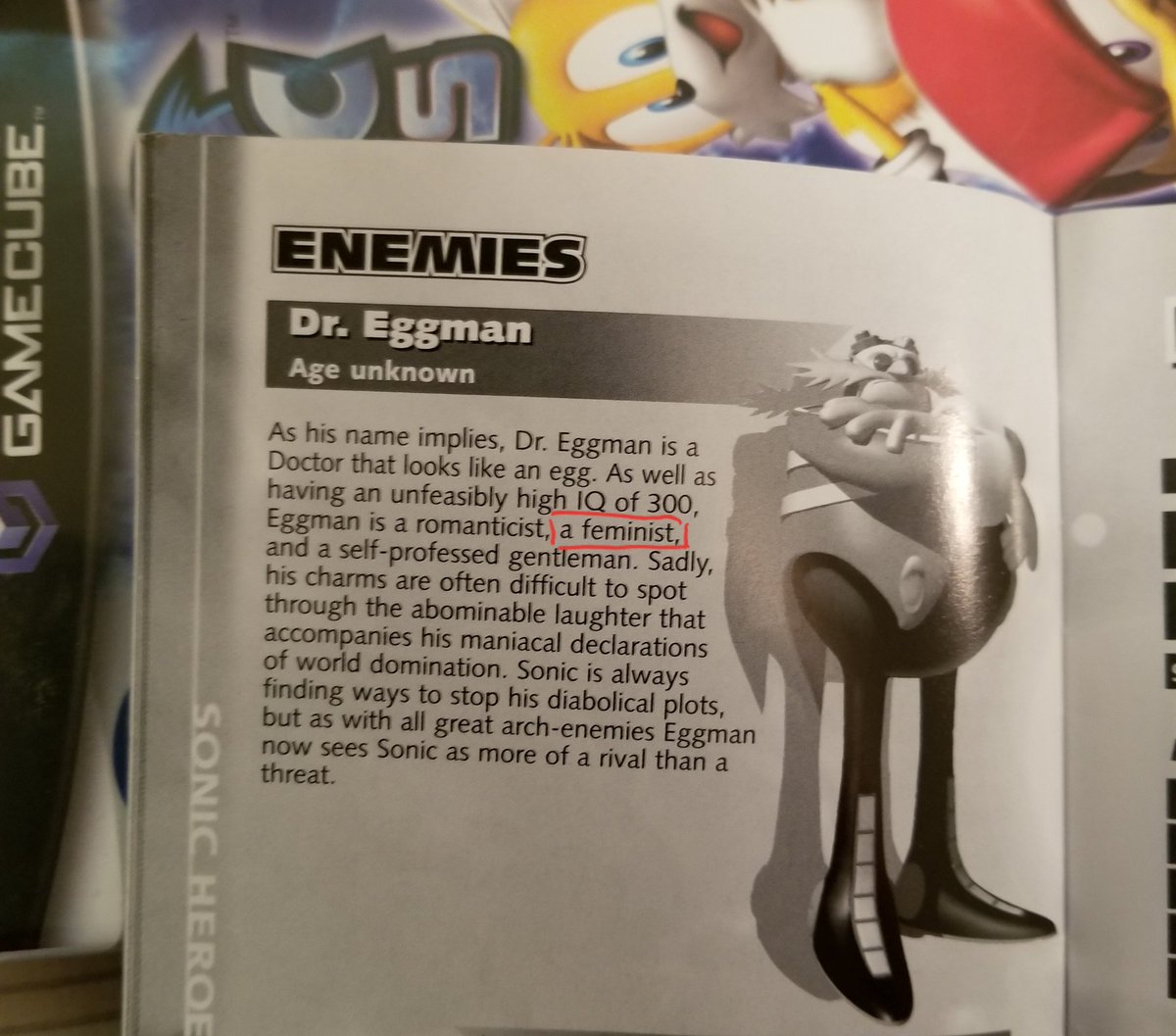
But according to the English-language Sonic Heroes manual, he has some hidden depths. He's also a feminist:
Eggman is a romanticist, a feminist, and a self-professed gentleman.
This quote has long confused Sonic fans because Dr. Eggman has never spoken about feminism or had any particular attitudes toward women. (If you want to determine for yourself whether Dr. Eggman is a feminist, I recommend reading this Vice article.) Imagine reading a description of Bowser from the Mario games that mentioned "Bowser is also a fiscal conservative" among random traits and you'll see how jarring this is.
There's been speculation that this is a mistranslation, because there's a Japanese word "feminisuto" that actually means something along the lines of "chivalrous, romantic." Considering the context that Dr. Eggman is both a "romanticist" (another strange translation) and "a self-professed gentleman," it makes more sense for the intention to be "chivalrous."
You can see an example of "feminisuto" to mean chivalrous in the following episode from the anime Revolutionary Girl utena:
In Japanese, "feminisuto" ("feminist"), actually means "chivalrous," as the poorly shot Utena clip demonstrates. Was feminist Eggman the result of a mistranslation? It gets odd. pic.twitter.com/uYEEy1mfFp
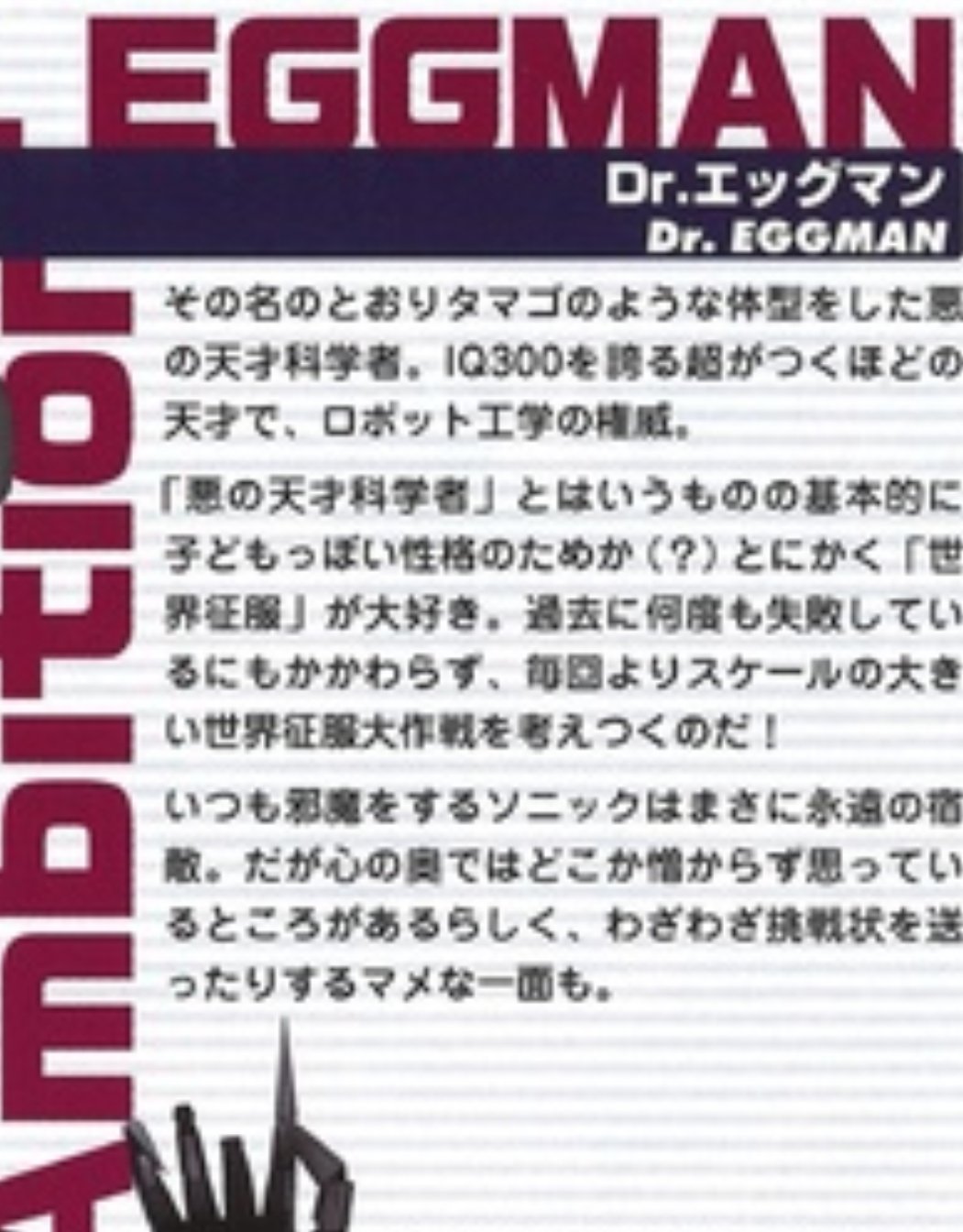
The Japanese manual of Sonic Heroes does not mention whether or not Dr. Eggman is "feminisuto." This has basically been the end of most research.
However, it's worth pointing out that the translation for the English Sonic Heroes manual may not have come from the Japanese manual, but from another source. The official Japanese site for the anime Sonic X does indeed say that Dr. Eggman is "feminisuto":
ロマンチストかつフェミニスト。 自称紳士のええかっこしい。
Romantic and chivalrous. (?)A self proclaimed gentleman.(?)
It seems that they decided to use Sonic X descriptions for the English Sonic Heroes manual, but whoever was translating it was unaware that "feminisuto" meant "chivalrous." "feminisuto" does also refer to someone who is a feminist, so the translator may also simply have decided that "feminist" would make more sense. It's even possible they thought it was funny.
Whatever the cause, it's a humorous example of how strange translations can end up taking on a life of their own.
Note: this was originally published in abbreviated form on Twitter in October 2018.