Several years ago, the construction ‘because [noun]’ became a meme on the internet. We started seeing sentences like "I can't go to a party because tired" and "I want this because reasons." The American Dialect Society even declared “because” their 2013 word of the year:
“This past year, the very old word because exploded with new grammatical possibilities in informal online use,” [Ben] Zimmer said. “No longer does because have to be followed by of or a full clause. Now one often sees tersely worded rationales like ‘because science’ or ‘because reasons.’ You might not go to a party ‘because tired.’ As one supporter put it, because should be Word of the Year ‘because useful!’”
Giving ‘because’ the word of the year status spurred a great deal of thought about what ‘because’ is doing in constructions like “I can’t go to a party because tired” or “I want this because reasons.” Ben Zimmer, writing for Language Log this time, gave a run down of various grammatical interpretations of this new because. Here’s a short collection of posts on this use of "because":
How old is this usage? One of the earlier examples of it is in the ‘because racecar’ meme from jalopnik.com. It comes from a craigslist posting for a Mazda MX-3, written in terse, short language. “1992 Mazda MX3 GS for sale. Does not run, needs motor. Completely stripped inside because race car.” This style is similar to that used in newspaper headlines.
There is a fair amount of speculation as to where this usage comes from. Neal Whitman traces it to humorous usages like “when life gives you lemons, make lemonade, because hey, free lemons.” The ‘hey’ here lets you introduce clauses if you like: “when life gives you lemons, make lemonade, because hey, free lemons are delicious.”
Whitman finds a relatively early example of ‘because NOUN’ from 2008:
“[M]arket capitalism leads to political liberalism because… well, because FREEDOM, that’s why!”
Ben Zimmer compares the ‘because [noun]’ constructions to humorous uses like the following:
Leslie: What the hell are you doing out here?
Ben: Sorry, babe, I am off City Hall property. You have to stop. Firewall.
Leslie: Wrong. All roads and bridges fall under the purview of the Pawnee Department of Transportation, which is located on the fourth floor of City Hall. Firewall down. Stay frosty, Wyatt. We're just getting started.
Ben: OK, well, that's interesting. You know why?
Leslie: Why?
Ben: Because… (runs away)
Similar examples date to 1871. Courtesy of the Oxford English Dictionary:
1.b. 1871–
Used elliptically in answer to a question, implying that a fuller reply is being withheld for some reason.
1871
The little fishes of the sea, They sent an answer back to me. The little fishes' answer was ‘We cannot do it, Sir, because—’.
‘L. Carroll’, Through Looking-glass vi. 132
1968
‘Why didn't you leave the bottle?’ ‘Because!’ I said shortly. I wasn't going to explain my feelings on the matter.
‘M. Carroll’, Dead Trouble x. 175Citation details for ‘M. Carroll’, Dead Trouble
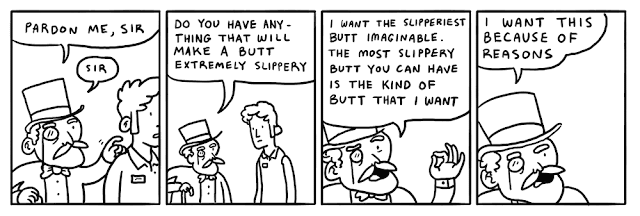
Gretchen McCulloch argues instead that the following 2011 comic was influential in spreading the ‘because’ construction, and argues for a shortening process:
I want this because of reasons
Because of reasons
because reasons
I don’t believe that there is just one process that created ‘because NOUN’. The construction appears to have independently been created multiple times. The ‘of’ in “because of [NOUN]” does not carry any semantic meaning, so it’s easy to remove it and preserve the meaning. Similarly, imagine a full version of the racecar meme: “[It is] complete stripped inside because [it is a] racecar.” Removing both ‘it is’ does not affect the meaning.
‘Because More Expeditious’ - An Older Use of “Because X”
I have found a dramatically earlier usage of ‘because [adjective]’ than is commonly reported, and which I have not (yet) seen cited as a possible model for the ‘because [noun]’. This is an academic or highly literate usage of ‘because [adjective].’
“Meanwhile the master saw no danger which would result from this preaching, unless he might foresee that eventually he should find the relation so responsible, and the character of the servant so well fitted for it as to render emancipation expedient, and a duty because expedient.” - 1831. Relation of Master and Servant, as exhibited in the New Testament, by S. Taylor
“As justifiable, the legal right, is such, as the thing, the most immediate and necessary, to do; and as the only thing feasible, or suitable, under the state of circumstances; but, when the exigence of occasion had passed away, and a normal condition of society had obtained, that which had been made right, as legal, and because expedient*, has now to be unmade, *because inexpedient.” - 1869. Of the commonwealth; its freehold and its freedom, by a county and borough elector
“Metallic cabinet work is superior to wood:
1. Because more durable, being stronger in construction and unaffected by climate or changes of seasons.
2. Because more sanitary, being impervious to microbes and vermin and more readily kept clean.
3. Because more convenient, having no parts to get out of order, shrink, or swell.
4. Because more agreeable in use, all parts being always usable and made with smooth, rounded surfaces and with suitable working tops.
5. Because more attractive, being more substantial in appearance and also artistically finished with surfaces subject to no deterioration.
6. Because more economical ultimately, with first costs little greater than wood.
7. Because entirely incombustible.” - 1902 Metallic Filing Devices, Fixtures and Furniture for Public Buildings and General File Rooms
“The limpness of a warm presents a bit of an obstacle to the critic's Freudian interpretation, but he readily overcomes it by citing the secondary medieval meaning of “gusano”: the more appropriate, because vertebrate, “víbora” (“viper”).” - 2001. Recovering Spain's feminist tradition
These examples show that ‘because more [adjective]” and “because [adjective]” existed in a variety of styles from the 1710s to the modern day. Religious commentary, industry publications, academic books, and even popular books. (I can report that one of these ‘because’ constructions appears in ‘Class: A guide to the American status system’, but I did not write the page it happened on. Bad habit!)
Where did this use of ‘because’ come from? It is hard to say. I can’t find a quotation of it in the Oxford English dictionary. It’s used throughout the 1700s and 1800s, but always dwarfed by other uses of ‘because.’
Indeed, this obscurity is so that some commenters on the English Language Learner Stack Exchange found it ungrammatical. The accepted answer incorrectly attributes the use of ‘because adjective’ to the recent slangy use. (The answer by sumelic is more correct.) None of the articles on ‘because [noun]’ I’ve read so far mention this older usage of ‘because [more] [adjective]’.
As idle speculation, I mention that French has a similar construction where the word 'car' (because) takes a direct object.
"C'est un chemin nefaste car passif, aliene, perdu" - Simone de Beauvoir, the Second Sex
"It is a nefarious path because passive, alien, lost"
Could this "because [adjective]" usage have been influential on the "because [noun]" construction and its variations? Possibly - it’s not as if there aren’t highly literate people on the internet who enjoy reading older texts. But I doubt it is a direct inheritance. For one, I could not find examples of ‘because [noun]’ in any older texts, only ‘because [adjective]’.
I would instead say that this usage shows that for a long time, we have had both the constructions ‘because it is [more] [adjective]’ coexisting with ‘because [more] [adjective]’. Eliding the words between ‘because’ and the adjective hasn’t affected our ability to understand the phrase. Since the ‘of’ in “because of reasons” is hardly contributing to meaning, perhaps we shouldn’t be surprised that “because [noun]” came around. The memeification of it from 2011-2013 just propelled it from a fringe or individual usage to part of a meme-y, informal style. Perhaps the emergence of this construction was just a matter of time, because history.
Most video games with voice acting go in one of two directions: using General American accents as a default, and using Received Pronunciation for fantasy settings or for upper class characters. The 2017 game Xenoblade Chronicles 2 bucks this trend entirely and features one of the most diverse collections of accents in a video game. Most remarkably, it does this while also avoiding the stereotyping that usually accompanies accent use, resulting in positive representation for most accents.
The original Japanese version of Xenoblade Chronicles 2 was homogenous in accent use, which means that the decision to use different accents was made during localization. Why would the localization differ so drastically on this issue, when it could have done the much easier job of securing actors that all come from one country and have the same accent? And how did people react to having a game where the protagonists had accents drawing from Manchester, Wales, and Scotland?
Xenoblade Chronicles 2 presents an excellent case study for a number of things: learning to distinguish between different major English accents; understanding the social contexts that result in linguistic prejudice; market decisions that support or suppress differing linguistic voices. We're also going to take a short look at the game's predecessor, the original Xenoblade Chronicles, and how that game's unusual history paved the way for our polydialectal protagonists.
Xenoblade is a video game series developed by Monolith Soft. They are spiritual successors to the Xenosaga series and the Xenogears game, which came out on PlayStation consoles. The Xenoblade games are available exclusively on Nintendo consoles. The first Xenoblade Chronicles tells the story of a world where the only two landmasses are two giant, immobile humanoids, and all life lives on these two beings. The protagonist, Shulk, is on a quest to avenge his hometown after it is attacked by mechanical creatures from the other humanoid landmass.
Xenoblade Chronicles 2 is loosely connected to the first Xenoblade Chronicles. In this world, there are multiple giant beings called Titan, and people live on them. The groups of people living on each Titan have their own cultures, politics, and - in the English version - accents. The protagonist, Rex, is on a quest to help his newfound friend Pyra reach the mythical land of Elysium, to solve the problem of Titans dying off.
It's not necessary to be much more intimately familiar with the plot than this, and I will avoid story spoilers if you are in the middle of playing these games.
A Tour of Accents
Southern England English
Most of the cast of the first Xenoblade Chronicles game speak in Southern England English. This is distinct from Xenoblade Chronicles 2, where each world has a distinct variety of English. Some characters, like Shulk, may sound more posh than other characters, like Fiora, but overall they stay within the range of Southern England English. Both heroes and late-game villains speak in a middle-class variety of Southern England English.
In Xenoblade Chronicles 2, the people of Tantal, the people of the historical nation of Torna, and the race of small furry bunny people called Nopon speak in this accent.
Examples of Southern England English
Non-rhotic: Like most English accents in England, Southern English does not pronounce historical 'r's after vowels.
"The fut[ə] doesn't belong to you!"
If a word ends in a vowel and the next word starts with a similar vowel, Southern English lets you insert an intrusive r to make the difference between the words clearer.
"Protect Melia-r-at all costs!"
Southern English English, and many other varieties of English English, have a three way vowel distinction between BOTHER /ɒ/, SPA /ɑ/, and THOUGHT /ɔ/. An American may use the same vowel in "monado", "mechon", and "law" ([ɔ]) but most Englishmen will use a different vowel in each: "monado" ([ɑ]) "Bionis" ([ɒ]), and "awesome" ([ɔ]).
"The Mon[ɑ]do... Bi[ɒ]nis and the Mech[ɒ]nis. That's [ɔ]some!"
"But it's starting to look like the mon[ɑ]do might be something far more significant than just a weapon for defeating Mech[ɒ]n."
"I really th[ɔ]t I'd l[ɒ]st you back then."
The TRAP-BATH split: In Southern England, words like "bath," "can't," and "laugh" are pronounced with the vowel of SPA instead of the vowel in TRAP.
"This is my ch[ɑ]nce! I c[ɑ]n’t see it clearly."
The HURRY-FURRY distinction: North Americans tend to rhyme HURRY and WORRY, but these are two distinct sounds in most English English, with HURRY having the 'uh' sound of STRUT.
"I'm more wuh-ried about you than the shell."
FEEL-FILL merger: Younger varieties of Southern English English pronounce 'feel' to sound like 'fill.' A similar merger is also occurring in white Southern American English and African American Vernacular English.
"The breeze f[ɪ]lls so good."
GOAT-fronting.: In Southern English English, the "oh" sound is made with the tongue pushed more forwards than in other varieties of English.
"[əʊ], the defense force colonel."
No yod-dropping: American English has a 'doo' in words like 'duty,' but English English preserves a 'dy' sound, so 'duty' sounds like 'dyooty.'
"I take this chance to bring vengeance to my brother and fulfill my d[j]uty."
Cockney English and Lower-class London English
Cockney is a working class accent found in London. Quite a bit of Cockney could be head in the first Xenoblade game, most notably with the villain Bronze Face. Xenoblade 2 also had a little Cockney, with a minor enemy guard speaking in Cockney.
Cockney and Working-Class London English Characteristics
FLEECE-diphthongization: The 'ee' vowel /iː/, like in FLEECE, is pronounced as a diphthong [əi~ɐi].
"Professor Tatazo, sp[ɪi]k! Sp[ɪi]k, you give orders."
GOAT-centralization: The 'oh' vowel /o/ becomes 'au' [æ̈ʊ~ɐʊ], so 'hoes' sounds like 'house.' The vowel is more centralized than the Southern English English mentioned above.
"If productions get more sl[ɐʊ], maybe you ready for sleep time with fishes."
"Professor Tatazo, speak! Speak, you give [oʊ]ders."
STRUT-raising: the 'uh' /ʌ/ sound moves towards 'a' [ɐ̟].
"If prod[ɐ̟]ctions get more slow, maybe you ready for sleep time with fishes."
T-glottalization: Ts between vowels are replaced with the glottal stop [ʔ].
"I've been ge[ʔ]in hungry!"
H-dropping: h sounds, especially at the beginnings of words, are likely to be dropped.
"I've been getting 'ungry!"
PRICE-backing: The vowel in PRICE /aɪ/ is backed to [ɑɪ]. In more extreme versions, "price" can sound like "proise."
"He's r[ɑɪ]ght here . He's still al[ɑɪ]ve."
FACE-lowering: The /eɪ/ sound in words like 'face' and 'ate' are lowered [æɪ~aɪ].
"I [æɪ]te 'em all up."
Myself can be realized as me-self [mi].
"I just couldn't help [mi]-self."
L-vocalization: The l's at the end of words can become a [w].
"I'm not meta[w] face."
Cockney is on a continuum with other forms of London English, so some "Cockney" features also appear on characters that otherwise don't sound Cockney, like Reyn. Reyn displays h-dropping, t-glottalization, and other features of Cockney English, but he does not sound anywhere near as Cockney as Bronze Face does.
You can think of Shulk, Reyn, and Bronze Face as being on a continuum from 'very middle class' to 'in the middle' to 'straight-up Cockney.' They will all share certain features that are relevant to their region, such as non-rhoticism, GOAT-fronting, and a 3-way distinction between SPA, BOTHER, and THOUGHT. This distinguishes this group of 3 dialects from other region-based dialects, like General American English.
As you move from the 'very middle class end' towards the middle, you'll notice an increase in traits like h-dropping, t-glottalization, and PRICE-backing. At the Cockney end of the spectrum, the frequency of h-dropping and t-glottalization can increase.
Cockney and 'very middle class' London English may both have GOAT-centering, but the Cockney vowel is different (more centered) than the 'very middle class' vowel. This shows that names like 'GOAT-centering' cover a lot of different possible realizations, and these realizations may be treated differently by society.
Northern English (Leftheria)
Xenoblade 1's dialect diversity was mostly limited to class, but Xenoblade 2 introduced more region-based diversity. Each in-game world has a predominant dialect of English associated with it, and the people of each region will speak their associated accent.
For example, the main character of Xenoblade Chronicles 2, Rex, is from the in-game world of Leftheria. The Leftherians were dubbed using Northern England English. Accordingly, Rex's voice actor is from the North of England - specifically, from Manchester. Other characters from Leftheria also use Northern English English.
Because of prejudice against Northerners, Northern accents are often judged negatively by Southerners. Some English players reacted negatively when they first heard Rex's accent, with one claiming he sounded like a "farmer." Some people from outside the UK who were not familiar with Northern accents even thought Rex was using a 'fake' accent!
But not everyone reacted negatively to Rex's accent. Northern English fans did not view their own accent negatively - they seemed to enjoy being represented as the hero! Many people in and outside the UK also delighted in hearing a Northern protagonist. Today, the general fan consensus toward's Rex's accent seems mostly positive.
Northern English English characteristics
HOUSE has a centered vowel: Words like "house" and "about" with the /aʊ/ diphthong are pronounced as "hoess" or "aboat," with a vowel like [əʊ]. This is closer to how these words were pronounced in Middle English.
"Time to take you down [dəʊn]!"
Monophthongization: Vowels like "ey" [eɪ] and "oh" [oʊ] are pronounced not as two vowels, but as a single vowel: [e] and [o].
"[oke]!"
Lowered TRAP vowel: Words like "trap" are not pronounced with [æ], but with a vowel more similar to the Spanish "a": [a]
"That wasn't supposed to h[a]ppen."
My is reduced:'my' [maɪ] can reduce to 'muh' [mə], similar to in the phrase 'm'lady'.
"No worries, I bet I can learn something to help m' salvaging too."
No STRUT-FOOT split: In Southern English accents, words like "strut" have the 'uh' [ʌ] vowel and words like "foot" have the 'oo' [ʊ] vowel. In Northern English accents like Rex's, both "strut" and "foot" words have the short 'oo' [ʊ] sound. (This is because distinguishing between "strut" and "foot" sounds is actually relatively new in the English language!)
"And an[ʊ]ther one! Aw yeah, d[ʊ]n and d[ʊ]sted.
Lax happY vowel: The final vowel in words like "happy" and "exactly" are not a long [i] but more like a lax 'e' sound.
"My thoughts exactleh."
Welsh English (Gormott)
The people of the titan Gormott are voiced by Welsh actors. One of the main characters, Nia, is Gormotti and has a noticeable Welsh accent throughout the games.
The decision to have a main character with a lot of screentime have a Welsh accent was variably received, with some people unsettled that she sounded like a "Welsh grandma." But many fans enjoyed the voice actress's work and her Welsh-ness has even become memetic.
Some players didn't even realize that she was Welsh. Players from the United Kingdom are very familiar with the difference between Welsh accents and Scottish and Irish accents, but non-UK players had a hard time placing her accent.
When we listen to different varieties of English, we don't studiously notice every single realization of every single word - we rely on known patterns to be able to 'tell' someone's accent. If you lack the pattern, you have a harder time placing the accent. Non-UK players had no frame of reference for a Welsh accent, so when she uses a monopthong in 'face' and 'goat' or when she trills her r's, non-UK players may mistakenly categorize her as Scottish or Irish because those accents also share those features.
Welsh English Characteristics
STRUT-centering: The vowel of "bus" /ʌ/ is pronounced [ɜ]. This means "us" can sound more like "ehs."
"You're picking a fight with ehs [ɜs]?"
"Woo hoo, Nia the ehn-[ɜn]-stoppable!"
DRESS-lowering: The DRESS vowel /ɛ/ is a more open vowel, sounding almost (though not quite) like [æ]. Notice how the way she says "Rex" can sound like "racks."
"Make sure you've got my tail, R[æ]x."
Much like the Manchester accent above, Welsh English has TRAP-lowering. The TRAP vowel /æ/ is pronounced almost like the Spanish 'a' [a].
"Quick, while we have the adv[a]ntage."
Much like Southern English English, Welsh English tends to be non-rhotic. This means that 'r's after vowels are not pronounced. In the following clip, notice how the 'er' in 'proper' and 'swear' become weak vowels [ə].
"I'll bash you up prop[ə] next time, I swe[ə]!"
Despite being non-rhotic, 'r's that start a syllable can be tapped/trilled.
"Show us some of that Nopon spi[ɾ]it."
"We're on a [r]oll now!"
Geminated consonants: Consonants between vowels are doubled in length and held longer. This is similar to double consonants in Italian.
"C'mon, believe in me a li[t:]le."
H's at the start of words can be dropped: Notice how "here" becomes "yere", while "happening" and "heads" just lose their 'h'.
" 'ere I come, ready or Gormotti."
"Why is this 'appening? Hey over [j]ere, just me the 'eads up."
The ER vowel in NURSE is pronounced with rounded lips. Southern English would have [ɜ:], but Welsh English has [ø:].
"It's like were in puofect [pøfɛkt] sync
FACE and GOAT may have the monophthongs [e] and [o] instead of [ei] and [ou], respectively. Notice the similarity to Manchester English above.
"Healing h[e]l[o]."
Consonants at the end of words can be devoiced. For example, this leads to "d" being pronounced as [t].
"Brutal bla[t]e."
Scottish English (Mor Ardain)
The empire of Mor Ardain is voiced with Scottish accents. One of the party members, Mòrag, hails from the region, and speaks relatively neutral Edinburgh English. However, there are villainous characters from this region as well. Both will be represented in the examples below.
"Mor Ardain" is strangely translated Scottish Gaelic for "big pride". "Mor" means big and "ardain" is supposedly pride, though some sources contest this use and suggest "ardain" is really "little height" (big little height?). The adjective ordering is also suspect, since the adjective normally comes after the noun in Scottish Gaelic. It ought to be "ardain mor," similar to "cù mòr" below.
cù mòr briagha dubh dog big beautiful black
'a big beautiful black dog.' (MacAulay 1992)
Scottish English Characteristics
Trilled and tapped /r/. This trilling is more prominent than in Welsh English.
"Special inquisto[r] Mor[r]ag! ... had we but heard of your g[r]ace's visit, we could have prepa[r]d a suitable..."
"Gut it? Gut, this... c[r]eature?"
The Scottish English /u/ sound has the tongue pushed all the way towards the front, sounding more like "ew" [ʉ].
"Sublime! Your efforts have borne many fr[ʉ]ts."
BOOK and BOOT have the same vowel. Scottish English does not have a "short u" or a "long u."
"Let's p[ʉ]t that thought into practice, shall we? Ass[ʉ]me your positions."
Like Manchester and Welsh English above, FACE and GOAT vowels are the monophthongs /e/ and /o/.
"D[o]n't forget me... think you can t[e]k me?"
No FERN-NURSE merger: "Learn" is not pronounced with the same vowel as "nurse," but with a distinct "eh" vowel, so it sounds like "lairn" [lern].
"There is still much to l[e]rn."
The BIT vowel is lowered to [ë̞]. However, there is no merger: "bit" and "bet" are distinct in Scottish English.
"You won't w[ë̞]n so easily. Let me go... you p[ë̞]g!"
COT-CAUGHT merger: "COT" and "CAUGHT" are pronounced with an o-like vowel.
"Let's put that th[o]ght into practice, shall we? Show us what you've g[o]t."
There is no /æ/-/ɑː/ distinction, which means that path, trap, and palm all have the same vowel.
"Shall we d[a]nce? ... We will forge a p[a]th and none shall stand in our way... I never imagined we'd be standing here on the b[a]ttlefield side by side."
Centralized PRICE vowel: Notice how the way she says "side" [said] is almost more like "say'd by say'd" [sɜid].
"I never imaged we'd by standing here on the battlefield s[ɜi]de by s[ɜi]de."
Australian English (Uraya)
The monarchic nation of Uraya, which is located inside a whale-like titan, is represented by Australian accents. The character Vandham is from this region, and hits us with life wisdom in a broad Aussie accent.
You may notice that there is significant overlap between Australian English and Cockney. This is because Cockney English was influential in the developmnent of Australian English!
Australian English Characteristics
PRICE-backing: ai sounds like 'oy' [ɑɪ].
"We've been bl[ɑɪ]nds[ɑɪ]ded! Hold the l[ɑɪ]ne!"
FACE-lowering: the FACE vowel [eɪ] is lowered to [aɪ], so "rain" sounds like "rhine."
"Here's the m[aɪ]n course. R[ai]n, shine or snow."
Lowered and centralized GOAT: GOAT is [ɐʊ], so "hoe" sounds like "how."
"Rain, shine, or sn[ɐʊ]w."
DRESS-raising: Raised DRESS vowel to [e].
"Nia, st[e]dy on."
American English (Indol; various blades)
The nation of Indol is voiced with General American accents. It controls the distribution of the Blades species, and which is also a religious pilgrimage spot. Many of the Blades are also voiced with American accents. Notably, the antagonists of the game - the terrorist group "Torna" (not the country) - primarily have American accents.
Below are some characteristics of American English that distinguish it from other varieties of English.
American English English Characteristics
Unrounded LOT vowel: Most Americans pronounce words like "lot", "want", and "holly" with unrounded lips. This is in contrast to all the dialects listed above. Notice how Akhos uses the same vowel in "father" and "not."
"Can you do that for your grandf[ɑ]ther? ...N[ɑ]t ether?"
LOT-THOUGHT merger: An increasing number of young Americans are pronouncing words like "caught","draw", and "all" to sound like the vowels in "cot" and "doll." Unlike Scottish English above, the resulting vowel is more similar to [ɑ] than [o]. Notice how "father," "not," and "thought" all have the [ɑ] vowel in Malos's speech. In Southern English, these would all have different vowels. (Note not all Americans have this merger: the characters Jin and Amalthus do not have this merger.)
"No wonder f[ɑ]ther abandoned them! ... She's n[ɑ]t dr[ɑ]wing from the ether."
Functional LOT words like "from", "was", and "what" have the STRUT vowel. Notice how Akhos rhymes "but" with "what."
"B[ʌ]twh[ʌ]t if we were to interrupt the flow?"
Usage
One of the nice things about this game's localization choices is that is they mostly avoid leaning into stereotypes. The end result is delightfully confusing if you take it at surface value: the two leading powers in the world are the Australians and the Scottish (who have colonized the Welsh cat-people). The Americans run a neutral theocracy that also controls the flow of the Blade people. Another group of Americans runs around the world kidnapping the same Blade people and threatening globals safety. The Northern English live secluded, rural lives on an archipelago, while Received Pronunciation speakers have decided to dive underwater and never return. (Irish English is even present, but only because two of the songs were sung by Irish English speakers. No characters in the games have an Irish accent.)
None of this really matches up to any stereotypes in real life. But the accents work well at making it immediately obvious where a particular character comes from. Because English is a pluricentric language, English speakers are used to hearing a variety of accents in real life. This makes the localization decision to use different English accents, while strange in the context of video game dubbing, normal as a storytelling decision.
It helps that the original Xenoblade Chronicles game was dubbed using English English accents - RP, Estuary, and Cockney English all appeared in the first game. This wasn't for any storytelling decision, though - it was because Nintendo of Europe decided to fund the dubbing effort since Nintendo of America was not interested.
It's here that we can see one of the unfortunate stereotypes that they did fall into. Cockney English is used primarily by villains in Xenoblade Chronicles 1 and 2. Two major villains, Metal Face and Bronze Face, use it in 1, and the minor Tirkin species uses it in 2. No other accent is used so obviously to convey morality in the series, and it's a tired trope, as noted by a game reviewer: "Only the Especially Evil Robot Bad Guys miss the mark with their way-over-the-top Cockney guffawing."
Impact
The majority of games with voice acting are dubbed in American English. This contributes to a sense that American English is "the neutral" form of English. The United States is the large "first circle" English speaking nation, after all, and a huge market for game studios. The abundance of American media exported to other countries means that American English is extremely familiar, too. The next most common form is some sort of English English, usually for games that are meant for Europe or are in the fantasy genre (example: the Witcher series). Outside of those, it becomes increasingly uncommon for other varieties of English to be represented.
This leads to the unusual situation that people from these less-represented regions, upon hearing their own varieties used in media, react with confusion. It is easier to suspend disbelief for people who live on two giant beings or that anyone would go around dressing like Rex would than it is for people to think that these very same fantasies can have people who sound like them.
It's reminiscent of what Chimimanda Adichie calls "the danger of a single story." If you spend your life only hearing stories about people from England who eat apples and play in the snow, it's easy to end up writing stories like that, even if you are not from England, have never seen snow, and grow mangoes instead of apples.
Similarly, if you spend your whole life hearing video game protagonists with American accents, you come to associate video game protagonists with American accents, and hearing them depart from that script feels strange. It's a powerful example of enregisterment, "the process by which a linguistic repertoire comes to be associated, culture-internally, with particular social practices and with persons who engage in such practices." (LSA Summer Institute Workshop) Video game voice acting becomes enregistered as American, and optionally RP in a fantasy or historical setting.
Because these are fictional worlds, there is nothing preventing these characters from being voiced with a Yorkshire accent. The worlds of Xenoblades 1 and 2 don't really exist in our universe, so "Yorkshire accents" and "American accents" are concepts that don't even make sense anyway. The characters speak some variety of a known human language for our convenience - it makes no difference to the story whether it's a Yorkshire accent or a New York accent.
Market concerns are the primary motivator. It's risky to put out a game where the main character has a Lancashire accent, and if Xenoblade didn't already have a history of English voice acting, I don't think it would have happened. We would probably wonder, "why did they voice the main character in a Japanese role-playing game with a Yorkshire accent? Does this game have something to do with Yorkshire?"
But because of Xenoblade's strange history, audiences could already expect that English English accents would be in the game. You could even say that fans were looking forward to it - a number of fans were disappointed that Xenoblade X, the game released after Xenoblade the first, was set in "New Los Angeles" and would therefore be full of American accents. (There were some English accents thrown in, but mostly RP.)
Xenoblade 2 has shown that having a variety of accents is not going to confuse the audience. It's currently the best selling game in the series. While the dub is still divisive, it's no longer entirely because it uses non-RP/GA accents. Even people who were skeptical of it before have warmed up to it.
I’m aware not everyone is a fan of the English dub, as there are those who insist on playing the game with the Japanese dub, but as an Englishman who has a fondness for the various accents Great Britain has to offer, I couldn’t help but embrace every piece of dialogue delivered by Nia and Mòrag. Heck, even the hoity-toity tones of Zeke were enjoyable.
As nice as the other accents are though, they are nothing when compared to the sultry tones that spread forth from Nia’s mouth. It’s not just her who’s Welsh accent sounds great as the accent of every Gormotti character, is just too good to be true.
This is going to be pure bias but the Gormotti are my favourite species in Xenoblade Chronicles 2 and it is mostly thanks to their accent. I may not know the names of all the voice actors who gave life to these characters, but their delivery of dialogue and how they conveyed emotions in their delivery, really helped to make the characters stand out and have me enjoy my time in Gormott, all the more.
One of the more heartwarming aspects is the people who have found themselves represented in the game. It has expanded whose voice gets to be in a video game. The following quotes from a Kotaku article demonstrate:
The first game’s exaggerated take on the British language formed the cornerstone for much of the narrative tone and pacing of later entries in the series. When Xenoblade Chronicles was at its finest, it was leaning heavily into its choice to be an exaggeration of the place I consider home. It wasn’t a nuanced take on British dialects — most people who live in Great Britain will likely agree nobody they know actually talks quite like Shulk does for example — but it was one that left a lasting impression of a world closer to home than JRPGs normally feel to me.
This is something which has stuck with the series since then and, a week or so deep into Xenoblade 2, I’ve finally worked out what it was about the presence of these close to home regional dialects that feels so special to me. It’s that as cringeworthy as they can at times be, they make me feel like the adventure unfolding could happen to me; like I could be part of the adventure — something that a series hasn't made me feel for a long time.
[...] There’s something about all these British accents that makes the characters in the adventure feel much more real to me. Perhaps it’s that I typically experience American accents through works of fiction, and they take on an air of the fake or exaggerated. Maybe it’s that when playing with Japanese audio and English subtitles, I tend to hear accents in my own head rather than as they’re voiced in the media itself. Whatever the cause, there’s an added feeling of authenticity and sincerity when the accents you encounter are a little closer to home — even if they’re caricatures in and of themselves.
Perhaps more games in the future will feel free to use a wider variety of accents, and without resorting to crude stereotypes. Xenoblade 2's voice acting certainly has room for improvement. The localization process resulted in a lot of awkward pauses and strange lines to meet the lip sync - when they meet it at all. But the accents themselves seem to have been greeted warmly, despite diverging from the Japanese source material. Here's hoping future Xenoblade games and beyond will continue to enrich their worlds with diverse dialects.
This article is also available in video form! You can watch below. The article has more points and citations while the video has more visual aids, so they both complement each other.
At the end of April, you'll start seeing memes of Justin Timberlake everywhere with the text "it's gonna be may." This, of course, is a reference to the 2000 hit song "It's Gonna Be Me," where Justin sings the hook. Only except of the expect "me," he sings "may." The meme itself dates back to 2012, but it has proven enduring as a cyclical meme. It reminds of us of both the hopeful month of May and how weird it was that pop stars used to sing like that. If you need a reminder or you've never heard the song before, here's a clip of the offending pronunciation:
"Baby, when you finally get to love somebody, guess what: it's gonna be may." - It's Gonna Be Me, N'Sync (2000)
Justin is not the only pop star to sing "me" as "may." We've all probably heard a pop star sing something like "I'm missing you like canday" or "I want to be the minoritay." The nameless but frequent phenomenon even inspired an Atlas Obscura investigation by Dan Nosowitz.
But tracing the pedigree of this feature has eluded most of the people who write about it. Nosowitz's article offers an explanation for why it happens now, but it doesn't tell us who first started using it. Moreover, it confuses the vowel in "it's gonna be may" with a different vowel entirely, which muddies the waters even further. He refers to Stevie Wonder saying "thirteen month old babay," but that's not actually what Stevie Wonder is saying: he's saying "thirteen month old bab-IH," with a short 'i' and no diphthong. These two vowels have separate histories and need separate accounts.
"Thirteen month old babee [beɪbi] ... thirteen month old babih [beɪbɪ]." - Superstition, Stevie Wonder
So why does it matter which vowel happened - singers change their vowels all the time, right? Well, most linguistic changes of this sort aren't random or arbitrary - there is usually a reason that sound changes happen, and a reason that they spread as well. The spread of "may" and "babay" doesn't seem to be caused by random innovation - it's a daisy chain of influence from disparate genres and peoples all reaching their zenith in the massive pop moment of the 90s.
I first tackled this subject in 2016 (re-published in 2017) in one of my earliest articles. This is not just a rewrite, but a totally new theory to explain just why pop singers do that thang. I hope you'll join me in what is probably the most comprehensive history of "it's gonna be may" yet.
Setting the boundaries
First, let's talk about "it's gonna be may." What’s happening is the "ee" [i] vowel is being converted to "ay" [ɪi]. This is an example of diphthongization, or a vowel "breaking" into two vowels. This breaking can apply to other words that have an 'ee' /i/ sound in them, like "knees" /niz/ can become "knays" [nɪiz]. We’ll call this pattern ‘ME-breaking.’ There some dialects that have ME-breaking commonly, like Southern American English (Lee, 2012; McDorman) and London English.
"He loves mee [mi]." No breaking.
"He loves may [mɪi]." Breaking.
Words like ‘happy’ and ‘sadly’ have an ‘ee’ sound in them, but the stress doesn’t fall on the ‘ee.’ This puts them in a separate category, called ‘HAPPY’ words. Nowadays, most dialects of English have an ‘ee’ sound in these words: this is called tense-HAPPY.
But in the 1800s, these HAPPY words were pronounced with a short 'i' [ɪ] sound. So they sounded like ‘happih’, ‘verih’, ‘anarchih.’ This pronunciation is called 'lax-HAPPY'. While lax-HAPPY isn’t popular nowadays, older speakers of conservative Received Pronunciation (Wells, 1980), Southern American English (Thomas, 2006), and African American English still use it.
So what if you had breaking in a HAPPY word? This would result in ‘happay.’ There’s no agreed-upon term for this, but I’ll call it HAPPY-breaking. You can find HAPPY-breaking in working class varieties of London English and in Yorkshire varieties, among others.
"She is happee [hæpi]." Tense-HAPPY
"She is happih [hæpɪ]." Lax-HAPPY
"She is happay [hæpɪi]." HAPPY-breaking
To keep things simple, I will use the IPA symbols [ɪi] to note that a word has vowel breaking: m[ɪi]. This is because the vowel breaking in "it's gonna be may" isn't actually identical to the sound in the word "May." Some instances of vowel breaking are not as obvious and will not sound as close to the word "May." I am less interested in the degree of breaking and more interested in the fact that it occurs at all, so both subtle and obvious breaking will be written with [ɪi].
Timeline
Here's the fun part: we're going to look at popular songs from the 20th century to find out who started this whole ME-breaking and HAPPY-breaking mess. To keep things simple, I mostly focused on songs that topped on the Billboard Hot 100, which is an American popular music chart. An even more comprehensive review would compare this with the UK charts or also look at songs that charted below #1, but I am just one person and listening to every #1 hit of the 80s was enough work for me.
One question we're going to try to tackle here is how could singers have been exposed to "may" and "babay"-like forms? Remember, it's unlikely that multiple people over multiple decades just happened to come up with vowel-breaking on their own, so we have to posit an explanation for how they picked up on it.
Unfortunately, there are rarely direct examples of a singer saying "I sang it like this because I heard it from this person/someone told me to." As such, we have to rely on some circumstantial evidence at times - such is the nature of tracing influences in pop music history. Sometimes we're lucky and we know that a singer was a fan of early singers because they've done covers of their material. Sometimes they even do interviews. Sometimes we have to rely on genre similarities and the fact that musicians tend to be aware of other people working in their scene. But sometimes there's no obvious explanation. Tracing history is rarely clean.
1950s-1960s: Lonesome Cowboy
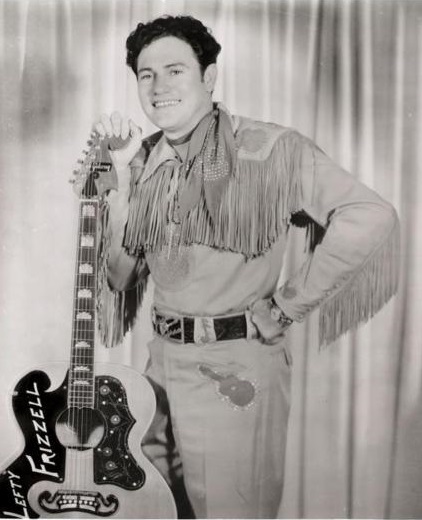
The earliest example of ME-breaking I've been able to find so far is in country music, by Southern American English speakers. Lefty Frizzell had a hit in the 1951 song "Give me more, more, more (of your kisses)," and also some ME-breaking. Another example is in his unreleased 1951 song, "You Want Everything But Me."
"They'll even pay the weddin' bills to just get rid of m[ɪi]" - Give Me More, More, More (Of Your Kisses), Lefty Frizzell (1951)
"You want everything but m[ɪi]" - You Want Everything But Me, Lefty Frizzell (recorded in 1951s, released 1981)
Another Southern country singer was Waylon Jennings. He sang a cover called "She Called Me Baby" in 1967 with some HAPPY-breaking.
"She called me baby, bab[ɪi]" - She Called Me Baby, Waylon Jennings (1967)
You could also find some breaking in jazz. The singer Chris O'Connor was Missouri born and raised, and has a diphthongized 'me' in S'Wonderful.
"That you should care for m[ɪi]" - S'Wonderful, Chris O'Connor (1957)
Overall, breaking in popular music is limited to Southerners in these two decades.
To my surprise, I was unable to find examples of African American singers with ME-breaking. ME-breaking appears to be more a characteristic of Southern American English than African American English, including Southern African American English. I haven't found examples of ME-breaking in the literature for African American English. I listened to influential black blues and rock 'n' roll artists such as Muddy Waters, Chuck Berry, Bo Diddley, and Little Richard, and Fats Domino, but they had no ME-breaking at all! (There was some lax-HAPPY, but remember that that is a different feature. Don't worry, I'm covering it in another article in the future.)
1970s-1980s: the Rock and Punk Years
The earliest example of breaking in rock music is the Rolling Stones. This group also happens to be from London, which is a region with ME-breaking. You can hear an example of it in their song "It's Only Rock and Roll (But I Like It)," from 1974:
"I said can't you say s[ɪi]" - It's Only Rock and Roll (but I Like It), the Rolling Stones (1974)
In 1975, an American-English rock group called the Arrows recorded a response to this song, called "I Love Rock and Roll." Their American lead singer also gave ME-breaking a try:
"I saw her dancin' there by the record mach[ɪi]ne ... And I could tell it wouldn’t be long till she was with m[ɪi], yeah, m[ɪi]." - I Love Rock 'n' Roll, The Arrows (1975)
Then in 1976, the English punk group the Sex Pistols released their first single “Anarchy in the UK.” Besides being massively successful, it also had ME-breaking (be -> bay) and pronounced HAPPY-breaking (anarchy > anarchay).
"I want to b[ɪi]anarch[ɪi]" - Anarchy in the U.K., the Sex Pistols (1976)
The singer Johnny Rotten came from a working-class household in London, so this ME-breaking wasn’t copped from country music. You can hear in this interview how he makes 'week' sound more like 'wake':
(1:07) Watch Top of the Pops and send their boring little letters into Melody Maker w[ɪi]k after w[ɪi]k.
From here, both ME-breaking and HAPPY-breaking appear sporadically throughout the 80s. The 1982 cover of I Love rock and roll by Joan Jett is the first #1 US hit of the 80s to feature ME-breaking, imitating the same vowel that the arrows used.
"He was looking at me, yeah, m[ɪi] ...take your time and dance with m[ɪi]" - I Love Rock 'n' Roll, Joan Jett & the Blackhearts (1982)
1986 had the top 10 hit by the Beastie Boys, “You gotta fight for your right to party.” Although the Beastie Boys were basically a rap group by that time, they started out as a hardcore punk band and the influences can still be heard in their instrumentation. Perhaps there’s also some influence in their vowels, because we hear HAPPY breaking:
"You gotta fight for your right to part[ɪi]!" - (You Gotta) Fight For Your Right (To Party), the Beastie Boys (1986)
ME-breaking hadn't just infiltrated classic rock and punk - it also made its way into glam rock. The 1987 song, "Pour Some Sugar On Me" by the English group Def Leppard should perhaps be called "Pour Some Sugar On May."
"Pour some sugar on m[ɪi]"- Pour Some Sugar On Me, Def Leppard (1987)
The 1990s and beyond: Pop Takes Over
As we leave the 80s, we can tell one thing. ME-breaking and HAPPY-breaking had firmly entrenched themselves in rock and rock-adjacent genres. You'll find examples of ME-breaking and HAPPY-breaking in rock music throughout the 90s. One could even consider them to be a part of what it means to sing rock music: a part of a rock singer "register." My favorite 90s-era of ME-breaking and subtle HAPPY-breaking is the theme song to the video game Sonic Adventure, which is a beautiful example of all the cliches associated with rock music at the end of the decade.
(upper harmony) I don't know what it can be but you drive me craz[ɪi] ... open your heart and you will s[ɪi]" - Open Your Heart, Crush 40 (1998)
However, knowing the path it took for ME-breaking and HAPPY-breaking to get into rock music doesn't explain how it got into pop music. That path is a little more mysterious and murky - but we're going to tread it anyway.
In 1994, rapper Notorious B.I.G. posthumously released "Juicy." The Brooklyn girl group Total sings on the hook:
"You had a goal but not that man[ɪi]" - "Juicy", The Notorious B.I.G. (ft. Total) (1994)
The chorus was interpolated from Mtume's song "Juicy Fruit" 1983, but this original version did not have HAPPY-breaking. Why did this girl group use HAPPY-breaking on the pop hook of a rap song? Perhaps influence from growing up around rock music? It's not clear, but what is clear is that this song was a massive hit, spreading HAPPY-breaking across the airwaves.
HAPPY-breaking and ME-breaking both appear in an unusual place in the 90s - Mariah Carey’s #1 hit song “Always Be My Baby.” This is one of the earlier places in pure pop music where we see HAPPY-breaking and exaggerated ME-breaking.
"Boy, don't you know you can’t escape m[ɪi]? Ooh darlin' cuz you’ll always be my bab[ɪi]" - Always Be My Baby, Mariah Carey (1995)
Like with "Juicy," it's not clear how Mariah came across this form. Perhaps she picked it up from "Juicy" - Mariah was a noted fan of hip-hop. She was also a noted fan of glam rock - she's covered songs by Def Leppard, which we noted were big users of this sort of breaking.
HAPPY-breaking makes a re-occurrence in the song “Quit playing games with my heart” by the Backstreet Boys. This song was produced by the Swedish producer Max Martin, a fact that we'll revisit later.
"Bab[ɪi], so bad, bab[ɪi], quit playing games with my heart." - Quit Playing Games (With My Heart), the Backstreet Boys (1994)
Then we have "Wannabe", released in 1996, has subtle ME-breaking by Mel B. Mel is from West Yorkshire, another region with ME-breaking. (Source).
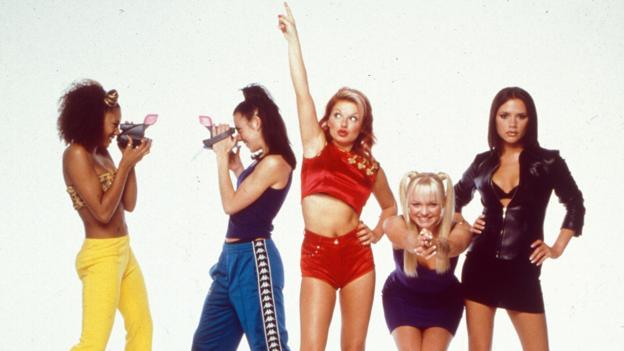
"And as for m[ɪi]? Ha, you’ll see!" - Wannabe, Spice Girls (1996)
In 1999, HAPPY-breaking and ME-breaking reached levels of vowel-breaking heretofore only dreamed of by man with Mandy Moore talking it all the way. This is one of the most obvious and exaggerated uses of HAPPY-breaking. It shows that by this point, HAPPY-breaking and ME-breaking had become associated with contemporary pop music.
"This feelin’s got me week in the kn[ɪi]s... come to m[ɪi], sw[ɪi]t to m[ɪi]... I'm missing you like cand[ɪi]" - Candy, Mandy Moore (1999)
It all comes full circle in the year 2000. N'Sync released “It’s gonna be me,” which topped the US charts for two weeks. The song has both normal 'me' and ME-breaking, which makes them easy to compare. No HAPPY-breaking, though.
"I remember you told m[ɪi] ...It’s gonna be m[ɪi] ... but in the end you know it's gonna be m[i]. It's gonna be m[ɪi], it's gonna be m[ɪi], gonna be m[ɪi]"
Justin was asked about this pronunciation in an interview and said something rather interesting:
Justin: I will say in my defense Max Martin made me sing 'me' that way. [...] I just want to throw Max Martin on the chopping block for that one.
[...]
Anchor: Did he give a reason for that?
Justin: I think he just wanted me to sound like I was from Tennessee. [...] He just kinda likes that.
Max Martin gave him direction on how to sing. Max Martin, if you'll remember, also produced "Quit Playing Games With My Heart," which had HAPPY-breaking. Perhaps he also guided the Backstreet Boys in using this pronunciation.
Timberlake clearly associated it with southerners as opposed to english punk rockers, but Max Martin was a fan of hard rock, so it’s likelier that Max Martin heard the pronunciation from them and decided to use it. He also could have picked up on it from Mariah Carey and the Spice Girls - he listened to pop music and could tell a trend when he heard one.
Noticeably, a number of Max Martin produced songs feature ME-breaking. This may seem coincidental, but Max Martin has been known to record demos of songs before giving them to singers, and telling them to copy the performance as much as they can. Another popular singer he worked with was, of course, Britney Spears. (She has enough linguistic peculiarities otherwise to merit her own article.)
There's nothing you can do or say, bab[ɪi] ... I'm not your property as from today, bab[ɪi]
Martin is known to be controlling about the music he writes. Music journalist John Seabrook writes:
And yet Martin is known to insist that the artists he works with sing his songs exactly the way he sings them on the demos. In a sense, Spears, Perry, and Swift are all singing covers of Max Martin recordings. They are also among the few people in the world who have actually heard the originals. Countless self-proclaimed performers on YouTube sing Max Martin songs, but there is not a single publicly available video or audio recording of Martin performing his own stuff. (In the course of researching my book “The Song Machine,” I got to hear an actual Max Martin demo, for “… Baby One More Time,” when a record man who had it on his phone played it for me. The Swede sounded exactly like Spears.)
If true, this would go a long way to explaining why other artists who have worked with Martin use breaking. For example, Martin worked on Katy Perry's song "Part Of Me." In this demo, she even rhymes "me" with "way" twice:
"I just wanna throw my phone away, find out who is really there for m[ɪi]... You can take the dog from m[ɪi], I never liked him anyway. In fact you can take everything except for m[ɪi]."
2010-era pop songs don't have to be produced by Max Martin, but his imprint is still strong. Taylor Swift's song "Out of the Woods" was produced by Jack Antonoff, but she still uses ME-breaking on the high notes.
"You were looking at may [mɪi], you were looking at may [mɪi], you were looking at may [mɪi]."
The Run-down
So we've traced the path that HAPPY-breaking and ME-breaking have taken through pop history. HAPPY-breaking and ME-breaking are no longer hot and trendy. But they haven't faded away entirely - instead, they've found a home in the linguistic toolbox of singers. They've expanded from the rock singer register to the pop singer register. Perhaps this is why we don't even comment on contemporary singers who still use it; it's become invisible to us as a sign of pop-ness.
The question to ask is why singers found these features so appealing. There are plenty of other vowels they could have used, after all. Why these?
Bio-mechanics and song
Nosowitz's Atlas Obscura article has an important point: close vowels, like 'ee' [i], are harder for singers to sing with than more open vowels like 'ih' [ɪ]. If you'll look back at a lot of the examples, you'll notice that breaking is more common on sustained or high notes. I personally do find it easier to sing high/sustained notes on 'ih' and 'ey' than on 'ee' (Mitrano, 2002).
Changing vowels to make singing easier or more 'beautiful' isn't unusual at all in sung speech. Classical singers have to learn the correct vowel placements to get the large, resonant and particular sound they need (Nix, 2004). These vowel placements are not the same as you would find in spoken speech! Pop singers are not usually classically trained, but you don't need classical training to experience the bio-mechanical feedback when you sing 'ee' on a high note versus 'ey.'
What if you could used these sounds on a lower note, which doesn't need the help of a different vowel? Vocal coach Lis Lewis (quoted in Atlas Obscura) suggests that "this is an attempt to co-opt the signifiers of intensity without actually needing to use them." This would match with JC Chasez's recollection of how "It's Gonna Be Me" was recorded:
[...]But because "It's Gonna Be Me" has become a meme for the month of May, it was interesting when we cut that record. It was actually a very conscious choice to say it that way, because we wanted it to really punch.
For certain words, we bent the pronunciation. We were hitting the L's hard on "lose." Instead of saying, "You don't wanna lose" -- which would be kind of boring -- we'd be like "You don't wanna NLUUSE." But when you're listening to someone in the studio singing it that way, at first you're like, "What is wrong with you?" But you have to dig and hit these different shapes of consonants and vowels to give them energy. Instead of saying, "It's gonna be ME" we said "ET'S GONNA BAY MAY!" for it to hit harder.
Those conscious choices sound funny from the outside, but when it all comes together it sounds amazing. There weren't memes back then, but we knew it needed to be more.
There is another process we need to consider before coming to the conclusion that it's all "fake energy"...
The process of enregisterment
A register is "a particular socially identifiable variety of a language." The classic examples are of formal and informal registers: a person who is giving a public speech will be speaking in a more formal register than someone who is hanging out at home with their friends.
You can also broaden the concept to refer to things like how English speakers can put on a 'vampire voice' by saying "I vant to suck your blod." Internet linguist Gretchen McCulloch points out that this is because one of the most iconic Draculas was played by Bela Lugosi, a Hungarian man with a Hungarian accent. So when Adam Sandler's vampire character in "Hotel Transylvania" says "welcome to hot'el trenseelvenia," he's not trying to communicate that his character is Hungarian - he's trying to communicate that he's a vampire. We call this association of linguistic features with an identity "enregisterment."
This concept can also apply to music. Originally, the people who said "may" and "happay" were just using their own Southern or London accents. But when singers started copying their pronunciation, they removed breaking from its origins. In turn, these features were re-analyzed and "enregistered" as part of a rock register. As the feature kept popping up in smash songs, it also became enregistered in the pop register.
Registers aren't mandatory - you can have vampires without Eastern European accents. But registers do communicate something: your awareness of belonging to that group. A rock or pop singer who uses "may" is able to signal their awareness of rock and pop singing styles (not to mention make use of a useful vowel modification in difficult songs).
That doesn't make using "may" a sign of fakeness or inauthenticity. Registers aren't always explicitly taught or acquired. You can learn different registers by osmosis: Just being in a different linguistic environment makes people change their own speech to sound more like everyone else. This is called "accommodation" and it's a sign of good faith and wanting to make things easier for other people (West & Lynn, 2017, p. 468-469).
Conclusion
Linguistic innovations happen all the time, but not all of them catch on. With HAPPY-breaking and ME-breaking in music, we are lucky to have such a long corpus of recorded music to use to trace its origins. The spread of breaking is a fascinating example of how different genres of music interact with and define each other. It's also an example of how modality-specific features can make a difference: it helps that breaking made it easier to sing harder notes.
Despite the massive spread of breaking in music, it remains locked to sung speech. Nobody starts saying "I hope you love may" or "I hope you're happay" in speech unless they're joking (or speak one of the varieties of English that we mentioned with these features). This also illustrates another feature: how we are clearly able to distinguish between registers. A singer can say "it's gonna be may" multiple times in a song and then get on an interview and use "me" consistently the entire time. Sung speech and spoken speech registers aren't anywhere as porous as the different genre registers are.
In the Atlas Obscura article, Nosowitz writes that it is surprising that nobody has taken the linguistics of pop music seriously considering how obvious the difference is, even for lay people. There is a treasure trove of interesting information for both linguists and musicologists in sung speech, if we only care to listen. After all, the simple meme that started this whole thing was almost 60 years in the making.
West, Richard & Turner, Lynn. 2017. Introducing Communication Theory: Analysis and Application
Mitrano, Melanie. 2002. The New Music Connoisseur. Vowels and Word Articulation. ("Closed vowels, as in the words greet and moon, are difficult to sing and articulate in the upper range.")