I like listening to songs in languages other than English, and on occasion these songs will borrow words or even entire phrases from other languages. This type of code-switching can happen for many reasons, but usually it doesn't involve any sense of lyricality to it: you were in one language, and now you are in another. This isn't always the case, though. Some songwriters try to make a rhyme or a pun between two languages. Here are a couple of examples of cross-language wordplay.
"Baddest Girl In Town - Pitbull" (Spanish/English)
Baila, dejame ver como tu mueves la salla
Ella es candela, fuego, fire
Dance, let me see how you move your skirt, she's a flame, fire, "fire"
The reggaeton genre features a fair amount of code-switching between English and Spanish, since it's not uncommon for singers to be bilingual. Here Pitbull shows a rhyme between "salla" (skirt) and "fire", pronounced with a non-rhotic accent. [aja] is a common sound sequence in Spanish, and English words ending in -ire can be pronounced non-rhotically to sound close enough to rhyme. Another example of a song using this rhyme is "Summer's Not Hot" by Selena Gomez, which goes:
The temperature is 99 and it can't get much higher, so come on over Romeo, and vamos a la playa (let's go to the beach)
"Shape of You - Ndlovu Youth Choir" (Zulu/English)
Ngamshaya ngo 'hi' yena wangshaya nge 'smile'
(I said hi, and she hit me with a smile)
This song features a fair amount of borrowing from English, some of it being lyrics from the original English version and some being original. This line has a lot of assonance, and like the Pitbull example, relies on the [aja] sequence. I especially like the combo of 'hi yena', which seamlessly puts an English word into a Zulu construction to continue the assonance. 'Smile' is pronounced with the diphthong broken into two syllables, as in 'smi-yul'.
"I am the Best - 2NE1" (Korean/English)
Geondeurimyeon gamdang mothae I'm hot-hot-hot, hot fire
Dwijibeojigi jeone jebal nuga nal jom mallyeo
(If you touch me you won't be able to handle it, I'm hot, hot, hot, hot fire)
(Before I flip something over, Please, can someone stop me?)
Here we have another 'fire' example (no English word has contributed as much to songwriting as 'fire'), but the rhyme is more slant than straight. 'fire' is still pronounced nonrhotically as [faja] but it's being rhymed with 'mallyeo' [maljʌ]. It's not unusual for k-pop songs to prefer inexact rhymes over direct rhymes. We can see another example of this Korean-English loose rhyme in the following lyric, where 'yaegi' [jɛgi] is rhymed with 'baby' [beibi]:
Eotteon bigyodo nan geobuhae igeon gyeomsonhan yaegi
Gachireul nonhajamyeon naneun Billion dollar, baby
(I refuse to be compared, I'm telling you the truth)
(If we're talking about my value, I'm a billion dollar baby)
Я не говорю про юмор, bitch, но мы shoot'им
Ya nye govoryu pro yumor bitch no my shutim
I'm not talking about humor, bitch, but we're joking/shooting
This one isn't a rhyme, but a pun. The Russian word for 'we're joking' is 'shutim', which sounds as if it had the English word 'shoot' in it. This leads to a pun on both the immediate theme of humor and the song title, 'my kalashnikov'.
"KAWAII - Tatarka" (Tatar/English)
Яңгыр ява, тама тамчы, Чылана минем Versace, She is cutie, she's almighty, You will never ever catcha
yaņgyr yava tama tamchy, chylana minem Versace, she is cutie, she's almighty, you will never ever catcha
It's raining cats and dogs, soaked my Versace, she is cutie, she's almighty, you will never ever catcha
Finally, a Tatar selection. Though 'Versace' is an Italian name, it's pronounced 'Versachy' as it usually is in English. The rhyme is for 'tamchy' [tamtʃɤ], Versace [versatʃi], and catcha (catch her) [katʃa].
Common themes in the English words being pronounced is a relatively simple consonant structure: 'fire' CVCV, 'baby' CVCV, 'shoot' CVC, 'catcha' CVCV. The most complicated words were 'smile', CCVCVC and and 'Versace', CVCCVCV. Not all languages allow for the types of consonants clusters English allows (e.g. 'strengths', 'strum', 'fixed'), so words with fewer consonant clusters are more likely to rhyme across languages.
Similarly, vowels were kept simple: [ai], [ei], [u]. Tatarka pronounced the /æ/ in 'Versace' and 'catcha' as [a], which made vowel repetition easier. English also has a high number of possible vowels, so it's not a surprise that words with the 5 cardinal vowels should be easier to rhyme and pun on cross-linguistically. I'd like to find examples of cross-language rhymes with rarer English words.
There is a rumor that Sweden's top three exports are Volvo, Ikea, and ABBA. Regardless of whether it's true, it shows that ABBA is an international brand on the level of Ikea and Volvo, and at the same time quintessentially Swedish. From 1972 to 1981, ABBA won Eurovision, recorded 8 studio albums studio, pioneered the concept of music videos, and toured the world thrice. They also gained a second life in the 90s with the release of ABBA Gold, a Greatest Hits record that your mom almost certainly owns on CD. The ABBA revival led to the production of the Mamma Mia musical, which itself got turned into a movie in the 2000s. Few artists have found this level of success after their peak.
Looking back, it is easy to assume they were fated to win. ABBA crafted intricately catchy melodies, distinctive walls of sound, and had a recognizable visual image. They were from Sweden, a country nowadays associated with pumping out pop songwriters in assembly-line fashion. Our pop stars no longer have to be from a native English-speaking country to be taken seriously.
None of this was clear in the 70s, where the idea that ABBA was disposible pop garbage for children was repeated by critics abroad and in their home country of Sweden. Indeed, their international success was taken as proof that their music was low grade, capitalist claptrap. Alternatively, there was the xenophobic implication that ABBA were only capable of making that appealed to the lowest common denominator because, as second language speakers, they could not be expected to write anything of value. More than one radio jockey suggested the members of ABBA may not even speak English at all.
Was ABBA's English really that bad? Were they trying to sound American, British, or something in-between? How did they fare in other languages? And what impact does this have on their legacy? These are the questions we'll be looking into on this Dialect Dissection.
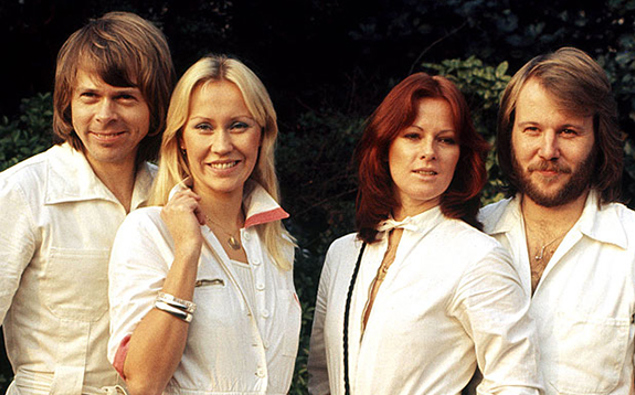
ABBA was made up of four members. In the the above image, from left to right: Björn Ulvaeus, Agnetha Fältskog, Anni-Frid (Frida) Lyngstad, and Benny Andersson. Agnetha and Frida took the lead vocals, Björn and Benny wrote the songs, and Björn also handled the lyrics. None of them speak English as a first language.
They all have native-level proficiency in Swedish, but they learned English as a second language. Before beginning their careers as ABBA, they had their own separate musical careers in Sweden where they sang primarily in Swedish. ABBA decided to sing on English because there was no future for an international band that song solely in Swedish (Palm, 2002)
Björn and Benny wrote the music together, but Björn alone handled the lyrics. Early on, their manager Stig Andersson assisted with lyrics and song titles, and Benny pitched it now and then, but it quickly became clear that Björn was best suited to writing lyrics: "When an English version of the lyrics were needed, Björn, who was by far the better English-speaker, would have the main responsibility, and that's the way it had been from the start. 'It came much, much easier to me than to Stig, who hadn't studied English as much in school, and was also of an earlier generation'" (Palm, 2017).
Being a second-language speaker of English meant Björn faced additional hurdles to songwriting: "That is our major problem - we're not born with English and don't have it as our first language," Björn admitted to an American reporter in 1974. "The phrasing has to be right so that it doesn't sound like you try to put something in that doesn't belong there. Nobody has complained so far, but it's our major problem" (Palm, 2017). As ABBA became more popular, the lyrics and even pronunciation came under additional scrutiny - but some critics took it too far.
The foreignness of ABBA's English has often been exaggerated for comic effect, or to denigrate them by suggesting that they are not as involved in the musical process as they claim. In truth, ABBA took pronunciation seriously. You can even see in some of the handwritten lyrical notes they used in the studio that they marked up the lyrics with pronunciation notes.
Original lyric sheet for "One Man, One Woman" featuring lyric changes by Björn as well as pronunciation notes by Frida. Notice the diaresis over "woman" to mark that the pronunciation is 'eh', not 'ah'. The pronunciation for 'live' is also clarified by writing an 'e' over the 'i' and crossing out the 'e', probaly to distinguish the pronunciation from 'live' as in 'live music.' Source: ABBA: The Complete Recording Sessions by Carl Magnus Palm
Because ABBA did not pick up English as a native language, they had to learn it as a second language - and with that came interference from their native Swedish. Swedish and English have a noticeable overlap in vowels and consonants, which goes a long way towards helping Swedish speakers sound closer to how native English speakers sound. But the overlap is not perfect, and they are missing vowels and consonants that appear in English. Sounds that are similar may also not be 100% the same, resulting in a pronunciation that's 'good enough' when heard over a low-fi AM radio, but unusual with high-quality headphones.
ABBA's accents also came through when they sang and spoke live. This is to be expected - ABBA owned their studio, so they could record as many takes as they wanted without having to worry about money or time. When performing live, you only have one take, and you are in a much more excitable environment than the calm, sterile atmosphere of a studio. With that said, let's take a look at how ABBA's English was influenced by their learning it as a second language:
The vowel in STRUT /ʌ/ is moved towards [a]. Swedish does not have an [ʌ] sound.
"Still my w[a]n and only." - My Love, My Life
No /z/ sound. Swedish does not have [z], so the nearest sound is [s].
"Where they play the right mu[s]ic." - Dancing Queen
No 'zh' /ʒ/ sound. Swedish also does not have [ʒ], and the nearest sound is the 'sh' sound [ʃ].
"Disillu[ʃ]ion" - Disillusion
The short 'oo' sound [ʊ] is sometimes [u]. Short 'i' is also sometimes fronted towards [i].
"You sh[u]dn't be so mean." Me and I
"It used to be so g[u]d." - SOS (Live at Wembley)
"They got the l[u]k in their eyes." Dancing Queen (early version)
"G[i]vin' love is a reason for l[i]vin'.
The /j/ sound in Swedish has a buzzy, fricated quality to it. ABBA sometimes carry this over into English.
"She's pushing [j]u around." - The King Has Lost His Crown
"We were [j]ung and full of life." - Fernando (Live)
The vowel in TRAP sounds like the 'eh' vowel in DRESS. Although Swedish does have an [æ] sound, it only appears in certain situations, and the next closest sound available is [ɛ]. The ABBA singers usually use an [æ] sound, but on occasion they use an [ɛ].
"In my fl[ɛ]t all alone." - Gimme! Gimme! Gimme! (A Man After Midnight)
Spelling pronunciations. Swedish spelling is more straightforward than English spelling, and it does not have many 'silent' consonants.
"No more [tʃ]ampagne." - Happy New Year
"I'm not a c[o]ward." - I Wonder (Departure)
"They say my w[o]und will heal." - Disillusion
"Clim[b]ing the apple tree." - Me and Bobby and Bobby's Brother
"It doesn't really b[v]ther you if this boy cries" - I Saw It In The Mirror
Non-standard grammar, or unidiomatic usage. This is more prevalent in their demos.
"Since many years, I haven't seen a rifle in your hands." - Fernando
"I'm down and I feel depressed, sitting here just waiting for next bus traveling downtown. It's a crying shame. Isn't it a beautiful weather?" - Free As A Bumblebee (Demo)
"Now I see you've broken a feather." - Chiquitita
"There's not, I think, a single episode of Dallas that I didn't see." - The Day Before You Came
American or English?
There are two major standards of English in both number of speakers and cultural power - English based on 'Received Pronunciation,' a prestige form from the United Kingdom; and General American, based on a variety of English spoken in America that is seen as 'region-free.' In Sweden, English textbooks and classes use UK English as the model for learners. However, the incredible cultural reach of American music and film means that Swedish speakers also have tremendous exposure to American English, and this is especially true for the generation born during and after the Second World War.
The increased availability of American media and English-language media in general meant that English became seen as a cosmopolitan language allowing access to the world beyond the borders of a then-ignored Scandinavian country. The Swedish language itself lost prestige, as Palm notes:
Björn's generation was perhaps the first that had grown up surrounded by English being spoken and sung, through 1950s rock'n'roll and then 1960s pop. For those born in the 1940s, English became the "cool" language, whereas for most in Stig's generation (he was born in 1931), Swedish always came first. Generally speaking, they wouldn't have romanticised the English language and all its connotations to quite the same extent as those who were 10 or 15 years younger. Not least importantly in Björn's case, he was the only ABBA member who'd gone on to senior high school, and had studied not only English but German and Spanish as well. (Palm, 2017)
Being inundated in both American and UK English meant that ABBA were aware of different possible pronunciations. For the most part, they made the choice to go with General American English in their music. However, they didn't play it straight - they also added in some features of British English.
Unlike many other artists of the time, ABBA avoided using aspects of African American English. This is not out of some sense of national or racial chauvinism - the members of ABBA were clearly aware of Black American music, and tried making songs in that vein on their earlier albums. These r-and-b attempts were, at best, cute, but they failed to live up to the artists they were cloning. A similar attempt at breaking into rock music, which was more in the Anglo-American vein (with appropriated Black language and culture) also failed, as audiences and critics alike weren't interested in their attempts at swagger. Their most successful forays were into pure pop, informed by their love of Swedish folk melody. Beyond the occasional flattening of 'I' to 'ah' and turning 'crazy' into 'crazih', ABBA did not use African American English - a fact that did not go unnoticed.
Variably rhoticism. ABBA mostly pronounce their R's, but will switch to a non-rhotic pronunciation when it's useful for a rhyme.
"In the night, a new day dawning and the f[ɜ]st b[ɜ]ds start to sing. In the pale light of the m[o]ning, nothing's worth remembering" - Summer Night City
COT-CAUGHT distinction: very noticeable in British English, more subtle in American English of the 70s, and increasingly disappearing from modern American English.
"From the first moment I s[o] you" - Love Isn't Easy (But It Sure Is Hard Enough)
"And I th[o]t" - Angeleyes
"In the night, a new day d[o]ning and the first birds start to sing. In the pale light of the morning, nothing's worth remembering" - Summer Night City
ABBA usually lacks the TRAP-BATH distinction, going with an American [æ] for both sets of words. The only exception is when a rhyme requires it in the song "I Let The Music Speak."
"Hiding their shame behind hollow l[æ]ghter." - Cassandra
"Let it be a f[a]ce if it makes me laugh." - I Let The Music Speak
They don't consistently distinguish between the MARY-MERRY-MARRY words the way an RP speaker would.
"I'm C[e]rri not the kind of girl you m[e]rry, that's me." - That's Me
"And your name is H[æ]rry." - Our Last Summer
Mixed RP and GA specific pronunciations.
"They all worship me and pay their [h]omage." - I Am The City
Varying realizations of words. These are not based on any accent, but selected for rhyme and euphony. For example, ABBA uses a 'u' sound in 'sure' in one of the early songs. This pronunciation is relatively conservative and likely to have been taught in schoolbooks. In a later song, they use the more common 'shore' pronunciation and even rhyme it with 'more'.
"Love isn't easy, but it s[u]re is hard enough." - Love Isn't Easy (But It Sure Is Hard Enough)
"Are you s[o] you wanna hear more?" - That's Me
Sung in Spanish
ABBA has recorded in multiple languages besides English. They've made a handful of official releases in their native language, Swedish. They've also done a few recordings in German and even one in French. But the non-English language they most recorded in was Spanish. After a Spanish-language version of Chiquitita was released to great success, ABBA began recording more songs in Spanish.
Their Spanish also shows signs of Swedish interference, and it is more noticeably non-native. Some examples follow.
/p/, /t/, and /k/ are aspirated
In Swedish and English, the sounds 'p', 't', and 'k' are accompanied by a little puff of air afterwards. In Spanish, these sounds are never aspirated. Agnetha and Frida seem to inconsistently aspirate these sounds.
"Yo pʰor tʰi me engane hace tʰiempo lo se" (I was cheated by you a while ago, I know it) - Mamma Mia (Spanish)
/e/ is raised
One noticeable L2 feature in their Spanish is their pronounciation of the sound 'e'. In Spanish, this sound is made in the center of the mouth. See the following vowel chart:
In Swedish, you'll notice that there are two vowels that are in that area, /e:/ and /ɛ/. Which one will ABBA use?
It turns out that they decide to go with the higher one. To a Spanish speaker, ABBA's 'e' vowels in Spanish sound like a short 'i' or even a long 'ee'.
"Donde se fu[e]?" (Where did it go?) - Hasta Manana
Taps and trills are not distinguished
Spanish has two contrasting 'r' sounds: 'r' and 'rr'. The single 'r' is pronounced as a tap between vowels, sounding like American English 'butter'. 'rr' sounds like a trill. If 'r' is at the beginning of a word, it is pronounced as a trill. In other positions, 'r' may be a trill or a tap.
Swedish has one r sound, and it can have multiple different forms. The important thing is that there is no meaningful distinction between the tap and the trill in Swedish. In Spanish, "caro" (expensive) and "carro" (car) are distinguished solely by whether the middle sound is a tapped or trilled 'r'; there is no situation like that in Swedish.
It seems that Agnetha and Frida had trouble remembering the rules, and defaulted to a trill. This is not surprising, as the trill is both more common in Spanish and in Swedish.
"Veras que el futurro" (You'll see that the future...) - Yo Lo Sone
"Te sabre esperrar" (I'll know how to wait for you) - Hasta Manana (Spanish)
Which Spanish?
Another interesting aspect of their Spanish is that they seem to change the model. For example, 'll' is a sound that varies widely in the Spanish speaking world. Some speakers pronounce it the same as 'y', which is a /j/. Some speakers from Spain pronounce it as a /lj/. And speakers from Argentina may pronounce it as /sh/. ABBA have used all three pronunciations.
The earliest song they recorded in Spanish, Ring Ring, uses the /j/ pronunciation.
"[j]amame al fin por favor" (Please, call me already) - Ring Ring (Spanish)
They then recorded "Chiquitita" in Spanish. After the success of this single, they also recorded "I Have a Dream" in Spanish. Chiquitita uses a harder version, while Yo Lo Sone uses the 'sh' pronunciation typical of Argentina.
"En mi hombro aqui [J]orando" (Here on my shoulder, crying) - Chiquitita (Spanish)
"Y [sh]egare" (And I'll arrive) - Yo Lo Sone
Once the success of the Spanish model was clear, Agnetha and Frida embarked on the journey of recording a large number of songs in Spanish. These use the Spain /lj/ pronunciation. Once this mass of Spanish songs were recorded, ABBA recorded four more Spanish songs: two for the release of Super Trouper, and two for the release of The Visitors (Palm, 2017). These songs songs varied in their usage of /j/.
"Estre[lj]aciones" - Fernando
"Bri[lj]as con plenitud" (you shine with plenty) - La Reina Del Baile
"Risas, [j]antos" - Conociendome, Conociendote
ABBA uses the velar fricative [x] for Spanish words with 'j', which is standard for Mexican and Spain Spanish. Caribbean varieties use a softer, English-like 'h' instead.
"La ve[x]ez llego" (Old age came) - Fernando (Spanish)
Cultural Analysis
English Parochialism
Perhaps even more impressive, in 2010 the group overcame considerable musical and cultural handicaps to be inducted into the Rock and Roll Hall of Fame, an American institution that's always been heavily geared towards acts from the U.S. and the U.K. "I didn't think this would happen, because we were a pop band, not a rock band," the group's Benny Andersson was quoted as saying in Rolling Stone. "Being a foreigner from the North Pole, this feels really good." (Vincentelli, 2011)
Björn recently pointed out, "We were not taken seriously: one-hit wonders, here today, gone tomorrow - 'This is something we dismiss, these strange, exotic Swedes.' It was difficult to cope with it. It wasn't like that in Germany or other places on the continent, but it definitely was the attitude in America and England. British music journalists were especially vitriolic, almost hateful: 'Go back to your bloody country in the north!" (Vincentelli, 2011)
A 2002 interview, American singer Dionne Warwick admitted, “I watched ABBA on TV during
their breakthrough. Their English wasn’t good so I thought they were adorable."
ABBA was popular throughout the world, including the US and the UK. Those two countries also produced the most scrutiny regarding their nationality.
A listener in Japan or the Soviet Union or Germany won't speak English as a native language, and will be less able to judge whether Agnetha and Frida's accents were native-like, or whether Björn's lyrics were idiomatic. The listeners may not even speak English at all, and just enjoy the sound of the melody. This is how Björn and Benny got their first exposure to English music, after all (Palm, 2002).
Native English speakers, on the other hand, do have a strong command of English and are sensitive to accent and sentence construction, as well as the lyricism. No doubt that their ABBA's simple lyrics, especially in their first four albums, seemed to be begging to be dismissed as foreign speakerese. Few ABBA fans are bold enough to defend lyrics like "She used to follow us in school, we really thought that she was a little fool."
Björn himself said he didn't pay much attention to the lyrics when he began writing them, focusing on meeting a bare standard of grammaticality and a pleasing sound to the ear: "It was far more important [in the 1960s] for a song to have been written as 'pop music in English' than to utilize the correct grammar or any real sense of logic, commitment, or significance" (Vincentelli, 2011). It was only beginning with the "Arrival" album that Björn tried to take songwriting more seriously, and "The Album" showed a maturation of his writing style.
The early, sillier song lyrics would dog ABBA for the rest of their career. The criticisms were sometimes fair, but often tinged with essentialist arguments about how non-native speakers can't really understand English lyricism, or were just mindlessly babbling. Even positive reviews excused the weaker lyrics as second-language problems:
What certainly served them well in smaller international markets may have detracted from early success in the U.S. and the UK. Some critics, such as Peter Hackman, felt as though ABBA’s members were unable to properly pronounce their own English lyrics, that ‘‘they [were] completely insensitive to the energetic rhythm of English language.” The Swedish band’s eager effort to sing in a variety of non-native languages calls into question the xenophobia that surrounds American and British assessments of the musicians’ occasional semantic missteps. Source
Ken Tucker in Rolling Stone: "Arrival is Muzak mesmerizing in its modality. By reducing their already vapid lyrics to utter irrelevance, lead singers Anni-Frid Lyngstad and Agnetha Falstkog are liberated to natter on in their shrill voices without regard to emotion or expression, and the language barrier is broken." (Vincentelli, 2011)
"... Those of us who love Abba do so because the band is about as pure an example of smart/dumb pop imaginable. Significant rock is all well and good, but there is always a place for pop music that is fun. Most of Abba's past hits have been unadulterated pop, with lyrics - written in English by Swedes who've always had a slightly quaint conception of English syntax and pronunciation - that operate at the most basic level of childish/adolescent fantasy." Review of 'The Album' by John Rockwell, from Vincentelli, 2011.
The attitude is encapsulated in the following segment from the British parody show 'Not the 9 o clock news.' They make fun of ABBA for their simple but repeated song titles, "wholesome" image, and "poor" English:
Two of us write music, two have way a song
Sorry in translation, that line come out wrong
[...]
The world is just a great big stage
Each man plays his part
In this concrete jungle, my sleeve is on my heart
On the beaches we go swimming in the nude
Oh how I wish now and then that we could sing something rude
Super duper, super duper, its a super duper refrain
So we thought how super duper to sing "super duper" again
ABBA's supposedly bad English was played up beyond what the evidence holds. What people called 'ungrammatical' was more often than not just weird phrasing or word choice. There is nothing ungrammatical about a phrase like "I feel like I win when I lose" or "come on, I'll give you consolation." Some other rumors regarding ABBA's craft I've been told:
ABBA were supermodels hired to mime pre-written pop songs (!)
These conspiracy theories were more likely to be spread by DJs and random people than serious critics, but they show an attitude of disbelief regarding the authenticity.
Moreover, the idea that the members of ABBA sounded like the 'Swedish Chef' character is promulgated by revival acts, such as Björn Again. (Disclosure: I've been to a Björn Again concert.) Part of the experience of going to see an ABBA revival band is in playing up the Swedish nationality, and too often by making their English sound far more cartoonish than it actually did. An ABBA fan writes as to the ubiquity of these bad Swedish accents in revival acts:
Open Letter to ABBA Tribute Bands
I’ve recently had the opportunity to see “ABBA Gold,” one of several ABBA tribute acts that I’ve had the chance to see over the years. While I certainly consider ABBA Gold to be one of the better ones I’ve seen, I’ve also seen some bad ones and just wanted to highlight some of the good and bad things I’ve seen at all these various tribute performances that I’ve seen in hopes that your shows can be improved.
1. Fake Swedish accents.
We know ABBA is from Sweden and their speaking English is slightly accented, but most tribute act performances take their fake Swedish to the extent of the Swedish Chef from the Muppet Show. This is completely unnecessary. Most of your audiences will only have casual knowledge of ABBA being from Sweden so it’s not necessary to use a fake Swedish accent when speaking to the audience. All it does is irritate the most diehard ABBA fans and it adds a “cheese factor” into your tribute performance that makes it feel more of a parody than a tribute.
The best tribute band utilizing a Swedish accent that I have seen is “ABBA: The Music” but that’s because they are really from Sweden, their accent is real, not fake. If you must employ a Swedish accent to channel ABBA for your performance, at least buy a couple of the CDs from the ABBAMAIL web shop that have interviews with the members of ABBA so you at least know what the real members of ABBA sounded like when they talked. - Ryan, ABBAMAil, April 2005
And Björn himself found the exaggerated accents less than flattering:
And what does he think about Björn Again, the fake-ABBA’s from Australia, carrying his first name, who are so successful?
“I’m flattered in a way, but I’m astonished that people are willing to pay money to see that group. What I like less is that they are copying us with an accent that reminds one of the Swedish cook from the Muppet Show. Now, I don’t have an accent like that, do I? Other than that I don’t object, although I only know them from television.”
Source
ABBA's foreign accents weren't always played negatively, though. At least some fans seemed to view them as part of artistic effect:
And in the second verse [of the song 'Me & I'] Frida brings forward the Swedish accent, uses it to make the verse sound even more edgy and challenging. I'm not sure if it's my ear, but sometimes I think Swedish and some Eastern European accents of English sound like hard steel spikes puncturing the flow of the language. And these accents can, if they are used in the right way, make the speaker sound slightly edgy and not really with "all bolts fastened properly". (Think crazy Russians in 80:ies cold war movies!) The vocoder and that accent goes together perfect, strengthening the effect of each other. Making it really spicy!! I might be reading in too much here, but this is how I hear Frida. She's using the accent to emphasise the lyrics about freakish behaviour. - Linda Grandqvist, Swedish ABBA Fan, ABBAMail
Race and American Music
ABBA made what one may call 'pure pop' or 'bubblegum pop' music, which is a label that is more useful in pointing out what something is not than what it is. ABBA dabbled in rock, rhythm and blues, and even reggae, but for the most part, their music was not in these genres nor was their influence directly felt. 'Pure pop' can perhaps be defined as pop music that lacks influence from genres created by Black Americans, such as the three R's mentioned earlier. This is always context-dependent, of course: by the 70s, rock was recontextualied as a white Anglo-American phenomenon. Music being made by Black Americans can vary in how 'Black' it is considered to be: the Supremes was made of three Black women, but their style of music appealed to white audiences. For the most part, ABBA's music followed the vein of light 60s pop, pre-Beatles seriousness.
The decision to avoid the self-seriousness, sonic experimentation, and introspection associated with other white acts made ABBA a target for accusations of frivolity. Their decision (or lack thereof?) to not draw from the Black American tradition drew some attention. Noted music critic Robert Christgau lambasted ABBA for embodying "late capitalism" and "aversion to singing like Negros," two characteristics that were somehow linked.
It is hard to imagine a music critic today complaining that white artists don't draw enough from Black musicians, let alone copying their pronunciation, but the cultural dialogue of the 70s was quite different from today's. Christgau was drawing a line between ABBA's conceptualization as a product for mass white America, and their failure to cross a racial boundary. Arguments about segregation were still fresh in the minds of Americans. Some people idealistically thought that white musicians using Black musical forms would succeed in breaking down racial barriers and hasten the end of racism. Not all people thought this (and certainly not all Black people), but it was a cultural idea that informed this critique of ABBA.
The Sweden the members of ABBA grew up in was racially (though not ethnically) homogenous. It is hard to estimate how many Black folks lived in Sweden, but here is one statistic: in 1960, the population of Sweden was 7 million, and the number of immigrants from Africa was 596. Some Black folks from America moved to Sweden, but it's hard to find hard numbers on this. Of note is Lotte, a Black singer from Brooklyn who moved to Sweden, formed a musical act with Svenne, and was signed to Polar, the same label as ABBA. Björn and Benny wrote songs for them, as they did for their other labelmates. People like Lotte are an exception in an overall rather white country.
Neither Björn nor Benny seem to recall hearing Black musicians like Chuck Berry played over the radio when they were children (Palm 2002) (though Benny backtracks on this in later interviews, see Vincentelli 2011). They instead heard white singers like Elvis and Connie Francis. This means they did not have direct exposure to Black English, only to white Americans imitating it (or not imitating it at all). Why did Swedish radio stations not play Chuck Berry? No explanation is given in the definitive ABBA biography Bright Lights, Dark Shadows. It may be that white singers were signed to labels that were able to create distribution deals in countries like Sweden and Black singers weren't. There were racist attitudes in Sweden and broader Scandinavia against Black people (Weisbord, 1972), which one speculates may have influenced which records DJs played. The point is that during a critical period of musical identity formation, ABBA were not exposed to Black singers the way white Americans were. As a result, their sung speech sounds more white American (versus white British).
After the experimentation on their first three albums, ABBA stuck to the pure pop template. It is what got them the most sales and acclaim. Although ABBA always wanted to do more rock-type music, it seems to have fallen on its face. "So Long," an underappreciated single, was an absolute disaster in the UK, and it took the immaculate pure pop "SOS" to steer their career back on track. ABBA didn't make a serious attempt at engaging with Black-created musical forms again until 1979's "Voulez-Vous," when they tried to adapt their sound to be more modern. (What alternative did they have, punk?) This was already quite late in the lifetime of disco, such that it had become less distinctly Black. For context, ABBA released "Voulez-Vous" in April of 1979, and the 'Disco Demolition Derby' happened a mere two months later in July of 1979. Their final two albums stuck to various flavors of synth-pop. Overall, ABBA's cautious relation towards Black music and language separated them from other white mainstream acts.
Swedes Go Cosmopolitan
In the linguistic analysis, we saw that ABBA split their English: non-rhotic American English for singing, Received Pronunciation when speaking. Why would they sing in American English when they were taught British English? The obvious answer is that the pop music that influenced them was American, or American-imitating, and this formed their mental template for what pop music should sound like. But we would be remiss if we didn't point out that there may have been a commercial aspect as well. Sounding 'neutral' meant you didn't stick out. You could have some non-Americanisms - the Beatles, after all, kept many of their Liverpool features. But sounding unapologetically English simply wasn't done in the international pop sphere. Choosing American English was a safe bet.
Regardless of how listeners perceived it, English language was an important vehicle in the band’s early stages of recognition. As Simon Frith and Peter Langley wrote in a 1977 article in Creem magazine, Rock is an essentially Anglo-American enterprise, and most other countries do have their rock groups. ABBA, by entering the Eurovision Contest, made clear they weren't one of them.
ABBA's aim towards global domination got them some consternation. I recall reading an English newspaper that blasted ABBA for their "pseudo-American accents." ABBA's mix of American English with RP non-rhoticity, as well as their second-language flavor, made them sound as if they belonged to no group for some people, like these posters.
Hey Nude Spock, it was me who said that when singing accents are lost (and it was me who said American ones were unsexy too). Now, there are definitely some people who sing with an accent. I was listening to Carole King today and she sings with a major American accent. But then bands like Aqua & Bjork & Abba & anyone Japanese don't sound American (even when they are trying to) and very few English and Australian and NZ bands do either. - toraneko, 2001. (emphasis mine)
Abba do a very convincing job of singing in the mid-Atlantic accent favoured by British performers of modern popular music. This was developed as a concession to the predominance of the USA in the 1950s and established itself as the norm from the 1960s onwards. 'Wahderloo' now sounds fairly natural to a British ear. However, I have no idea what the Americans think when they hear it. - Lancashireman, 2010.
I did not know they were Swedish for quite a long time! Having been used to lots of accents from Anglo-Indian to various American and Canadian to a range of northern and southern British... I could not place ABBA, but that did not worry me. - Christine Andersen, 2010.
They sound mid-Atlantic to me. Not pleasant. Harsh, flat, without inflection, pronounced as though a machine were speaking English. But does it really matter all that much how Abba sounds? Should I be lying awake at night worrying about this? - Tom in London, 2010.
Finally, ABBA's music and career always had an international bent. The name 'ABBA' was selected because it "had no specific connection to any one language or culture" (McMullen, 2019) and "sounds right in as many languages as possible" (Palm, 2002). Additionally, their earlier song titles were also chosen for sounding good in multiple languages. For their first four albums, their manager Stig had a hand in suggesting good song titles. They ventured into singing in German and French before recording a Spanish album late in their career. Their use of language melded with their international, almost universalist ambitions.
"I was looking for a word that wouldn't need a translation, something that everybody would be familiar with... I needed a three-syllable word that would fit the melody." - Stig Anderson on 'Waterloo'. (Palm, 2002)
"In an artificial world of neon, Abba appeared onstage and disappeared in the same way. Afterwards these four people seemed just as unreal and elusive as the smoke that stayed behind at the stage....A perfect show with well-directed spontaneous laughter and musicianship. Nothing personal that could disturb Stig Anderson's consummate hit products.... The songs are built on simple harmonies and multinational repetition... "I love you," Abba sing and point towards the audience. But it's a lie. Abba don't love us. They love the 20 kronor they can steal from us when we've been swept away by the Abbamania and lose our grip on reality for an hour." Reviewer for ABBA concert. Quoted in Palm 2002, 268. From McMullen, 2011. Emphasis mine.
One the one hand, ABBA was too international, but on the other their English was not good enough. Would not poor English pronunciation be a good thing and make ABBA less of a vehicle for the international music industry and more of a Swedish group? There seemed to be no limit as to what one could accuse ABBA of: Composer Jan W. Morthenson even referred to ABBA as ‘‘a totalitarian culture’’(Morthenson 1977a). But English was important for ABBA. It was an important vehicle for international success. During the Brighton contest,they performed ‘‘Waterloo’’ in Swedish during the competition—as prescribed by the rules at the time—but had prepared an English version in case they won and were given the opportunity to perform another time on stage (Broman 2005, p. 52)
As mentioned above, ABBA was sometimes seen as not American or English enough to truly appeal. At the same time, their American-ness was trotted out when ABBA needed to be perceived as an international evil by leftist Swedes. ABBA's use of language was ambiguous enough to support whatever interpretation of them you wanted to.
Thank You For The Music
So “when all is said and done,” what was ABBA’s linguistic legacy? And how did it fit in with their image?
Both leftist Swedish music critics and Anglo-American rock critics agreed that ABBA was ‘too commercial,’ but they had different bases for their claims. The ‘proggers’ (leftist music critics) saw ABBA as making disembodied, international messageless music. The rock critics saw ABBA as foreign mindless babblers selling sonic candy floss. Both agreed that ABBA was nothing but a money-making machine, sure to fade as soon as possible.
To some extent, the ABBA circle internalized some of these messages. Björn certainly felt inspired to step up the lyrics starting with their fifth album. And even musically, the group felt they needed to prove they could hang with the big dogs on account of not being Anglo-American:
"They were very confident about 'Dancing Queen' because that was a really good piece of music," [their recording engineer] Tretow, a master of understatement, said. "It was so together, and the swing and the feel to it was different from everything they did before and after. We used 'Rock Me Baby' as a guide for the feel of the swing. We're Swedish and that's quite different from being American or English - because we weren't brought up with that music. We had to make our own; it wasn't natural." (Vincentelli, 2011) Emphasis mine.
At the same time, it was hardly an albatross. Indeed, the members of ABBA took pride in not being from the UK or US, and some critics saw it as a much-needed shakeup in the pop scene.
In a 1978 article for The New York Times, John Rockwell observed that "ABBA represents a healthy challenge to the two-decades-long dominance of Western pop music by Britain and the United States. The musical context from which ABBA evolved is that of so-called Euro-pop - a flossy, bouncy, sometimes triumphantly silly fluff-music that derives not from the urgency of American blues (the source of rock) but from older forms of European folk music."
"Maybe that's another reason ABBA still exists," Benny mused recently. "We come from Sweden and we were raised on music that was not just Anglo-Saxon. We listened to Chuck Berry, Little Richard, the Beatles, the Kinks, and all that - at the same time that we had [bandleader and composer] Hugo Montenegro and [strings arranger] Mantovani, German schlager, Italian songs and French chansons. It all comes to you and probably stays there. If you grow up with three chords and only Little Richard and Elvis stuff, and you continue in that spirit, it will limit you. But if you grow up in a country like Sweden, with all this stuff from France, Italy, German, Denmark, along with England and America, together with classical music and folk traditional music, it keeps your possibilities open." (Vincentelli, 2011)
By now, you've noticed that we've spent more time talking about how ABBA was perceived than what they intended to do. This is by design: the members of ABBA were notoriously private for being part of such a popular group. They didn't appear in the press for scandals (Vincentelli, 2011). They rarely spoke about what their songs meant, who they were for, or their inspirations while writing them. This gave everyone else space to project their own cultural anxieties and expectations on to them.
This was aided along by ABBA’s ambition to universal appeal. Per McMullen, ABBA “sought to avoid what they considered the ‘particular,’” such as “ethnic sounds.” With the exception of the Swedish folk-influenced track “Arrival,” ABBA stuck to radio-ready pop. Their international commercial ambitions wouldn’t allow anything outside that mold. A great example is the demo track, “Hamlet III.” It is obviously influenced by Swedish folk music, particularly the “schottis.” But it was too much a schottis, and Benny and Björn felt the track didn’t work as a pop song, and it was shelved until Benny released an accordeon-only version on his own folk album decades letter. Avoiding the “particular” indeed. This also influenced ABBA’s reputation as "some of the brightest whiteness pop has ever known", per Barry Walters (McMullen 2019).
Combined with their desire to reach as many audiences as possible by singing in different languages and using language-agnostic names, it is perhaps inevitable that ABBA became a blank screen ready for projection. “Because it was so visible, perfect, delineated, and vacuous, Palm suggests ‘the audience could spin their own fantasies around Abba's slightly unreal, almost too perfect appearance’” (McMullen, 2019).
But this seemingly formless outreach had a bright side, too: ABBA’s music reached a broad swathe of the public that had perhaps never felt represented by Anglo-American rock. They showed it was possible to make great, international pop music without being American or English – or even speaking English as a first language. They showed you didn’t need to conform to rock critic sensibilities to touch people. They showed it’s okay to have fun and dance through the tears, even if everyone else think it’s cringe – a doubtless factor among ABBA’s decades-long popularity with LGBT listeners.
In the comments section of entertainment writer Owen Gleiberman’s July 2018 Variety article titled “The Secret Majesty of ABBA,” one fan speaks to the dual effect of the band’s unapologetically-European sensibilities: I am an Asian American growing up in Europe and I remember so well, after the ‘Eurovision Contest’ in 1973 [sic], ABBA was loved and appreciated by all European people. Unlike the Beatles, or the Bee Gees, ABBA sang songs not only in English, [but] also in Spanish, French, Italian and their native tongue Swedish.
From our modern perspective, the idea that an all-white group of heterosexual musicians could, in any way, be 'outsiders', may seem nonsensical. But pop music was so homogenous in the 60s and 70s that a group coming from Sweden was seen as both threatening and laughable. ABBA reflected an international approach to music that didn't center American and British tastes: a tiny crack, but a crack nonetheless. The rest of the world is here, and the US and the UK no longer have sole control over the musical discourse.
Hey Nude Spock, it was me who said that when singing accents are lost (and it was me who said American ones were unsexy too). Now, there are definitely some people who sing with an accent. I was listening to Carole King today and she sings with a major American accent. But then bands like Aqua & Bjork & Abba & anyone Japanese don't sound American (even when they are trying to) and very few English and Australian and NZ bands do either. - toraneko, 2001. (emphasis mine)
Kim Petras: L2 English, California Dreamin': Like the members of ABBA, Kim Petras speaks English as a second language - and still has a thriving career as a pop singer. Compare how Kim chooses different models of English that better suit her desired genre.
Dialect Dissection: The Beatles and Regional Identity: One of the most famous rock bands of all the time, with an accent nobody expected. Read about how the Beatles countered common expectations for how a rock band 'should' sound - and how the UK and the US reacted.
Most video games with voice acting go in one of two directions: using General American accents as a default, and using Received Pronunciation for fantasy settings or for upper class characters. The 2017 game Xenoblade Chronicles 2 bucks this trend entirely and features one of the most diverse collections of accents in a video game. Most remarkably, it does this while also avoiding the stereotyping that usually accompanies accent use, resulting in positive representation for most accents.
The original Japanese version of Xenoblade Chronicles 2 was homogenous in accent use, which means that the decision to use different accents was made during localization. Why would the localization differ so drastically on this issue, when it could have done the much easier job of securing actors that all come from one country and have the same accent? And how did people react to having a game where the protagonists had accents drawing from Manchester, Wales, and Scotland?
Xenoblade Chronicles 2 presents an excellent case study for a number of things: learning to distinguish between different major English accents; understanding the social contexts that result in linguistic prejudice; market decisions that support or suppress differing linguistic voices. We're also going to take a short look at the game's predecessor, the original Xenoblade Chronicles, and how that game's unusual history paved the way for our polydialectal protagonists.
Xenoblade is a video game series developed by Monolith Soft. They are spiritual successors to the Xenosaga series and the Xenogears game, which came out on PlayStation consoles. The Xenoblade games are available exclusively on Nintendo consoles. The first Xenoblade Chronicles tells the story of a world where the only two landmasses are two giant, immobile humanoids, and all life lives on these two beings. The protagonist, Shulk, is on a quest to avenge his hometown after it is attacked by mechanical creatures from the other humanoid landmass.
Xenoblade Chronicles 2 is loosely connected to the first Xenoblade Chronicles. In this world, there are multiple giant beings called Titan, and people live on them. The groups of people living on each Titan have their own cultures, politics, and - in the English version - accents. The protagonist, Rex, is on a quest to help his newfound friend Pyra reach the mythical land of Elysium, to solve the problem of Titans dying off.
It's not necessary to be much more intimately familiar with the plot than this, and I will avoid story spoilers if you are in the middle of playing these games.
A Tour of Accents
Southern England English
Most of the cast of the first Xenoblade Chronicles game speak in Southern England English. This is distinct from Xenoblade Chronicles 2, where each world has a distinct variety of English. Some characters, like Shulk, may sound more posh than other characters, like Fiora, but overall they stay within the range of Southern England English. Both heroes and late-game villains speak in a middle-class variety of Southern England English.
In Xenoblade Chronicles 2, the people of Tantal, the people of the historical nation of Torna, and the race of small furry bunny people called Nopon speak in this accent.
Examples of Southern England English
Non-rhotic: Like most English accents in England, Southern English does not pronounce historical 'r's after vowels.
"The fut[ə] doesn't belong to you!"
If a word ends in a vowel and the next word starts with a similar vowel, Southern English lets you insert an intrusive r to make the difference between the words clearer.
"Protect Melia-r-at all costs!"
Southern English English, and many other varieties of English English, have a three way vowel distinction between BOTHER /ɒ/, SPA /ɑ/, and THOUGHT /ɔ/. An American may use the same vowel in "monado", "mechon", and "law" ([ɔ]) but most Englishmen will use a different vowel in each: "monado" ([ɑ]) "Bionis" ([ɒ]), and "awesome" ([ɔ]).
"The Mon[ɑ]do... Bi[ɒ]nis and the Mech[ɒ]nis. That's [ɔ]some!"
"But it's starting to look like the mon[ɑ]do might be something far more significant than just a weapon for defeating Mech[ɒ]n."
"I really th[ɔ]t I'd l[ɒ]st you back then."
The TRAP-BATH split: In Southern England, words like "bath," "can't," and "laugh" are pronounced with the vowel of SPA instead of the vowel in TRAP.
"This is my ch[ɑ]nce! I c[ɑ]n’t see it clearly."
The HURRY-FURRY distinction: North Americans tend to rhyme HURRY and WORRY, but these are two distinct sounds in most English English, with HURRY having the 'uh' sound of STRUT.
"I'm more wuh-ried about you than the shell."
FEEL-FILL merger: Younger varieties of Southern English English pronounce 'feel' to sound like 'fill.' A similar merger is also occurring in white Southern American English and African American Vernacular English.
"The breeze f[ɪ]lls so good."
GOAT-fronting.: In Southern English English, the "oh" sound is made with the tongue pushed more forwards than in other varieties of English.
"[əʊ], the defense force colonel."
No yod-dropping: American English has a 'doo' in words like 'duty,' but English English preserves a 'dy' sound, so 'duty' sounds like 'dyooty.'
"I take this chance to bring vengeance to my brother and fulfill my d[j]uty."
Cockney English and Lower-class London English
Cockney is a working class accent found in London. Quite a bit of Cockney could be head in the first Xenoblade game, most notably with the villain Bronze Face. Xenoblade 2 also had a little Cockney, with a minor enemy guard speaking in Cockney.
Cockney and Working-Class London English Characteristics
FLEECE-diphthongization: The 'ee' vowel /iː/, like in FLEECE, is pronounced as a diphthong [əi~ɐi].
"Professor Tatazo, sp[ɪi]k! Sp[ɪi]k, you give orders."
GOAT-centralization: The 'oh' vowel /o/ becomes 'au' [æ̈ʊ~ɐʊ], so 'hoes' sounds like 'house.' The vowel is more centralized than the Southern English English mentioned above.
"If productions get more sl[ɐʊ], maybe you ready for sleep time with fishes."
"Professor Tatazo, speak! Speak, you give [oʊ]ders."
STRUT-raising: the 'uh' /ʌ/ sound moves towards 'a' [ɐ̟].
"If prod[ɐ̟]ctions get more slow, maybe you ready for sleep time with fishes."
T-glottalization: Ts between vowels are replaced with the glottal stop [ʔ].
"I've been ge[ʔ]in hungry!"
H-dropping: h sounds, especially at the beginnings of words, are likely to be dropped.
"I've been getting 'ungry!"
PRICE-backing: The vowel in PRICE /aɪ/ is backed to [ɑɪ]. In more extreme versions, "price" can sound like "proise."
"He's r[ɑɪ]ght here . He's still al[ɑɪ]ve."
FACE-lowering: The /eɪ/ sound in words like 'face' and 'ate' are lowered [æɪ~aɪ].
"I [æɪ]te 'em all up."
Myself can be realized as me-self [mi].
"I just couldn't help [mi]-self."
L-vocalization: The l's at the end of words can become a [w].
"I'm not meta[w] face."
Cockney is on a continuum with other forms of London English, so some "Cockney" features also appear on characters that otherwise don't sound Cockney, like Reyn. Reyn displays h-dropping, t-glottalization, and other features of Cockney English, but he does not sound anywhere near as Cockney as Bronze Face does.
You can think of Shulk, Reyn, and Bronze Face as being on a continuum from 'very middle class' to 'in the middle' to 'straight-up Cockney.' They will all share certain features that are relevant to their region, such as non-rhoticism, GOAT-fronting, and a 3-way distinction between SPA, BOTHER, and THOUGHT. This distinguishes this group of 3 dialects from other region-based dialects, like General American English.
As you move from the 'very middle class end' towards the middle, you'll notice an increase in traits like h-dropping, t-glottalization, and PRICE-backing. At the Cockney end of the spectrum, the frequency of h-dropping and t-glottalization can increase.
Cockney and 'very middle class' London English may both have GOAT-centering, but the Cockney vowel is different (more centered) than the 'very middle class' vowel. This shows that names like 'GOAT-centering' cover a lot of different possible realizations, and these realizations may be treated differently by society.
Northern English (Leftheria)
Xenoblade 1's dialect diversity was mostly limited to class, but Xenoblade 2 introduced more region-based diversity. Each in-game world has a predominant dialect of English associated with it, and the people of each region will speak their associated accent.
For example, the main character of Xenoblade Chronicles 2, Rex, is from the in-game world of Leftheria. The Leftherians were dubbed using Northern England English. Accordingly, Rex's voice actor is from the North of England - specifically, from Manchester. Other characters from Leftheria also use Northern English English.
Because of prejudice against Northerners, Northern accents are often judged negatively by Southerners. Some English players reacted negatively when they first heard Rex's accent, with one claiming he sounded like a "farmer." Some people from outside the UK who were not familiar with Northern accents even thought Rex was using a 'fake' accent!
But not everyone reacted negatively to Rex's accent. Northern English fans did not view their own accent negatively - they seemed to enjoy being represented as the hero! Many people in and outside the UK also delighted in hearing a Northern protagonist. Today, the general fan consensus toward's Rex's accent seems mostly positive.
Northern English English characteristics
HOUSE has a centered vowel: Words like "house" and "about" with the /aʊ/ diphthong are pronounced as "hoess" or "aboat," with a vowel like [əʊ]. This is closer to how these words were pronounced in Middle English.
"Time to take you down [dəʊn]!"
Monophthongization: Vowels like "ey" [eɪ] and "oh" [oʊ] are pronounced not as two vowels, but as a single vowel: [e] and [o].
"[oke]!"
Lowered TRAP vowel: Words like "trap" are not pronounced with [æ], but with a vowel more similar to the Spanish "a": [a]
"That wasn't supposed to h[a]ppen."
My is reduced:'my' [maɪ] can reduce to 'muh' [mə], similar to in the phrase 'm'lady'.
"No worries, I bet I can learn something to help m' salvaging too."
No STRUT-FOOT split: In Southern English accents, words like "strut" have the 'uh' [ʌ] vowel and words like "foot" have the 'oo' [ʊ] vowel. In Northern English accents like Rex's, both "strut" and "foot" words have the short 'oo' [ʊ] sound. (This is because distinguishing between "strut" and "foot" sounds is actually relatively new in the English language!)
"And an[ʊ]ther one! Aw yeah, d[ʊ]n and d[ʊ]sted.
Lax happY vowel: The final vowel in words like "happy" and "exactly" are not a long [i] but more like a lax 'e' sound.
"My thoughts exactleh."
Welsh English (Gormott)
The people of the titan Gormott are voiced by Welsh actors. One of the main characters, Nia, is Gormotti and has a noticeable Welsh accent throughout the games.
The decision to have a main character with a lot of screentime have a Welsh accent was variably received, with some people unsettled that she sounded like a "Welsh grandma." But many fans enjoyed the voice actress's work and her Welsh-ness has even become memetic.
Some players didn't even realize that she was Welsh. Players from the United Kingdom are very familiar with the difference between Welsh accents and Scottish and Irish accents, but non-UK players had a hard time placing her accent.
When we listen to different varieties of English, we don't studiously notice every single realization of every single word - we rely on known patterns to be able to 'tell' someone's accent. If you lack the pattern, you have a harder time placing the accent. Non-UK players had no frame of reference for a Welsh accent, so when she uses a monopthong in 'face' and 'goat' or when she trills her r's, non-UK players may mistakenly categorize her as Scottish or Irish because those accents also share those features.
Welsh English Characteristics
STRUT-centering: The vowel of "bus" /ʌ/ is pronounced [ɜ]. This means "us" can sound more like "ehs."
"You're picking a fight with ehs [ɜs]?"
"Woo hoo, Nia the ehn-[ɜn]-stoppable!"
DRESS-lowering: The DRESS vowel /ɛ/ is a more open vowel, sounding almost (though not quite) like [æ]. Notice how the way she says "Rex" can sound like "racks."
"Make sure you've got my tail, R[æ]x."
Much like the Manchester accent above, Welsh English has TRAP-lowering. The TRAP vowel /æ/ is pronounced almost like the Spanish 'a' [a].
"Quick, while we have the adv[a]ntage."
Much like Southern English English, Welsh English tends to be non-rhotic. This means that 'r's after vowels are not pronounced. In the following clip, notice how the 'er' in 'proper' and 'swear' become weak vowels [ə].
"I'll bash you up prop[ə] next time, I swe[ə]!"
Despite being non-rhotic, 'r's that start a syllable can be tapped/trilled.
"Show us some of that Nopon spi[ɾ]it."
"We're on a [r]oll now!"
Geminated consonants: Consonants between vowels are doubled in length and held longer. This is similar to double consonants in Italian.
"C'mon, believe in me a li[t:]le."
H's at the start of words can be dropped: Notice how "here" becomes "yere", while "happening" and "heads" just lose their 'h'.
" 'ere I come, ready or Gormotti."
"Why is this 'appening? Hey over [j]ere, just me the 'eads up."
The ER vowel in NURSE is pronounced with rounded lips. Southern English would have [ɜ:], but Welsh English has [ø:].
"It's like were in puofect [pøfɛkt] sync
FACE and GOAT may have the monophthongs [e] and [o] instead of [ei] and [ou], respectively. Notice the similarity to Manchester English above.
"Healing h[e]l[o]."
Consonants at the end of words can be devoiced. For example, this leads to "d" being pronounced as [t].
"Brutal bla[t]e."
Scottish English (Mor Ardain)
The empire of Mor Ardain is voiced with Scottish accents. One of the party members, Mòrag, hails from the region, and speaks relatively neutral Edinburgh English. However, there are villainous characters from this region as well. Both will be represented in the examples below.
"Mor Ardain" is strangely translated Scottish Gaelic for "big pride". "Mor" means big and "ardain" is supposedly pride, though some sources contest this use and suggest "ardain" is really "little height" (big little height?). The adjective ordering is also suspect, since the adjective normally comes after the noun in Scottish Gaelic. It ought to be "ardain mor," similar to "cù mòr" below.
cù mòr briagha dubh dog big beautiful black
'a big beautiful black dog.' (MacAulay 1992)
Scottish English Characteristics
Trilled and tapped /r/. This trilling is more prominent than in Welsh English.
"Special inquisto[r] Mor[r]ag! ... had we but heard of your g[r]ace's visit, we could have prepa[r]d a suitable..."
"Gut it? Gut, this... c[r]eature?"
The Scottish English /u/ sound has the tongue pushed all the way towards the front, sounding more like "ew" [ʉ].
"Sublime! Your efforts have borne many fr[ʉ]ts."
BOOK and BOOT have the same vowel. Scottish English does not have a "short u" or a "long u."
"Let's p[ʉ]t that thought into practice, shall we? Ass[ʉ]me your positions."
Like Manchester and Welsh English above, FACE and GOAT vowels are the monophthongs /e/ and /o/.
"D[o]n't forget me... think you can t[e]k me?"
No FERN-NURSE merger: "Learn" is not pronounced with the same vowel as "nurse," but with a distinct "eh" vowel, so it sounds like "lairn" [lern].
"There is still much to l[e]rn."
The BIT vowel is lowered to [ë̞]. However, there is no merger: "bit" and "bet" are distinct in Scottish English.
"You won't w[ë̞]n so easily. Let me go... you p[ë̞]g!"
COT-CAUGHT merger: "COT" and "CAUGHT" are pronounced with an o-like vowel.
"Let's put that th[o]ght into practice, shall we? Show us what you've g[o]t."
There is no /æ/-/ɑː/ distinction, which means that path, trap, and palm all have the same vowel.
"Shall we d[a]nce? ... We will forge a p[a]th and none shall stand in our way... I never imagined we'd be standing here on the b[a]ttlefield side by side."
Centralized PRICE vowel: Notice how the way she says "side" [said] is almost more like "say'd by say'd" [sɜid].
"I never imaged we'd by standing here on the battlefield s[ɜi]de by s[ɜi]de."
Australian English (Uraya)
The monarchic nation of Uraya, which is located inside a whale-like titan, is represented by Australian accents. The character Vandham is from this region, and hits us with life wisdom in a broad Aussie accent.
You may notice that there is significant overlap between Australian English and Cockney. This is because Cockney English was influential in the developmnent of Australian English!
Australian English Characteristics
PRICE-backing: ai sounds like 'oy' [ɑɪ].
"We've been bl[ɑɪ]nds[ɑɪ]ded! Hold the l[ɑɪ]ne!"
FACE-lowering: the FACE vowel [eɪ] is lowered to [aɪ], so "rain" sounds like "rhine."
"Here's the m[aɪ]n course. R[ai]n, shine or snow."
Lowered and centralized GOAT: GOAT is [ɐʊ], so "hoe" sounds like "how."
"Rain, shine, or sn[ɐʊ]w."
DRESS-raising: Raised DRESS vowel to [e].
"Nia, st[e]dy on."
American English (Indol; various blades)
The nation of Indol is voiced with General American accents. It controls the distribution of the Blades species, and which is also a religious pilgrimage spot. Many of the Blades are also voiced with American accents. Notably, the antagonists of the game - the terrorist group "Torna" (not the country) - primarily have American accents.
Below are some characteristics of American English that distinguish it from other varieties of English.
American English English Characteristics
Unrounded LOT vowel: Most Americans pronounce words like "lot", "want", and "holly" with unrounded lips. This is in contrast to all the dialects listed above. Notice how Akhos uses the same vowel in "father" and "not."
"Can you do that for your grandf[ɑ]ther? ...N[ɑ]t ether?"
LOT-THOUGHT merger: An increasing number of young Americans are pronouncing words like "caught","draw", and "all" to sound like the vowels in "cot" and "doll." Unlike Scottish English above, the resulting vowel is more similar to [ɑ] than [o]. Notice how "father," "not," and "thought" all have the [ɑ] vowel in Malos's speech. In Southern English, these would all have different vowels. (Note not all Americans have this merger: the characters Jin and Amalthus do not have this merger.)
"No wonder f[ɑ]ther abandoned them! ... She's n[ɑ]t dr[ɑ]wing from the ether."
Functional LOT words like "from", "was", and "what" have the STRUT vowel. Notice how Akhos rhymes "but" with "what."
"B[ʌ]twh[ʌ]t if we were to interrupt the flow?"
Usage
One of the nice things about this game's localization choices is that is they mostly avoid leaning into stereotypes. The end result is delightfully confusing if you take it at surface value: the two leading powers in the world are the Australians and the Scottish (who have colonized the Welsh cat-people). The Americans run a neutral theocracy that also controls the flow of the Blade people. Another group of Americans runs around the world kidnapping the same Blade people and threatening globals safety. The Northern English live secluded, rural lives on an archipelago, while Received Pronunciation speakers have decided to dive underwater and never return. (Irish English is even present, but only because two of the songs were sung by Irish English speakers. No characters in the games have an Irish accent.)
None of this really matches up to any stereotypes in real life. But the accents work well at making it immediately obvious where a particular character comes from. Because English is a pluricentric language, English speakers are used to hearing a variety of accents in real life. This makes the localization decision to use different English accents, while strange in the context of video game dubbing, normal as a storytelling decision.
It helps that the original Xenoblade Chronicles game was dubbed using English English accents - RP, Estuary, and Cockney English all appeared in the first game. This wasn't for any storytelling decision, though - it was because Nintendo of Europe decided to fund the dubbing effort since Nintendo of America was not interested.
It's here that we can see one of the unfortunate stereotypes that they did fall into. Cockney English is used primarily by villains in Xenoblade Chronicles 1 and 2. Two major villains, Metal Face and Bronze Face, use it in 1, and the minor Tirkin species uses it in 2. No other accent is used so obviously to convey morality in the series, and it's a tired trope, as noted by a game reviewer: "Only the Especially Evil Robot Bad Guys miss the mark with their way-over-the-top Cockney guffawing."
Impact
The majority of games with voice acting are dubbed in American English. This contributes to a sense that American English is "the neutral" form of English. The United States is the large "first circle" English speaking nation, after all, and a huge market for game studios. The abundance of American media exported to other countries means that American English is extremely familiar, too. The next most common form is some sort of English English, usually for games that are meant for Europe or are in the fantasy genre (example: the Witcher series). Outside of those, it becomes increasingly uncommon for other varieties of English to be represented.
This leads to the unusual situation that people from these less-represented regions, upon hearing their own varieties used in media, react with confusion. It is easier to suspend disbelief for people who live on two giant beings or that anyone would go around dressing like Rex would than it is for people to think that these very same fantasies can have people who sound like them.
It's reminiscent of what Chimimanda Adichie calls "the danger of a single story." If you spend your life only hearing stories about people from England who eat apples and play in the snow, it's easy to end up writing stories like that, even if you are not from England, have never seen snow, and grow mangoes instead of apples.
Similarly, if you spend your whole life hearing video game protagonists with American accents, you come to associate video game protagonists with American accents, and hearing them depart from that script feels strange. It's a powerful example of enregisterment, "the process by which a linguistic repertoire comes to be associated, culture-internally, with particular social practices and with persons who engage in such practices." (LSA Summer Institute Workshop) Video game voice acting becomes enregistered as American, and optionally RP in a fantasy or historical setting.
Because these are fictional worlds, there is nothing preventing these characters from being voiced with a Yorkshire accent. The worlds of Xenoblades 1 and 2 don't really exist in our universe, so "Yorkshire accents" and "American accents" are concepts that don't even make sense anyway. The characters speak some variety of a known human language for our convenience - it makes no difference to the story whether it's a Yorkshire accent or a New York accent.
Market concerns are the primary motivator. It's risky to put out a game where the main character has a Lancashire accent, and if Xenoblade didn't already have a history of English voice acting, I don't think it would have happened. We would probably wonder, "why did they voice the main character in a Japanese role-playing game with a Yorkshire accent? Does this game have something to do with Yorkshire?"
But because of Xenoblade's strange history, audiences could already expect that English English accents would be in the game. You could even say that fans were looking forward to it - a number of fans were disappointed that Xenoblade X, the game released after Xenoblade the first, was set in "New Los Angeles" and would therefore be full of American accents. (There were some English accents thrown in, but mostly RP.)
Xenoblade 2 has shown that having a variety of accents is not going to confuse the audience. It's currently the best selling game in the series. While the dub is still divisive, it's no longer entirely because it uses non-RP/GA accents. Even people who were skeptical of it before have warmed up to it.
I’m aware not everyone is a fan of the English dub, as there are those who insist on playing the game with the Japanese dub, but as an Englishman who has a fondness for the various accents Great Britain has to offer, I couldn’t help but embrace every piece of dialogue delivered by Nia and Mòrag. Heck, even the hoity-toity tones of Zeke were enjoyable.
As nice as the other accents are though, they are nothing when compared to the sultry tones that spread forth from Nia’s mouth. It’s not just her who’s Welsh accent sounds great as the accent of every Gormotti character, is just too good to be true.
This is going to be pure bias but the Gormotti are my favourite species in Xenoblade Chronicles 2 and it is mostly thanks to their accent. I may not know the names of all the voice actors who gave life to these characters, but their delivery of dialogue and how they conveyed emotions in their delivery, really helped to make the characters stand out and have me enjoy my time in Gormott, all the more.
One of the more heartwarming aspects is the people who have found themselves represented in the game. It has expanded whose voice gets to be in a video game. The following quotes from a Kotaku article demonstrate:
The first game’s exaggerated take on the British language formed the cornerstone for much of the narrative tone and pacing of later entries in the series. When Xenoblade Chronicles was at its finest, it was leaning heavily into its choice to be an exaggeration of the place I consider home. It wasn’t a nuanced take on British dialects — most people who live in Great Britain will likely agree nobody they know actually talks quite like Shulk does for example — but it was one that left a lasting impression of a world closer to home than JRPGs normally feel to me.
This is something which has stuck with the series since then and, a week or so deep into Xenoblade 2, I’ve finally worked out what it was about the presence of these close to home regional dialects that feels so special to me. It’s that as cringeworthy as they can at times be, they make me feel like the adventure unfolding could happen to me; like I could be part of the adventure — something that a series hasn't made me feel for a long time.
[...] There’s something about all these British accents that makes the characters in the adventure feel much more real to me. Perhaps it’s that I typically experience American accents through works of fiction, and they take on an air of the fake or exaggerated. Maybe it’s that when playing with Japanese audio and English subtitles, I tend to hear accents in my own head rather than as they’re voiced in the media itself. Whatever the cause, there’s an added feeling of authenticity and sincerity when the accents you encounter are a little closer to home — even if they’re caricatures in and of themselves.
Perhaps more games in the future will feel free to use a wider variety of accents, and without resorting to crude stereotypes. Xenoblade 2's voice acting certainly has room for improvement. The localization process resulted in a lot of awkward pauses and strange lines to meet the lip sync - when they meet it at all. But the accents themselves seem to have been greeted warmly, despite diverging from the Japanese source material. Here's hoping future Xenoblade games and beyond will continue to enrich their worlds with diverse dialects.