A casual observation. It seems English gerunds or present participles, such as 'streaming', 'jogging', 'rock climbing', are fairly popular as loan words in other languages. Of course, any part of speech can become a loan word (and English has been a fruitful source of nouns and verbs), but I'm particularly fascinated by the popularity of the gerunds.
A handful of examples - my Russian professor in college spoke with special venom about English loanwords in Russian such as 'jogging' and 'rock climbing.' You can see such an example below:
In Russian, the official is ЛЕДОЛАЗАНИЕ (ledolazanie) but we also have АЙС КЛАЙМИНГ (ais klaiming).
In French, 'going jogging' is 'faire du jogging'.
In Japanese, there is the loan word 'トレーニング' (toreeningu, training) which can be turned into a verb by adding 'suru'.
In Spanish, the word 'streaming' has been borrowed for live digital transmissions, as in 'hacer streaming.'
My interest is in whether gerunds are especially popular as loan words. I can understand borrowing a noun, verb, or adjective, but the present participle of a verb being used as a noun? That's quite specific. No other verbal derivation seems popular. Past participles (bitten, ridden) don't seem to be borrowed much. Verbs are usually borrowed in their dictionary form, not a conjugated form (so no past tense or third person singular).
The simple explanation may be that since gerunds function as nouns ("I love swimming! Climbing is my favorite hobby. Labored breathing is a bad sign."), it doesn't really matter that they were derived from verbs. Gerunds are also very common in English and easy to form.
Why borrow gerunds then? There is a certain cosmopolitan cool factor in English loan words, and English gerunds are quite distinctive. I wonder, though, if it's really just that. I have an inkling gerunds may somehow be more convenient. There is already a word for 'ice climbing' in Russian, so why the English calque?
It is certainly easier to say 'hacer streaming' than to say 'hacer transmision en directo.' It's also much more compact - instead of using a noun phrase with an embedded prepositional phrase, you can just use this shorter noun phrase. (It helps that 'streaming' is a more particular activity than 'transimision en directo', which refers to any live streaming of data. A meteorologist on television may rely on live streaming data, but she is not a 'streamer.')
It may also be a matter of ignorance. If you somehow don't know how to say 'ice climbing' in Spanish ('escalada en hielo') but you know the English for some reason, instead of trying to figure out how you would say it (is there a single word for it, or is it a phrase?), you can just borrow the English and add 'hacer' to it if you need to turn it into a verb. Google search results gives 3 results for 'hacer ice climbing', so it's definitely very rare, but not unprecedented.
We all know when someone is listing something in a speech, but what is it about the intonation that tells us a list is happening? I had always thought there was a particular intonation contour associated with lists. Some researchers of intonation have argued this as well, suggesting there are particular intonation contours for particular lists:
They are likely to have one of the following patterns, depending on whether they are complete or incomplete: Complete
(i) ́ ́ ́ `
(ii) ` ` ́ `
(iii) ` ` ` `
(i) there are hundreds of RÚSSian // CÚBan // and East German [SPÈCialists] and adVÌSors //
(ii) the horses were NÈIGHing; the oxen were BÈLlowing; the cows were LÓWing; and the pigs were GRÙNTing (Schubiger 1958: 72)
(iii) and they're about to die // M ̄Utilated // and B ̄URNED // and HÙRT [...]
Incomplete
(iv) ́ ́ ́ ́ ́
(v) ` ` ` ` ` (Schubiger 1958: 72f.)
(iv) if you ask people to speak about their LÁWyers // or their WÁSHer repairman // or their CÁR mechanic
(v) it's like FL ̄Uoride // it's like [C ̄APital] PÙnNishment // it's ̄ONE"
(Couper-Kuhlen 1986: 150)
A complete list is one that includes all members of a relevant category, and an incomplete list is one that does not. If you are making a list and you find yourself starting it with "for example" or ending it with "and so on," it is an incomplete list.
...it is not so much the particular intonation contour that is constitutive of lists, but a variety of similar contours plus the repetition of the chosen contour for at least some or even all of the list items. (Selting, 2003: 51).
In other words, list prosody isn’t a particular contour, but involves repeating a contour over and over again. You can have more than one contour so long as it is repeated for some of the items in the list.
In the following examples, you'll hear two lists with different intonation contours.
For example, here is an example from Jhett, where a rising intonation contour is used. Notice that before he starts listing the items, he was already ending his sentences with a rising intonation (list in bold):
“Your favorite Gamecube game is Shadow the hedgehog?↑ Do you know how many good gamecube games there are?↑
You could have said, Wind Waker↑, Metroid Prime↑, Super Smash Bros Melee↑, but your favorite is the one where Shadow the Hedgehog has a gun↑? I mean what is wrong↑ with you↓, I don't even...”
This is similar to the intonation contour (iv), where every list member has a high tone. In this example, we can hear that it's not just that there is a high tone, but that each list member ends with a rising intonation, unlike the example that Couper-Kuhlen gave for (iv).
“People started to study European science from books they bought from the Dutch↓. We’re talking geography↓, skeletons↓, physics↓, chemistry↓, astronomy↓, and maybe even electricity↓.”
This one is similar to both complete (iii) and incomplete (v), since every member has a falling contour. It's not clear to me whether the list is complete or incomplete (there could possibly be more subjects that were studied?).
Though each intonation contour is different, it’s clear from the intonation alone that items are being listed. The choice of intonation contour appears to be reflected by the context of the wider sentence. In the first one, the speaker is confused and taken aback by the addressee’s favorite video game, and is embedding the list in the context of an accusatory question. In the second one, the speaker is making a non-emotional declarative sentence about what Japanese people at the time were studying, and the sentence ends in a falling contour.
Several years ago, the construction ‘because [noun]’ became a meme on the internet. We started seeing sentences like "I can't go to a party because tired" and "I want this because reasons." The American Dialect Society even declared “because” their 2013 word of the year:
“This past year, the very old word because exploded with new grammatical possibilities in informal online use,” [Ben] Zimmer said. “No longer does because have to be followed by of or a full clause. Now one often sees tersely worded rationales like ‘because science’ or ‘because reasons.’ You might not go to a party ‘because tired.’ As one supporter put it, because should be Word of the Year ‘because useful!’”
Giving ‘because’ the word of the year status spurred a great deal of thought about what ‘because’ is doing in constructions like “I can’t go to a party because tired” or “I want this because reasons.” Ben Zimmer, writing for Language Log this time, gave a run down of various grammatical interpretations of this new because. Here’s a short collection of posts on this use of "because":
How old is this usage? One of the earlier examples of it is in the ‘because racecar’ meme from jalopnik.com. It comes from a craigslist posting for a Mazda MX-3, written in terse, short language. “1992 Mazda MX3 GS for sale. Does not run, needs motor. Completely stripped inside because race car.” This style is similar to that used in newspaper headlines.
There is a fair amount of speculation as to where this usage comes from. Neal Whitman traces it to humorous usages like “when life gives you lemons, make lemonade, because hey, free lemons.” The ‘hey’ here lets you introduce clauses if you like: “when life gives you lemons, make lemonade, because hey, free lemons are delicious.”
Whitman finds a relatively early example of ‘because NOUN’ from 2008:
“[M]arket capitalism leads to political liberalism because… well, because FREEDOM, that’s why!”
Ben Zimmer compares the ‘because [noun]’ constructions to humorous uses like the following:
Leslie: What the hell are you doing out here?
Ben: Sorry, babe, I am off City Hall property. You have to stop. Firewall.
Leslie: Wrong. All roads and bridges fall under the purview of the Pawnee Department of Transportation, which is located on the fourth floor of City Hall. Firewall down. Stay frosty, Wyatt. We're just getting started.
Ben: OK, well, that's interesting. You know why?
Leslie: Why?
Ben: Because… (runs away)
Similar examples date to 1871. Courtesy of the Oxford English Dictionary:
1.b. 1871–
Used elliptically in answer to a question, implying that a fuller reply is being withheld for some reason.
1871
The little fishes of the sea, They sent an answer back to me. The little fishes' answer was ‘We cannot do it, Sir, because—’.
‘L. Carroll’, Through Looking-glass vi. 132
1968
‘Why didn't you leave the bottle?’ ‘Because!’ I said shortly. I wasn't going to explain my feelings on the matter.
‘M. Carroll’, Dead Trouble x. 175Citation details for ‘M. Carroll’, Dead Trouble
Gretchen McCulloch argues instead that the following 2011 comic was influential in spreading the ‘because’ construction, and argues for a shortening process:
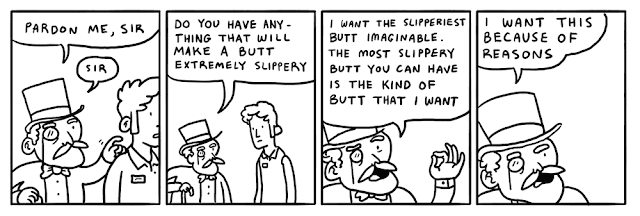
I want this because of reasons
Because of reasons
because reasons
I don’t believe that there is just one process that created ‘because NOUN’. The construction appears to have independently been created multiple times. The ‘of’ in “because of [NOUN]” does not carry any semantic meaning, so it’s easy to remove it and preserve the meaning. Similarly, imagine a full version of the racecar meme: “[It is] complete stripped inside because [it is a] racecar.” Removing both ‘it is’ does not affect the meaning.
‘Because More Expeditious’ - An Older Use of “Because X”
I have found a dramatically earlier usage of ‘because [adjective]’ than is commonly reported, and which I have not (yet) seen cited as a possible model for the ‘because [noun]’. This is an academic or highly literate usage of ‘because [adjective].’
“Meanwhile the master saw no danger which would result from this preaching, unless he might foresee that eventually he should find the relation so responsible, and the character of the servant so well fitted for it as to render emancipation expedient, and a duty because expedient.” - 1831. Relation of Master and Servant, as exhibited in the New Testament, by S. Taylor
“As justifiable, the legal right, is such, as the thing, the most immediate and necessary, to do; and as the only thing feasible, or suitable, under the state of circumstances; but, when the exigence of occasion had passed away, and a normal condition of society had obtained, that which had been made right, as legal, and because expedient*, has now to be unmade, *because inexpedient.” - 1869. Of the commonwealth; its freehold and its freedom, by a county and borough elector
“Metallic cabinet work is superior to wood:
1. Because more durable, being stronger in construction and unaffected by climate or changes of seasons.
2. Because more sanitary, being impervious to microbes and vermin and more readily kept clean.
3. Because more convenient, having no parts to get out of order, shrink, or swell.
4. Because more agreeable in use, all parts being always usable and made with smooth, rounded surfaces and with suitable working tops.
5. Because more attractive, being more substantial in appearance and also artistically finished with surfaces subject to no deterioration.
6. Because more economical ultimately, with first costs little greater than wood.
7. Because entirely incombustible.” - 1902 Metallic Filing Devices, Fixtures and Furniture for Public Buildings and General File Rooms
“The limpness of a warm presents a bit of an obstacle to the critic's Freudian interpretation, but he readily overcomes it by citing the secondary medieval meaning of “gusano”: the more appropriate, because vertebrate, “víbora” (“viper”).” - 2001. Recovering Spain's feminist tradition
These examples show that ‘because more [adjective]” and “because [adjective]” existed in a variety of styles from the 1710s to the modern day. Religious commentary, industry publications, academic books, and even popular books. (I can report that one of these ‘because’ constructions appears in ‘Class: A guide to the American status system’, but I did not write the page it happened on. Bad habit!)
Where did this use of ‘because’ come from? It is hard to say. I can’t find a quotation of it in the Oxford English dictionary. It’s used throughout the 1700s and 1800s, but always dwarfed by other uses of ‘because.’
Indeed, this obscurity is so that some commenters on the English Language Learner Stack Exchange found it ungrammatical. The accepted answer incorrectly attributes the use of ‘because adjective’ to the recent slangy use. (The answer by sumelic is more correct.) None of the articles on ‘because [noun]’ I’ve read so far mention this older usage of ‘because [more] [adjective]’.
As idle speculation, I mention that French has a similar construction where the word 'car' (because) takes a direct object.
"C'est un chemin nefaste car passif, aliene, perdu" - Simone de Beauvoir, the Second Sex
"It is a nefarious path because passive, alien, lost"
Could this "because [adjective]" usage have been influential on the "because [noun]" construction and its variations? Possibly - it’s not as if there aren’t highly literate people on the internet who enjoy reading older texts. But I doubt it is a direct inheritance. For one, I could not find examples of ‘because [noun]’ in any older texts, only ‘because [adjective]’.
I would instead say that this usage shows that for a long time, we have had both the constructions ‘because it is [more] [adjective]’ coexisting with ‘because [more] [adjective]’. Eliding the words between ‘because’ and the adjective hasn’t affected our ability to understand the phrase. Since the ‘of’ in “because of reasons” is hardly contributing to meaning, perhaps we shouldn’t be surprised that “because [noun]” came around. The memeification of it from 2011-2013 just propelled it from a fringe or individual usage to part of a meme-y, informal style. Perhaps the emergence of this construction was just a matter of time, because history.
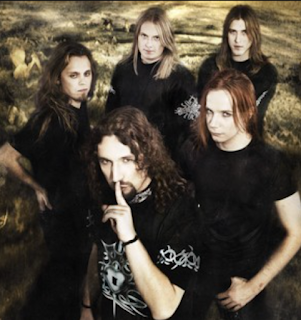
Although Europeans dominate metal music, the lingua franca of the genre is still English. And not only is it English, but many subgenres of metal rely on specific vocabulary (fantastical and Tolkien-esque, or macabre and deathly). This leads to a lot of interesting little quirks of pronunciation and grammar. I've already documented some examples in the non-metal pop band, ABBA. I don't want to make fun of these singers or lyricists, as writing songs in a different language is difficult, and these mistakes are harmless - I just find them interesting and want to share. Here are some I've noticed from a handful of bands:
Nightwish, a symphonic metal band from Finland: their earliest records, understandably, had more L2 errors than later ones.
"And the [p]ath under my bare feet... the [e]lven [p]ath" - Pronouncing the 'p' sound without aspiration makes it sound like the "elven bath." Finnish does not have aspirated consonants, so it sounds like singer Tarja is transerring Finnish rules to English.
"Songs as a SED-uction of sirens" - Writer Tuomas appear to have thought that 'seduction' has the stress on the first syllable, and Tarja sings it with an unexpected 'eh' vowel.
"The unc[e]rven path" - A spelling pronunciation from Tarja, perhaps by analogy with words like 'care' [ker].
"The moonwitch took me TO a ride on a broomstick" - The expression in English is either "took me on a ride" or "took me for a ride." There is no expression "take to a ride."
"You stand a[k]used of robbery" - A lack of aspiration and no 'y' sound here (a spelling pronunciation?) makes this sound like "You stand a goose of robbery."
Burning Witches, a power metal band from Switzerland:
"Just stories on tape-stries" - a spelling pronunciation dividing 'tapestry' up not as 'ta - pes - try' but as 'tape - stry.'
Sonata Arctica, a power metal band from Finland, has relatively good pronunciation, but the writer struggles with stylistically appropriate English.
"Find a barn which to sleep in, but can he hide anymore?" - The use of 'anymore' without a negative sounds odd to me, especially in a question, but some people do use the word like this. If you're a 'positive anymore' user, does this sound grammatical to you? The 'barn which to sleep in' is clumsy. Stylistically you would prefer either 'Find a barn to sleep in' (no linking word necessary).
"Knock on the door and scream that is soon ending" - lack of article on both 'knock' and 'scream'.
Share your favorite moments of L2 errors in metal or other genres in the comments!
Ever since the sentence 'a girlfriend was walking down the street' appeared to me unbidden in a hazy late-night half-sleep, I've been trying to understand what makes certain relationship words sound so weird as the subject of a sentence. Consider:
1a."I saw a boyfriend enter the store."
1b. "A wife selected zucchini from the produce section."
1c. "The dog chased a husband down the street."
My immediate thought is that these relationship words, girlfriend/boyfriend/wife/husband, need a pair to make sense. The sentences are immediately made more acceptable by adding on another member:
2a. "I saw two boyfriends enter the store."
2b. "A wife selected zucchini from the produce section and handed it to her husband."
2c. "The dog chased a husband and wife down the street."
Compare also the words 'mother' and 'father'. Both of these need another member to make sense ('child'), but it is actually quite acceptable to use them by themselves, in the indefinite.
3a."I saw a lonely dad at the playground."
3b. "A mother was excitedly waiting in line for coffee."
Hmm, what if we compare with another relationship word, 'friend'?
4a. "A friend entered the store."
4b. "I saw a friend select zucchini from the produce section."
The effect is interesting - I read these sentences differently from the ones above. The implication is very strong that this is my friend, not somebody who is a friend to someone else and not me. Meanwhile, sentence sets 1 and 2 don't have the implication that the boyfriend, wife, or husband have any relation to me at all. While the feeling is uncanny, you do get the intended meaning, which is "somebody who is male who is in a committed relationship entered the store." If you try to force the same distant reading on the 'friend' sentences, you get the same quirky feeling.
I suspect part of it is custom - we almost never have need to refer to someone's paired-off status without mentioning the pair. On the other hand, people talk about the behavior of mothers and fathers separate from their children often. And to refer to a stranger as a friend of some unmentioned other person, but not you, is something we almost never need to do. Don't we assume, rightly or wrongly, that everyone is a friend of someone else?
This obviousness comes into play with 'daughter' and 'son':
5a. "A daughter came into my store."
5b. "A son selected zucchini from the produce seciton."
Everyone is someone's child, so this construction that foregrounds someone's status as a son or daughter is simply unneeded.
The Holiday Season is fast approaching, so let's have some seasonal fun! If you're an American, odds are you're familiar with the song "Santa Claus Is Coming To Town." The vaguely ominous song forewarns of the jolly, big-bellied toymaker who only distributes gifts to sufficiently moral children.
The earliest known recording of the song dates back to 1934. The song has since become a Christmas standard having been covered multiple times and played yearly during the "Christmas Freeze" on radio. The song has three different unique words that can be subjected to the COT-CAUGHT merger: 'Claus', 'naughty', and 'all' in some versions. This, combined with the song's enduring popularity for decades, means we can compare how the COT-CAUGHT merger has spread throughout the decades.
Stacks clearly has an [o] in 'naughty' and 'Claus', and even in 'gonna.'
"He's making a list, checkin' it twice. G[o]nna find out who's n[o]ghty and nice! Santa Cl[o]s is comin' to town."
Bing Crosby's version: Released 1944.
Born 1903, Tacoma, Washington.
Bing uses different vowels in these words. His first 'Claus' sounds more like the German name 'Klaus', with an [aw] diphthong.
"You'd better not pout, I'm telling you why (why?) - Santa Cl[aw]s is comin' to town."
But his 'naughty' has [ɑ]:
"He's gonna find out who's n[ɑ]ghty and nice."
If you want to compare with other songs, his "It's Beginning to Look a Lot Like Christmas" has [ɑ] in "dolls that will w[ɑ]k".
"D[ɑ]lls that will t[ɑ]lk and will go for a w[ɑ]lk is the hope of Janice and Jen."
The Andrews sisters noticeably have an [o] in 'watch'. All three sisters were born and raised in Mound, Minnesota. Listen to the upper harmony:
"You'd better w[o]tch out, you'd better not cry."
Frank Sinatra's version: Released 1948.
1915, Hoboken, New Jersey.
Frank has what seems to be a [ɒ] - not as clear as Tom Stack, but distinct from the [ɑ] in "watch."
"You better watch out, you better not cry, better not pout, I'm tellin' you why - Santa Claus is coming to town."
"Gonna find out who's n[ɒ]ghty and nice."
Ross Bagdasarian, Sr. Released 1958.
Born 1919, Fresno, California.
Ross Bagdasarian Sr. is best known for creating the characters "Alvin and the Chipmunks," anthropomorphic chipmunks with sped-up human voices. Though Bagdasarian's vowel in 'naughty' isn't clear, the vowel in 'Claus' is [ɑ]. Despite only being born four years later, Bagdasarian is more merged than Sinatra. Multiple factors may come into play here - he was born in California, which appears to be an early spot for the COT-CAUGHT merger. He is also a child of Armenian immigrants. One preliminary study shows that children of immigrants seem more likely to pick up on vowel systems with the COT-CAUGHT merger than ones without.
"You'd better watch out, you'd better not cry, you'd better not pout, I'm telling you why - Santa Cl[ɑ]s is comin'..."
The Crystals, released 1963.
Dolores "La La" Brooks, born 1947, New York City, New York.
Dolores Brooks sang lead on this Phil Spector-produced version of the song. She has an introductory monologue on the song, where she produces a very clear [o] in 'called'.
"I stocked up at the North pole to spend the holiday. I c[o]lled on old dear Santa Claus..."
She keeps this clear [o] sound in 'Claus' and 'naughty'. Brooks is Black, but she does not use a diphthongized [ɑɒ] as is typical of African American English. The [o] she uses is more typical of New York City English - it's quite similar to the [o] used by Stacks!
"You'd better watch out, you'd better not pout, you'd better not cry I'm telling you why, Santa Cl[o]s is coming to town."
"Gonna find out who's n[o]ghty and nice."
Michael Jackson, released 1970.
Born 1958, Gary, Indiana.
Stacks, Sinatra, and Bagdasarian were all born within a 20 year period of each other, and all were white. Michael Jackson, on the other hand, was Black and born in 1958 - the same year Bagdasarian released his version of "Santa Claus Is Comin' To Town."
In the literature, you'll see people say that African American Vernacular English usually avoids the merger by having the CAUGHT sound be [ɑɒ]. However, Jackson doesn't use a diphthong in 'naughty' or 'Claus'. The difference between his COT and CAUGHT vowel seems to be that his COT is more [a] and CAUGHT is [ɑ].
"You better w[a]tch out, you better not cry - Santa Claus is coming to town."
"Gonna find out who's n[ɑ]ghty and nice."
It is possible that Jackson kept the two vowels distinct when pronouncing them, but still have considered them the two vowels to be shades of the same sound. In other words, he may have kept a distinction in production but not in perception. This is a stage in the spread of a merger.
If you want to hear a young Michael Jackson use the [ɑ] sound in another CAUGHT word, listen to the song "Maria," where "calling" clearly has [ɑ].
"Maria, don't you hear me c[ɑ]lling, Maria?"
Discussion
In the 20th century, the COT-CAUGHT merger was already spreading to different locales. Bing Crosby, born 1903 in Washington, is the earliest of this list to have the merger. He is from a Western state, so that should not be surprising. What is notable is just how early that is. Ross Bagdasarian is another Westerner who was born 16 years after Bing, and has a merged vowel in some locations. I suspect that the merger may have even begun before the twentieth century.
The clarity of the CAUGHT vowel is also in flux. Tom Stacks and Dolores Brooks use very obvious o-like vowels. Sinatra's CAUGHT vowel is more ambiguous, and harder to tell apart from his COT vowel.
The topic of race also shows variability. Dolores Brooks is from New York City, which is a region that preserves a strong COT-CAUGHT distinction. She does not use the diphthongized [ɑɒ] vowel that appears in most descriptions of African American English, but a vowel that is closer to what other New Yorkers use. Michael Jackson also does not use this diphthongized vowel, and appears to have a system that is also partially merged.
Are there any other standards or songs you'd like to see examined over time for language change?
Finally, a version of Santa Claus Is Coming To Town in the minor key. Really brings out the creepy undertones in the original song.
Art thou in the mood for Traditional Englishe Ballades? Yesterday, a friend asked me why there are couplets in the traditional English song "Greensleeves" that don't rhyme. Most of the song is in an ABAB rhyme scheme, but some lines stand out for not rhyming at all. Or rather, not rhyming in modern versions. In 1580, when the song first appeared, the song did rhyme - we've just changed the language a bit since then.
The song "Greensleeves" was first registered in 1580. This date is important because there were some great changes happening in the English language, not least of which is the Great Vowel Shift. The Great Vowel Shift is a series of changes that happened in English that overhauled the entire vowel system, resulting in modern English sounding very different from Middle English.
The changes didn't happen all at once - the Great Vowel Shift is often divided into phases. Greensleeves was written after the first phase of the Great Vowel Shift, but not quite having completetd the second phase.
"I have been readie at your hand,
to grant what ever you would crave.
I have both waged life and land,
your love and good will for to have."
Here, "have" and "crave" rhyme. No modern rendition of Greensleeves rhymes these two, with "crave" having the /e/ sound and "have" having the /æ/ sound. But in Middle English, "crave" and "have" rhymed, both having an /a/ sound. The Great Vowel Shift would later affect "crave", raising the vowel to become /e/.
Why did "have" not become [hejv]? Some more common words escaped the effects of the GVS - for example, 'bead' and 'bread' used to rhyme, but 'bead' changed to an /i/ sound and 'bread' didn't. The uneven applicability of the GVS has ruined the rhyme for modern English speakers.
Another failed rhyme occurs in this verse:
"Thy purse and eke thy gay guilt knives,
thy pincase gallant to the eye:
No better wore the Burgesse wives,
and yet thou wouldst not love me."
"Eye" in modern English is /ai/, and "me" is /i/. But "eye" and "me" rhyme here. What did "eye" sound like, and what did "me" sound like? We can get some tips, because "me" is rhymed with a number of words throughout the song:
"Thy girdle of gold so red,
with pearles bedecked sumptuously:
The like no other lasses had,
and yet thou wouldst not loue me,"
"My men were clothed all in green,
And they did euer wait on thee
Al this was gallant to be seen,
and yet thou wouldst not love me."
"Me" rhymes with other "thee" and "sumptuously," suggesting all these words ended in the same vowel.
"Me" and "thee" both had an /e:/ vowel in Middle English. The GVS would have already raised them both to /i/ at this point. The "-ly" suffix was already pronounced with /i/ in Middle English, and was not affected at this phase. So it seems that "eye", which was originally /ɛi/, had become /i:/!
A final interesting note: the song's first two verses use "you", but the song switches to "thou" on the third verse and stays that way for the rest of the song.
First Verse:
Alas my love, ye do me wrong,
to cast me off discurteously:
And I haue loved you so long,
Delighting in your companie.
Third Verse:
I bought thee kerchers to thy head,
that were wrought fine and gallantly:
I kept thee both at boord and bed,
Which cost my purse wel fauouredly,
The famous English playwright William Shakespeare also did this switching. "Thou" was used for social inferiors or intimate relationships, and "you" was used to indicate distance, formality, or respect.
BENEDICT. Tarry, good Beatrice. By this hand, I love thee.
BEATRICE. Use it for my love some other way than swearing by it.
BENEDICT. Think you in your soul the Count Claudio hath wronged Hero?
- Much Ado About Nothing
The play "Much Ado About Nothing" was written between 1598 and 1599, almost twenty years after Greensleeves was first registered. If we apply the same line of thinking to the song "Greensleeves," it begins with a respectful reference to the addressee, before degrading into either disrespect or intimacy.
Finally, a fun fact - Shakespeare was aware of the song "Greensleeves," for he references it in his play "Merry Wives of Windsor:"
"Let the sky rain potatoes; let it thunder to the tune of 'Greensleeves'."
Fleetwood Mac's "Dreams" has found new popularity with the younger generation as a popular TikTok featuring a man skateboarding, drinking cranberry juice, and lip syncing the song has gone viral.
While listening to the song, I was reminded of how I always found Stevie Nicks kind of hard to understand - I'm pretty sure I just made up half the lyrics to "Dreams" whenever I sang it.
I listened to the following three songs: Rhiannon, Dreams, and Gold Dust Woman. All three were primarily written and performed by Nicks, and are considered signature songs for her. I left out songs like "I Don't Wanna Know" and "The Chain," both of which had Nicks as writer but not as the primary vocalist. I also did not look at any post-Rumours albums because it gets weird and also I did not want to.
We are lucky enough to have studio and filtered acapella tracks, which makes it easier to tell what is her singing and what is interference from the background. I have selected clips from the below tracks to illustrate.
Stevie Nicks seems to operate on the base American Rock Register, which is influenced primarily by African American English and secondarily by white Southern English. The following features are quite common among 70s rock bands:
PRICE-monophthongization. Every "I" becomes an "ah" for Nicks.
"Who am [a] to keep you down?" (Dreams)
CAUGHT-diphthongization. "Want" sounds like "wa-unt."
"You wawnt your freedom" (Dreams)
TRAP-diphthongized. Nicks splits the vowel in words like "had" into two vowels.
"What you "he-ad and what you lost." (Dreams)
"Thunder only heappens when it's raining." (Dreams)
"Heave you any dreams you'd like to sell?" (Dreams)
STRUT-centralization - the 'uh' sound in "loves" is raised to sound kind of like "lurves."
"See your sunrise lurves to go down." (Gold Dust Woman)
KIT-diphthongization. Nicks loves to split short 'ih' sounds into two vowels.
"Wake up ian the mornian'" (Gold Dust Woman)
"Neaver seen a woman taken by the wiand" (Rhiannon)
Non-rhoticism. Nicks pronounces 'er' sounds as 'uh.'
"Lousy lovas." (Gold Dust Woman)
Fleetwood Mac originated as a blues band, but Nicks's arrival in the band heralded a shift towards more lush pop material. The band still used a lot of acoustic instrumentation, and the electric instruments like guitars and keyboards were not used aggressively. Nicks' faux Southern/AAE accent jibes perfectly well with the band's musical direction, as well as the musical zeitgiest of the time.
All her Southern features are vowel-based, and most of them introduce diphthongs. The only one that reduces a diphthong, PRICE-monophthongization, has been standard in American rock for so long that it's almost not even worth mentioning. (I wonder if Lana Del Rey was influenced by Nicks - her love of diphthongizing the short 'i' KIT vowel is very Nicksian.)
Nicks also has the following features, non-consistently?
Consonant deletion.
"It's o-ly right that you should..." (Dreams)
"Bla[ʔ] widow." (Gold Dust Woman)
Consonant lenition.
"Pick your [f]ath and I'll p[f]ray" (Gold Dust Woman)
/t/s before /l/s become vocalized and flapped.
"Hea[r]less challenge." (Gold Dust Woman)
"But they never cry ou[r] loud." (Gold Dust Woman)
GOAT-monopthongization. "In your shad[o]" (Gold Dust Woman)
Lack of aspiration.
"Mmm [p]ale shadow, she's a dragon." (Gold Dust Woman)
"Women, they will [k]ome and they will go." (Dreams)
Very emphatic /b/. "She rings like a Bell in the night." Could be an example of cowboy (implosive) b? (Rhiannon)
Splitting one syllable into two: "It's only right that you should p-lay the way you feel it." (Dreams)
EmPHAsis on the wrong syLLAble. "When the rain wash-ES you clean, you'll know." (Dreams)
If you're a long-time reader, you may recognize some of these features from my Ariana Grande article. These features increase singability by simplifying a more complex syllable into CVCV.
Combined with Stevie Nick's recognizably light, breathy voice and floaty phrasing, it's clear that Stevie Nicks is not singing for comprehensibility, but for aesthetic effect. She loves to stretch out her vowels, especially in words like "cat" and "win" that would normally be harder to sing.
Finally, it does not help that her lyrics are unusual for American rock. She uses a lot of symbolic imagery and unusual collocations, making it harder to fill in the gaps if you happen to miss a word. If the topic is "I love you, tell me it's true" you've probably heard enough variations on a lyric like that to be able to fill in what's going on if the singer slurs "I love you, tell ??? it's true." But it's harder to predict what's meant to go in "It's ??? ??? that you should play away your ???."
"Rock on gold dust woman
Take your silver spoon
Dig your grave
Heartless challenge
Pick your path and I'll pray
Wake up in the morning
See your sunrise loves to go down
Lousy lovers pick their prey
But they never cry out loud" - Gold Dust Woman
"Now, here I go again, I see
The crystal vision
I keep my visions to myself
It's only me, who wants to
Wrap around your dreams and
Have you any dreams you'd like to sell" - Dreams
"She rules her life like a fine skylark
And when the sky is starless
All your life you've never seen
A woman taken by the wind
Would you stay if she promised you heaven?" - Rhiannon
Having listened to these songs again, Stevie Nicks is not the most incomprehensible singer. Ariana Grande is more willing to play fast and loose with consonantts than Stevie is, who is picky about when she deletes and when she stretches. Nicks is also not the most unusual vowel performer. A band like Alt-J is easily weirder than her.
She actually reminds me a little of Fergie when she did that really weird rendition of the American National Anthem. Weird phrasing, a recognizable tonal color, and unpredictable phonetic changes. The difference is Stevie Nicks wrote these songs, and so her interpretation of them matched with the lyrics and the production - Fergie's version of the Star Spangled Banner clashes with previous renditions we've heard before by going for a weird slow sexy cabaret thing.
What makes Stevie Nicks's performance so memorable? Perhaps when the rain wash-es us clean, we'll know.
In honor of the spookiest month of the year, I've been watching the Halloween-themed video "Everybody (Backstreet's Back)" by the famous 90s band the Backstreet Boys.
Despite having listened to it for several years, this week was the first time I noticed that the chorus was not, in fact, "everybody (yeah) rock your body (yeah)", but in fact had a phantom 'yeah' added in: "Everybody yeah (yeah) rock your body yeah (yeah)." I checked several lyrics sites to confirm this and yes, these are the official lyrics. How did I miss this yeah for so long?
Well, the introduction of the song has a very clear extra yeah.
Everybody, yeah. Rock your body, yeah.
ɛvrɪbadɪ jɛə. rɑk jo bɑdɪ jɛə
You can clearly hear that there is a 'y' in that 'yeah'. Compare how they say "body yeah" with the next section, with no 'yeah':
Rock your body right.
rɑk jo bɑdɪ rait
It turns out that this pattern of a lyrics plus a 'yeah' actually repeats in every chorus. But I had never noticed because, well, there is some pretty wild smoothing going on:
Everybodye (yeah) rock your bodye (yeah)
ɛvrɪbadɪɛ (jɛə) rɑk jo bɑdɪɛ (jɛə)
Did you catch it? [ɛvrɪbadɪ jɛə] has become [ɛvrɪbadɪɛ] or [ɛvrɪbadɪə]. The [j] has mysteriously disappeared!
It doesn't help that the Backstreet Boys use a lax-HAPPY vowel in 'everybody' and 'body,' which means there is less distance between the 'ih' in 'everybody' and the 'eh' of the swallowed yeah. I think I would have noticed it if they had used a tense HAPPY-vowel - it would have been harder to ignore the difference in vowel quality.
This particular conversion of a falling diphthong to a monophtong is called smoothing, or at least it is in the study of English. Indeed, the only other example I can think of smoothing happens in RP, where a word like 'fire' /faɪə/ can become [faə].
Is this part of some larger linguistic trend? Not that I can tell. The lax-HAPPY is definitely very typical of the period (as I shall write about soon), but I don't think smoothing of this sort was widespread. This smoothing seems to have been motivated by the meldody, which was melismatic in the first chorus ("Everybody, ye-e-ah") and then became syllabic in the following choruses ("everybody-e"). It was easier to reduce the 'yeah' to a monophthong than to try and produce the full form, especially since the full form was repeated by the backing vocals anyway.
Most video games with voice acting go in one of two directions: using General American accents as a default, and using Received Pronunciation for fantasy settings or for upper class characters. The 2017 game Xenoblade Chronicles 2 bucks this trend entirely and features one of the most diverse collections of accents in a video game. Most remarkably, it does this while also avoiding the stereotyping that usually accompanies accent use, resulting in positive representation for most accents.
The original Japanese version of Xenoblade Chronicles 2 was homogenous in accent use, which means that the decision to use different accents was made during localization. Why would the localization differ so drastically on this issue, when it could have done the much easier job of securing actors that all come from one country and have the same accent? And how did people react to having a game where the protagonists had accents drawing from Manchester, Wales, and Scotland?
Xenoblade Chronicles 2 presents an excellent case study for a number of things: learning to distinguish between different major English accents; understanding the social contexts that result in linguistic prejudice; market decisions that support or suppress differing linguistic voices. We're also going to take a short look at the game's predecessor, the original Xenoblade Chronicles, and how that game's unusual history paved the way for our polydialectal protagonists.
Xenoblade is a video game series developed by Monolith Soft. They are spiritual successors to the Xenosaga series and the Xenogears game, which came out on PlayStation consoles. The Xenoblade games are available exclusively on Nintendo consoles. The first Xenoblade Chronicles tells the story of a world where the only two landmasses are two giant, immobile humanoids, and all life lives on these two beings. The protagonist, Shulk, is on a quest to avenge his hometown after it is attacked by mechanical creatures from the other humanoid landmass.
Xenoblade Chronicles 2 is loosely connected to the first Xenoblade Chronicles. In this world, there are multiple giant beings called Titan, and people live on them. The groups of people living on each Titan have their own cultures, politics, and - in the English version - accents. The protagonist, Rex, is on a quest to help his newfound friend Pyra reach the mythical land of Elysium, to solve the problem of Titans dying off.
It's not necessary to be much more intimately familiar with the plot than this, and I will avoid story spoilers if you are in the middle of playing these games.
A Tour of Accents
Southern England English
Most of the cast of the first Xenoblade Chronicles game speak in Southern England English. This is distinct from Xenoblade Chronicles 2, where each world has a distinct variety of English. Some characters, like Shulk, may sound more posh than other characters, like Fiora, but overall they stay within the range of Southern England English. Both heroes and late-game villains speak in a middle-class variety of Southern England English.
In Xenoblade Chronicles 2, the people of Tantal, the people of the historical nation of Torna, and the race of small furry bunny people called Nopon speak in this accent.
Examples of Southern England English
Non-rhotic: Like most English accents in England, Southern English does not pronounce historical 'r's after vowels.
"The fut[ə] doesn't belong to you!"
If a word ends in a vowel and the next word starts with a similar vowel, Southern English lets you insert an intrusive r to make the difference between the words clearer.
"Protect Melia-r-at all costs!"
Southern English English, and many other varieties of English English, have a three way vowel distinction between BOTHER /ɒ/, SPA /ɑ/, and THOUGHT /ɔ/. An American may use the same vowel in "monado", "mechon", and "law" ([ɔ]) but most Englishmen will use a different vowel in each: "monado" ([ɑ]) "Bionis" ([ɒ]), and "awesome" ([ɔ]).
"The Mon[ɑ]do... Bi[ɒ]nis and the Mech[ɒ]nis. That's [ɔ]some!"
"But it's starting to look like the mon[ɑ]do might be something far more significant than just a weapon for defeating Mech[ɒ]n."
"I really th[ɔ]t I'd l[ɒ]st you back then."
The TRAP-BATH split: In Southern England, words like "bath," "can't," and "laugh" are pronounced with the vowel of SPA instead of the vowel in TRAP.
"This is my ch[ɑ]nce! I c[ɑ]n’t see it clearly."
The HURRY-FURRY distinction: North Americans tend to rhyme HURRY and WORRY, but these are two distinct sounds in most English English, with HURRY having the 'uh' sound of STRUT.
"I'm more wuh-ried about you than the shell."
FEEL-FILL merger: Younger varieties of Southern English English pronounce 'feel' to sound like 'fill.' A similar merger is also occurring in white Southern American English and African American Vernacular English.
"The breeze f[ɪ]lls so good."
GOAT-fronting.: In Southern English English, the "oh" sound is made with the tongue pushed more forwards than in other varieties of English.
"[əʊ], the defense force colonel."
No yod-dropping: American English has a 'doo' in words like 'duty,' but English English preserves a 'dy' sound, so 'duty' sounds like 'dyooty.'
"I take this chance to bring vengeance to my brother and fulfill my d[j]uty."
Cockney English and Lower-class London English
Cockney is a working class accent found in London. Quite a bit of Cockney could be head in the first Xenoblade game, most notably with the villain Bronze Face. Xenoblade 2 also had a little Cockney, with a minor enemy guard speaking in Cockney.
Cockney and Working-Class London English Characteristics
FLEECE-diphthongization: The 'ee' vowel /iː/, like in FLEECE, is pronounced as a diphthong [əi~ɐi].
"Professor Tatazo, sp[ɪi]k! Sp[ɪi]k, you give orders."
GOAT-centralization: The 'oh' vowel /o/ becomes 'au' [æ̈ʊ~ɐʊ], so 'hoes' sounds like 'house.' The vowel is more centralized than the Southern English English mentioned above.
"If productions get more sl[ɐʊ], maybe you ready for sleep time with fishes."
"Professor Tatazo, speak! Speak, you give [oʊ]ders."
STRUT-raising: the 'uh' /ʌ/ sound moves towards 'a' [ɐ̟].
"If prod[ɐ̟]ctions get more slow, maybe you ready for sleep time with fishes."
T-glottalization: Ts between vowels are replaced with the glottal stop [ʔ].
"I've been ge[ʔ]in hungry!"
H-dropping: h sounds, especially at the beginnings of words, are likely to be dropped.
"I've been getting 'ungry!"
PRICE-backing: The vowel in PRICE /aɪ/ is backed to [ɑɪ]. In more extreme versions, "price" can sound like "proise."
"He's r[ɑɪ]ght here . He's still al[ɑɪ]ve."
FACE-lowering: The /eɪ/ sound in words like 'face' and 'ate' are lowered [æɪ~aɪ].
"I [æɪ]te 'em all up."
Myself can be realized as me-self [mi].
"I just couldn't help [mi]-self."
L-vocalization: The l's at the end of words can become a [w].
"I'm not meta[w] face."
Cockney is on a continuum with other forms of London English, so some "Cockney" features also appear on characters that otherwise don't sound Cockney, like Reyn. Reyn displays h-dropping, t-glottalization, and other features of Cockney English, but he does not sound anywhere near as Cockney as Bronze Face does.
You can think of Shulk, Reyn, and Bronze Face as being on a continuum from 'very middle class' to 'in the middle' to 'straight-up Cockney.' They will all share certain features that are relevant to their region, such as non-rhoticism, GOAT-fronting, and a 3-way distinction between SPA, BOTHER, and THOUGHT. This distinguishes this group of 3 dialects from other region-based dialects, like General American English.
As you move from the 'very middle class end' towards the middle, you'll notice an increase in traits like h-dropping, t-glottalization, and PRICE-backing. At the Cockney end of the spectrum, the frequency of h-dropping and t-glottalization can increase.
Cockney and 'very middle class' London English may both have GOAT-centering, but the Cockney vowel is different (more centered) than the 'very middle class' vowel. This shows that names like 'GOAT-centering' cover a lot of different possible realizations, and these realizations may be treated differently by society.
Northern English (Leftheria)
Xenoblade 1's dialect diversity was mostly limited to class, but Xenoblade 2 introduced more region-based diversity. Each in-game world has a predominant dialect of English associated with it, and the people of each region will speak their associated accent.
For example, the main character of Xenoblade Chronicles 2, Rex, is from the in-game world of Leftheria. The Leftherians were dubbed using Northern England English. Accordingly, Rex's voice actor is from the North of England - specifically, from Manchester. Other characters from Leftheria also use Northern English English.
Because of prejudice against Northerners, Northern accents are often judged negatively by Southerners. Some English players reacted negatively when they first heard Rex's accent, with one claiming he sounded like a "farmer." Some people from outside the UK who were not familiar with Northern accents even thought Rex was using a 'fake' accent!
But not everyone reacted negatively to Rex's accent. Northern English fans did not view their own accent negatively - they seemed to enjoy being represented as the hero! Many people in and outside the UK also delighted in hearing a Northern protagonist. Today, the general fan consensus toward's Rex's accent seems mostly positive.
Northern English English characteristics
HOUSE has a centered vowel: Words like "house" and "about" with the /aʊ/ diphthong are pronounced as "hoess" or "aboat," with a vowel like [əʊ]. This is closer to how these words were pronounced in Middle English.
"Time to take you down [dəʊn]!"
Monophthongization: Vowels like "ey" [eɪ] and "oh" [oʊ] are pronounced not as two vowels, but as a single vowel: [e] and [o].
"[oke]!"
Lowered TRAP vowel: Words like "trap" are not pronounced with [æ], but with a vowel more similar to the Spanish "a": [a]
"That wasn't supposed to h[a]ppen."
My is reduced:'my' [maɪ] can reduce to 'muh' [mə], similar to in the phrase 'm'lady'.
"No worries, I bet I can learn something to help m' salvaging too."
No STRUT-FOOT split: In Southern English accents, words like "strut" have the 'uh' [ʌ] vowel and words like "foot" have the 'oo' [ʊ] vowel. In Northern English accents like Rex's, both "strut" and "foot" words have the short 'oo' [ʊ] sound. (This is because distinguishing between "strut" and "foot" sounds is actually relatively new in the English language!)
"And an[ʊ]ther one! Aw yeah, d[ʊ]n and d[ʊ]sted.
Lax happY vowel: The final vowel in words like "happy" and "exactly" are not a long [i] but more like a lax 'e' sound.
"My thoughts exactleh."
Welsh English (Gormott)
The people of the titan Gormott are voiced by Welsh actors. One of the main characters, Nia, is Gormotti and has a noticeable Welsh accent throughout the games.
The decision to have a main character with a lot of screentime have a Welsh accent was variably received, with some people unsettled that she sounded like a "Welsh grandma." But many fans enjoyed the voice actress's work and her Welsh-ness has even become memetic.
Some players didn't even realize that she was Welsh. Players from the United Kingdom are very familiar with the difference between Welsh accents and Scottish and Irish accents, but non-UK players had a hard time placing her accent.
When we listen to different varieties of English, we don't studiously notice every single realization of every single word - we rely on known patterns to be able to 'tell' someone's accent. If you lack the pattern, you have a harder time placing the accent. Non-UK players had no frame of reference for a Welsh accent, so when she uses a monopthong in 'face' and 'goat' or when she trills her r's, non-UK players may mistakenly categorize her as Scottish or Irish because those accents also share those features.
Welsh English Characteristics
STRUT-centering: The vowel of "bus" /ʌ/ is pronounced [ɜ]. This means "us" can sound more like "ehs."
"You're picking a fight with ehs [ɜs]?"
"Woo hoo, Nia the ehn-[ɜn]-stoppable!"
DRESS-lowering: The DRESS vowel /ɛ/ is a more open vowel, sounding almost (though not quite) like [æ]. Notice how the way she says "Rex" can sound like "racks."
"Make sure you've got my tail, R[æ]x."
Much like the Manchester accent above, Welsh English has TRAP-lowering. The TRAP vowel /æ/ is pronounced almost like the Spanish 'a' [a].
"Quick, while we have the adv[a]ntage."
Much like Southern English English, Welsh English tends to be non-rhotic. This means that 'r's after vowels are not pronounced. In the following clip, notice how the 'er' in 'proper' and 'swear' become weak vowels [ə].
"I'll bash you up prop[ə] next time, I swe[ə]!"
Despite being non-rhotic, 'r's that start a syllable can be tapped/trilled.
"Show us some of that Nopon spi[ɾ]it."
"We're on a [r]oll now!"
Geminated consonants: Consonants between vowels are doubled in length and held longer. This is similar to double consonants in Italian.
"C'mon, believe in me a li[t:]le."
H's at the start of words can be dropped: Notice how "here" becomes "yere", while "happening" and "heads" just lose their 'h'.
" 'ere I come, ready or Gormotti."
"Why is this 'appening? Hey over [j]ere, just me the 'eads up."
The ER vowel in NURSE is pronounced with rounded lips. Southern English would have [ɜ:], but Welsh English has [ø:].
"It's like were in puofect [pøfɛkt] sync
FACE and GOAT may have the monophthongs [e] and [o] instead of [ei] and [ou], respectively. Notice the similarity to Manchester English above.
"Healing h[e]l[o]."
Consonants at the end of words can be devoiced. For example, this leads to "d" being pronounced as [t].
"Brutal bla[t]e."
Scottish English (Mor Ardain)
The empire of Mor Ardain is voiced with Scottish accents. One of the party members, Mòrag, hails from the region, and speaks relatively neutral Edinburgh English. However, there are villainous characters from this region as well. Both will be represented in the examples below.
"Mor Ardain" is strangely translated Scottish Gaelic for "big pride". "Mor" means big and "ardain" is supposedly pride, though some sources contest this use and suggest "ardain" is really "little height" (big little height?). The adjective ordering is also suspect, since the adjective normally comes after the noun in Scottish Gaelic. It ought to be "ardain mor," similar to "cù mòr" below.
cù mòr briagha dubh dog big beautiful black
'a big beautiful black dog.' (MacAulay 1992)
Scottish English Characteristics
Trilled and tapped /r/. This trilling is more prominent than in Welsh English.
"Special inquisto[r] Mor[r]ag! ... had we but heard of your g[r]ace's visit, we could have prepa[r]d a suitable..."
"Gut it? Gut, this... c[r]eature?"
The Scottish English /u/ sound has the tongue pushed all the way towards the front, sounding more like "ew" [ʉ].
"Sublime! Your efforts have borne many fr[ʉ]ts."
BOOK and BOOT have the same vowel. Scottish English does not have a "short u" or a "long u."
"Let's p[ʉ]t that thought into practice, shall we? Ass[ʉ]me your positions."
Like Manchester and Welsh English above, FACE and GOAT vowels are the monophthongs /e/ and /o/.
"D[o]n't forget me... think you can t[e]k me?"
No FERN-NURSE merger: "Learn" is not pronounced with the same vowel as "nurse," but with a distinct "eh" vowel, so it sounds like "lairn" [lern].
"There is still much to l[e]rn."
The BIT vowel is lowered to [ë̞]. However, there is no merger: "bit" and "bet" are distinct in Scottish English.
"You won't w[ë̞]n so easily. Let me go... you p[ë̞]g!"
COT-CAUGHT merger: "COT" and "CAUGHT" are pronounced with an o-like vowel.
"Let's put that th[o]ght into practice, shall we? Show us what you've g[o]t."
There is no /æ/-/ɑː/ distinction, which means that path, trap, and palm all have the same vowel.
"Shall we d[a]nce? ... We will forge a p[a]th and none shall stand in our way... I never imagined we'd be standing here on the b[a]ttlefield side by side."
Centralized PRICE vowel: Notice how the way she says "side" [said] is almost more like "say'd by say'd" [sɜid].
"I never imaged we'd by standing here on the battlefield s[ɜi]de by s[ɜi]de."
Australian English (Uraya)
The monarchic nation of Uraya, which is located inside a whale-like titan, is represented by Australian accents. The character Vandham is from this region, and hits us with life wisdom in a broad Aussie accent.
You may notice that there is significant overlap between Australian English and Cockney. This is because Cockney English was influential in the developmnent of Australian English!
Australian English Characteristics
PRICE-backing: ai sounds like 'oy' [ɑɪ].
"We've been bl[ɑɪ]nds[ɑɪ]ded! Hold the l[ɑɪ]ne!"
FACE-lowering: the FACE vowel [eɪ] is lowered to [aɪ], so "rain" sounds like "rhine."
"Here's the m[aɪ]n course. R[ai]n, shine or snow."
Lowered and centralized GOAT: GOAT is [ɐʊ], so "hoe" sounds like "how."
"Rain, shine, or sn[ɐʊ]w."
DRESS-raising: Raised DRESS vowel to [e].
"Nia, st[e]dy on."
American English (Indol; various blades)
The nation of Indol is voiced with General American accents. It controls the distribution of the Blades species, and which is also a religious pilgrimage spot. Many of the Blades are also voiced with American accents. Notably, the antagonists of the game - the terrorist group "Torna" (not the country) - primarily have American accents.
Below are some characteristics of American English that distinguish it from other varieties of English.
American English English Characteristics
Unrounded LOT vowel: Most Americans pronounce words like "lot", "want", and "holly" with unrounded lips. This is in contrast to all the dialects listed above. Notice how Akhos uses the same vowel in "father" and "not."
"Can you do that for your grandf[ɑ]ther? ...N[ɑ]t ether?"
LOT-THOUGHT merger: An increasing number of young Americans are pronouncing words like "caught","draw", and "all" to sound like the vowels in "cot" and "doll." Unlike Scottish English above, the resulting vowel is more similar to [ɑ] than [o]. Notice how "father," "not," and "thought" all have the [ɑ] vowel in Malos's speech. In Southern English, these would all have different vowels. (Note not all Americans have this merger: the characters Jin and Amalthus do not have this merger.)
"No wonder f[ɑ]ther abandoned them! ... She's n[ɑ]t dr[ɑ]wing from the ether."
Functional LOT words like "from", "was", and "what" have the STRUT vowel. Notice how Akhos rhymes "but" with "what."
"B[ʌ]twh[ʌ]t if we were to interrupt the flow?"
Usage
One of the nice things about this game's localization choices is that is they mostly avoid leaning into stereotypes. The end result is delightfully confusing if you take it at surface value: the two leading powers in the world are the Australians and the Scottish (who have colonized the Welsh cat-people). The Americans run a neutral theocracy that also controls the flow of the Blade people. Another group of Americans runs around the world kidnapping the same Blade people and threatening globals safety. The Northern English live secluded, rural lives on an archipelago, while Received Pronunciation speakers have decided to dive underwater and never return. (Irish English is even present, but only because two of the songs were sung by Irish English speakers. No characters in the games have an Irish accent.)
None of this really matches up to any stereotypes in real life. But the accents work well at making it immediately obvious where a particular character comes from. Because English is a pluricentric language, English speakers are used to hearing a variety of accents in real life. This makes the localization decision to use different English accents, while strange in the context of video game dubbing, normal as a storytelling decision.
It helps that the original Xenoblade Chronicles game was dubbed using English English accents - RP, Estuary, and Cockney English all appeared in the first game. This wasn't for any storytelling decision, though - it was because Nintendo of Europe decided to fund the dubbing effort since Nintendo of America was not interested.
It's here that we can see one of the unfortunate stereotypes that they did fall into. Cockney English is used primarily by villains in Xenoblade Chronicles 1 and 2. Two major villains, Metal Face and Bronze Face, use it in 1, and the minor Tirkin species uses it in 2. No other accent is used so obviously to convey morality in the series, and it's a tired trope, as noted by a game reviewer: "Only the Especially Evil Robot Bad Guys miss the mark with their way-over-the-top Cockney guffawing."
Impact
The majority of games with voice acting are dubbed in American English. This contributes to a sense that American English is "the neutral" form of English. The United States is the large "first circle" English speaking nation, after all, and a huge market for game studios. The abundance of American media exported to other countries means that American English is extremely familiar, too. The next most common form is some sort of English English, usually for games that are meant for Europe or are in the fantasy genre (example: the Witcher series). Outside of those, it becomes increasingly uncommon for other varieties of English to be represented.
This leads to the unusual situation that people from these less-represented regions, upon hearing their own varieties used in media, react with confusion. It is easier to suspend disbelief for people who live on two giant beings or that anyone would go around dressing like Rex would than it is for people to think that these very same fantasies can have people who sound like them.
It's reminiscent of what Chimimanda Adichie calls "the danger of a single story." If you spend your life only hearing stories about people from England who eat apples and play in the snow, it's easy to end up writing stories like that, even if you are not from England, have never seen snow, and grow mangoes instead of apples.
Similarly, if you spend your whole life hearing video game protagonists with American accents, you come to associate video game protagonists with American accents, and hearing them depart from that script feels strange. It's a powerful example of enregisterment, "the process by which a linguistic repertoire comes to be associated, culture-internally, with particular social practices and with persons who engage in such practices." (LSA Summer Institute Workshop) Video game voice acting becomes enregistered as American, and optionally RP in a fantasy or historical setting.
Because these are fictional worlds, there is nothing preventing these characters from being voiced with a Yorkshire accent. The worlds of Xenoblades 1 and 2 don't really exist in our universe, so "Yorkshire accents" and "American accents" are concepts that don't even make sense anyway. The characters speak some variety of a known human language for our convenience - it makes no difference to the story whether it's a Yorkshire accent or a New York accent.
Market concerns are the primary motivator. It's risky to put out a game where the main character has a Lancashire accent, and if Xenoblade didn't already have a history of English voice acting, I don't think it would have happened. We would probably wonder, "why did they voice the main character in a Japanese role-playing game with a Yorkshire accent? Does this game have something to do with Yorkshire?"
But because of Xenoblade's strange history, audiences could already expect that English English accents would be in the game. You could even say that fans were looking forward to it - a number of fans were disappointed that Xenoblade X, the game released after Xenoblade the first, was set in "New Los Angeles" and would therefore be full of American accents. (There were some English accents thrown in, but mostly RP.)
Xenoblade 2 has shown that having a variety of accents is not going to confuse the audience. It's currently the best selling game in the series. While the dub is still divisive, it's no longer entirely because it uses non-RP/GA accents. Even people who were skeptical of it before have warmed up to it.
I’m aware not everyone is a fan of the English dub, as there are those who insist on playing the game with the Japanese dub, but as an Englishman who has a fondness for the various accents Great Britain has to offer, I couldn’t help but embrace every piece of dialogue delivered by Nia and Mòrag. Heck, even the hoity-toity tones of Zeke were enjoyable.
As nice as the other accents are though, they are nothing when compared to the sultry tones that spread forth from Nia’s mouth. It’s not just her who’s Welsh accent sounds great as the accent of every Gormotti character, is just too good to be true.
This is going to be pure bias but the Gormotti are my favourite species in Xenoblade Chronicles 2 and it is mostly thanks to their accent. I may not know the names of all the voice actors who gave life to these characters, but their delivery of dialogue and how they conveyed emotions in their delivery, really helped to make the characters stand out and have me enjoy my time in Gormott, all the more.
One of the more heartwarming aspects is the people who have found themselves represented in the game. It has expanded whose voice gets to be in a video game. The following quotes from a Kotaku article demonstrate:
The first game’s exaggerated take on the British language formed the cornerstone for much of the narrative tone and pacing of later entries in the series. When Xenoblade Chronicles was at its finest, it was leaning heavily into its choice to be an exaggeration of the place I consider home. It wasn’t a nuanced take on British dialects — most people who live in Great Britain will likely agree nobody they know actually talks quite like Shulk does for example — but it was one that left a lasting impression of a world closer to home than JRPGs normally feel to me.
This is something which has stuck with the series since then and, a week or so deep into Xenoblade 2, I’ve finally worked out what it was about the presence of these close to home regional dialects that feels so special to me. It’s that as cringeworthy as they can at times be, they make me feel like the adventure unfolding could happen to me; like I could be part of the adventure — something that a series hasn't made me feel for a long time.
[...] There’s something about all these British accents that makes the characters in the adventure feel much more real to me. Perhaps it’s that I typically experience American accents through works of fiction, and they take on an air of the fake or exaggerated. Maybe it’s that when playing with Japanese audio and English subtitles, I tend to hear accents in my own head rather than as they’re voiced in the media itself. Whatever the cause, there’s an added feeling of authenticity and sincerity when the accents you encounter are a little closer to home — even if they’re caricatures in and of themselves.
Perhaps more games in the future will feel free to use a wider variety of accents, and without resorting to crude stereotypes. Xenoblade 2's voice acting certainly has room for improvement. The localization process resulted in a lot of awkward pauses and strange lines to meet the lip sync - when they meet it at all. But the accents themselves seem to have been greeted warmly, despite diverging from the Japanese source material. Here's hoping future Xenoblade games and beyond will continue to enrich their worlds with diverse dialects.