Search Ace Linguist

Showing posts with label needs music links. Show all posts

October 26, 2020

Get Ready For This - Accent Mix-up?

I'm going to need a special tag for '90s music' because I keep finding weird stuff going on in music from the 90s.

Today's 90s jam we're talking about is "Get Ready For This," by 2 Unlimited. If you grew up in the U.S. during the 90s and 2000s, you will remember this song as a club banger and a basketball "jock jam" (the only basketball game I've ever been to, in the 2000s, played this song). I never heard the full version until recently.

The song features a standard, 80s-inspired New York-style rap. The parts that sound particularly New York-ish are the following:

"Feel the base, you just get closer
Be impressed by the words I chose of
Once again kickin' it live
Doin' everything yo just to survive
Above the law, I take our stand
Being on stage with a mic in my hand"

Let's ignore the ungrammatical "the words I chose of" lyric. In "live" and "law," the singer uses a heavy dark 'l' sound. Using a dark 'l' sound at the beginning of syllables used to be a more common New York feature. Nowadays it's widespread enough among American English speakers to not be considered "accented," but Newman (2015) considers New York dark 'l's to be heavier than other American varieties.

The more interesting part is the vowels that follow - he uses an [a] sound in "live" and on [o] in "law."

Monophthongal [a] is found in two varieties - white Southern English and African American English. The song otherwise doesn't have features of white Southern English. The original influential rappers were Black Americans from New York, who speak an accent of African American English that is influenced by the multi-ethnic New York English variety. He sounds more similar to the latter than the former to me.

He also uses an [o] vowel in "law" and "on." If he were imitating either white or Black Southerners, he would have probably used a diphthong like [ɑɒ] here. Instead he uses [o]. The COT-CAUGHT distinction was already losing its foothold on American English by this time, with New York English holding out and preserving the distinction. This distinction would also be found among Black New Yorkers. This makes his performance even more Black New York-ish.

This wouldn't be notable except for this lyric:

"Bustin' it loud to the crowd, the age is 20, I'm from the south"

No way this man is "from the South." He is obviously imitating New York rappers. He may be broadly imitating Black Americans, but African American Vernacular English has regionally distinct varieties, and the one he's imitating is not Southern.

The rapper in question is not only not from the South, he's not even from the U.S. His name is Ray Slijngaard, and he seems to be a Black Dutchman. He speaks English, but with a clear Dutch accent. Notice how he devoices /v/ to [f] in his interviews.

There are varieties of Dutch that distinguish /v/ and /f/, but Amsterdam Dutch does not (H. Van de Helde, 1996) - just as well, since Slijngaard is from Amsterdam. There is no English dialect that devoices /v/ to [f], to my knowledge. And his English, while seemingly based on American English, still shows signs of L1 interference.

One topic we have covered ceaselessly on this site is that people feel comfortable imitating other accents in music, but not so much in spoken speech. Slijngaard appears to have felt comfortable enough doing a faux-NY-AAVE accent on his rap. But he didn't have enough awareness to realize that there is something a little weird about saying "I'm from the South" when you have an accent that is not only not Southern, but from another region entirely.

The "I'm from the south" lyric is probably just mimicking rappers who rep their hometown, and filling in a rhyme with "crowd." And nobody else seems to have paid much attention to this, because it's not a song that requires deep attention to the lyrics. It is, nevertheless, a source of humor when listening to the song on repeat.

Works Cited

October 12, 2020

And in cheeching you will learn: More Stop-Affrication

I've written about sounds becoming fricatives (like 'v', 'zh') or affricates (like 'ts', 'ch', 'dj') multiple times on the blog: glides becoming fricatives, /tr/ and /dr/ clusters getting affricated, and all manner of stops becoming affricates.

Today I present to you a very simple example of stops becoming affricates: /t/ becoming /tʃ/ before a high vowel. This is happens commonly across languages. Those of you studying Japanese may know that historically, the sequence /ti/ became [tɕi] and /tu/ became /tsu/.

I don't know exactly how common this is in English, but I've found /t/ becoming /tʃ/ before /i/. Example from Phil Collins:

In learning you will [tʃ]eech (teach), and in [tʃ]eeching (teaching) you will learn

Example number two is from the Backstreet Boys. Notice that although there is a /tʃ/ in 'reach' before the 'to', the singer clearly stops and produces a second /tʃ/ sound for "to." I would imagine that this one is influenced by the nearby /tʃ/ in the environment (he doesn't affricate the 't' in 'two worlds' one line before), but it's still neat.

Can't rea[tʃ] [tʃ]o your heart

October 5, 2020

ABBA's Special Swedish Sibilants

I'm curious as to whether any of the members of ABBA have any non-standard features in Swedish.

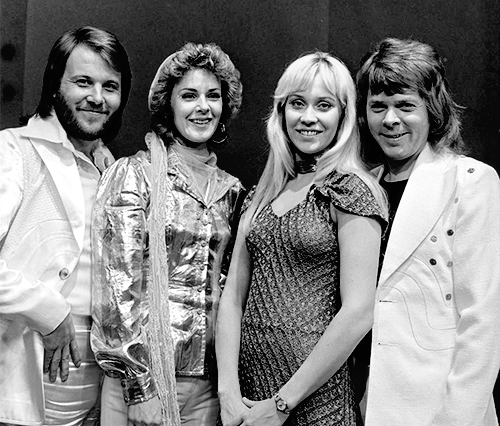
Members of ABBA. From left to right: Benny Andersson, Frida Lyngstad, Agnetha Fältskog, Björn Ulvaeus.

The two men, Björn and Benny, grew up in major cities (Goteburg and Stockholm, respectively), so I don't expect them to have anything distinct from Central Standard Swedish. Frida (the brown-haired mezzo soprano) was born in Norway, but grew up in a small Swedish town which I can't find much about.

The members of ABBA having an interview in Swedish. Do you hear anything unusual? Sounds pretty standard Stockholm Swedish to my (limited) ear.

Agnetha (the blonde soprano) grew up in Jönköping, which is a town in Småland. Småland is a region in the south of Sweden which does have some interesting phonetic features, though Jönköping lies outside of that isogloss. I have found at least one phonetic curiosity from Agnetha.

Central Standard Swedish has a process of retroflexion that occurs when an alveolar /r/ gets too close to a dental consonant like /t, d, n, l, s/. The two produce a single retroflexed (or postalveolar) consonant: [ʈ, ɖ, ɳ, ɭ, ʂ]. So a word like "förstå" (to understand) will be pronounced [fœ̞ʂˈtoː].

This retroflexion only occurs in dialects that have an alveolar /r/ sound. In Southern Swedish, the standard /r/ is a uvular [ʁ] instead. This means no assimilation happens, so no retroflexion happens.

Agnetha grew up in the Southern region of Swedish, but she does not have that uvular [ʁ] sound. Does she still do retroflexion? Well, inconsistently.

In her debut single "Jag var så kär" (I was so in love), she sings "Men nu först förstår jag" (but now I begin to understand), with two opportunities for retroflexion: "först förstår." She actually splits the difference: "först" has [ʂ] but förstår has [s].

Men nu för[ʂ]t för[s]tår jag

I was tipped off to the existence of this detail by this blog (Swedish). Apparently this is the only noteworthy Swedish-dialect pronunciation in Agnetha's discography, because nobody else has made any reference to her accent.

Why the difference between [ʂ] and [s] in these closely related words? May have to do with the syllable struct. The /st/ cluster in "först" is in the coda, or end, of the word. Meanwhile the /st/ cluster in "förstår" is at the onset: för-står.

Perhaps underlyingly, the 'r' in "förstår" being in a different syllable than the "står" means that it cannot 'travel forward' and cause the 's' to assimilate. This would predict that the assimilation shouldn't happen across syllable boundaries.

So Agnetha's assimilation rules would be a little different compared to a Jönköping-er who has a uvular 'r', and no assimilation at all. It would be interesting to see how much other people from this region with alveolar 'r' have assimilation: similar to Stockholmers (lots of assimilation), similar to Southern Swedes with uvular 'r' (no assimilation), or variable assimilation (with different rules, or assimilation is part of a word itself).

I'll give Agnetha's discography a re-listen to see if she continues to avoid assimilation. Perhaps, this being her first single, nobody gave her any accent coaching. Once she became popular, record labels may have wanted her to sound more standard, and so she may end up avoiding this in the future.

October 1, 2020

Spooky Smoothing in Backstreet's Back

In honor of the spookiest month of the year, I've been watching the Halloween-themed video "Everybody (Backstreet's Back)" by the famous 90s band the Backstreet Boys.

Despite having listened to it for several years, this week was the first time I noticed that the chorus was not, in fact, "everybody (yeah) rock your body (yeah)", but in fact had a phantom 'yeah' added in: "Everybody yeah (yeah) rock your body yeah (yeah)." I checked several lyrics sites to confirm this and yes, these are the official lyrics. How did I miss this yeah for so long?

Well, the introduction of the song has a very clear extra yeah.

Everybody, yeah. Rock your body, yeah.
ɛvrɪbadɪ jɛə. rɑk jo bɑdɪ jɛə

You can clearly hear that there is a 'y' in that 'yeah'. Compare how they say "body yeah" with the next section, with no 'yeah':

Rock your body right.
rɑk jo bɑdɪ rait
It turns out that this pattern of a lyrics plus a 'yeah' actually repeats in every chorus. But I had never noticed because, well, there is some pretty wild smoothing going on:
Everybodye (yeah) rock your bodye (yeah)
ɛvrɪbadɪɛ (jɛə) rɑk jo bɑdɪɛ (jɛə)

Did you catch it? [ɛvrɪbadɪ jɛə] has become [ɛvrɪbadɪɛ] or [ɛvrɪbadɪə]. The [j] has mysteriously disappeared!

It doesn't help that the Backstreet Boys use a lax-HAPPY vowel in 'everybody' and 'body,' which means there is less distance between the 'ih' in 'everybody' and the 'eh' of the swallowed yeah. I think I would have noticed it if they had used a tense HAPPY-vowel - it would have been harder to ignore the difference in vowel quality.

This particular conversion of a falling diphthong to a monophtong is called smoothing, or at least it is in the study of English. Indeed, the only other example I can think of smoothing happens in RP, where a word like 'fire' /faɪə/ can become [faə].

Is this part of some larger linguistic trend? Not that I can tell. The lax-HAPPY is definitely very typical of the period (as I shall write about soon), but I don't think smoothing of this sort was widespread. This smoothing seems to have been motivated by the meldody, which was melismatic in the first chorus ("Everybody, ye-e-ah") and then became syllabic in the following choruses ("everybody-e"). It was easier to reduce the 'yeah' to a monophthong than to try and produce the full form, especially since the full form was repeated by the backing vocals anyway.