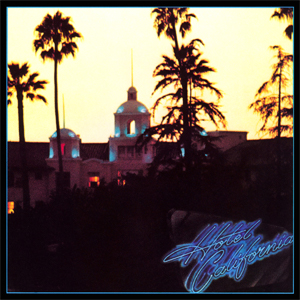
I was listening to "Hotel California" a while back and was suddenly struck by the impression that the singer, Don Henley, sounds vaguely Jamaican or Spanish. A search shows that I'm not the only one who got this impression (emphasis mine):
I'd also be curious to know what Mexican-Americans think of the title tune's Spanish accent. Robert Christgau
Just to acknowledge where this thread came from, there is a definitely reggae influence though I think it’s mixed with a generic south of the border vibe. Chickenfrank mentioned calypso, and I think there’s some Latino in there as well. Henley occasionally slips in a little pseudo Jamaican accent, doesn’t he?
[...] Ugh, I think you’re right about that. Almost never a good practice. Take heed, tomorrow’s recording artists who are checking in on this thread! Rock Town Hall
Wtf is that accent that clown singing "Hotel California" has? The guy in the Police has it too. Sounds like they're making fun of Jamaicans. Twitter
Does Don Henley sound Jamaican in "Hotel California"? In the song "Hotel California" by The Eagles, Don Henley the lead singer, sings in some sort of accent. My family thinks he is singing perfectly normal. Does anyone agree he sings in some sort of accent? My parents think I'm crazy. Here's the song. Yahoo Answers
Okay, so I'm not the only one who got this impression, and the scale is tilted towards 'Jamaican' as opposed to 'Spanish.' Let's listen to the song and see if we can figure out what's causing this.
Analysis
The use of [ɪ] (short 'i') and [i] (long 'ee') instead of [ə] ('uh') for 'the' is unusual in General American. Because 'the' is usually unstressed, it is pronounced with an 'uh' [ə] vowel. When 'the' is stressed, it is pronounced with an 'ee' vowel - but 'the' is rarely stressed. Henley goes for a pronunciation of 'the' that is higher and fronter in the mouth. How might this relate to a Jamaican impression? Jamaican patois has a wider variety of vowels available on non-stressed syllables (see also 'Accents of English 3' by Wells, 1982, pg 570-571). And Spanish has no vowel reduction, so an English L2 speaker may well use a full 'ee' [i] in words like 'the'.
"I had to stop for th[ɪ] night"
"So I call up th[ɪ] captain"
"Wake you in the middle of th[ɪ] night"
"I heard th[ɪ] mission bell"
"They livin' it up at th[i] hotel california"
The 'tance' in 'distance' is realized as a full [a], where normally it would be pronounced as [ə]. This is also a characteristic of Caribbean English (Wells 1982 pg 570), as well as a characteristic of Spanish ESOL.
"Up ahead in the dist[a]nce"
When he says the 'c' sound, he doesn't produce a strong puff of air - that is to say, it is weakly aspirated, or not aspirated at all. Spanish has no aspiration on these consonants.
"Then she lit up a c'andle
He breaks the vowel in 'ahead'. The [ea] sound in associated with Jamaican English, though it isn't used in words with the 'head' vowel, but with FACE words (Wells 1982 pg 576).
"Up ah[ea]d in the distance"
Impressionistically, the heavy use of triplets in the melody's rhythm makes it sound less 'General American'. This is total speculation, but perhaps it recalls the syllable-timed nature of Spanish.
"Then she lit up a candle"
American English has a tendency to make the 't's in words like "pretty" and "better" soft, a process called "t-flapping." Pronouncing these words with a harder "t" sounds unusual for General American. Twice, Henley avoids using T-flapping in this song, pronouncing 't's with an unaspirated [t] sound instead of a flap. This goes some way towards making the song sound more 'foreign', because flapping these words is almost a necessity for General American English.
"She got a lot of pre[t]y pre[t]y boys"
"Then she li[t] up a candle"
"Warm smell of coli[t]as"
His pronounciation of "show" is long on the [o] and not on the [w], which makes it sound closer to a monophthong, and therefore more Jamaican (Wells 1982 pg 571).
"And she sh[o]d me the way"
He pronounces the 'r' in 'corridor' as a flap, which is typical of Spanish ESOL speakers.
"There were voices down the co[ɾ]idor"
Is there any smoking gun for this accent sounding Spanish or Jamaican? I would say not. There are some features that could have been plucked from either Jamaican English or English as spoken by Spanish speakers. Moreover, these are instances of features: not every 'oh' is turned into a monophthong, and some 't's are flapped. Henley's "Hotel California" performance is a mosaic of pronunciation features, each one ringing differently to different listeners.
I would venture that whether you interpret his accent as being more 'Spanish' or 'Jamaican' has to do with the extent to which the music influences you. The song's working title was 'Mexican Reggae' and both influences are present: the reggae influence is more rhythmic (the 'chka-chka' guitar scratch in the background), the Mexican-Spanish influence in the instrumentation and chord progression. Speaker familiarity with either variety and the influence from the genre of the song may affect whether he sounds 'Jamaican' or 'Mexican' or, as some listeners said, neither!
This sort of mosaic of features is more common than you would think in pop music. Previous Dialect Dissections show that singers run the gamut from copying simple phonetic features to imitating entire accents. It's not always clear that a phonetic feature is inspired from one particular accent - when Don Henley sings "she got a lot of preTTy preTTy boys," was he subconsciously influenced by Spanish or Jamaican? Was it a conscious attempt to imitate either (or even both) accents? Or a stylistic choice based on maing the word 'pretty' sound a little harder than it would with a flap? We will probably never know what intentions singers had, but we can document where they choose to diverge from the accent they use when speaking, and we can document how people interpret those sounds.
Dialect Dissection: The Beatles and Regional Identity: The ur-rock group with the Liverpool accents - or wait, is that American? A look on why these two accents sound similar, and why it matters that the Beatles sound Scouse.
Art thou in the mood for Traditional Englishe Ballades? Yesterday, a friend asked me why there are couplets in the traditional English song "Greensleeves" that don't rhyme. Most of the song is in an ABAB rhyme scheme, but some lines stand out for not rhyming at all. Or rather, not rhyming in modern versions. In 1580, when the song first appeared, the song did rhyme - we've just changed the language a bit since then.
The song "Greensleeves" was first registered in 1580. This date is important because there were some great changes happening in the English language, not least of which is the Great Vowel Shift. The Great Vowel Shift is a series of changes that happened in English that overhauled the entire vowel system, resulting in modern English sounding very different from Middle English.
The changes didn't happen all at once - the Great Vowel Shift is often divided into phases. Greensleeves was written after the first phase of the Great Vowel Shift, but not quite having completetd the second phase.
"I have been readie at your hand,
to grant what ever you would crave.
I have both waged life and land,
your love and good will for to have."
Here, "have" and "crave" rhyme. No modern rendition of Greensleeves rhymes these two, with "crave" having the /e/ sound and "have" having the /æ/ sound. But in Middle English, "crave" and "have" rhymed, both having an /a/ sound. The Great Vowel Shift would later affect "crave", raising the vowel to become /e/.
Why did "have" not become [hejv]? Some more common words escaped the effects of the GVS - for example, 'bead' and 'bread' used to rhyme, but 'bead' changed to an /i/ sound and 'bread' didn't. The uneven applicability of the GVS has ruined the rhyme for modern English speakers.
Another failed rhyme occurs in this verse:
"Thy purse and eke thy gay guilt knives,
thy pincase gallant to the eye:
No better wore the Burgesse wives,
and yet thou wouldst not love me."
"Eye" in modern English is /ai/, and "me" is /i/. But "eye" and "me" rhyme here. What did "eye" sound like, and what did "me" sound like? We can get some tips, because "me" is rhymed with a number of words throughout the song:
"Thy girdle of gold so red,
with pearles bedecked sumptuously:
The like no other lasses had,
and yet thou wouldst not loue me,"
"My men were clothed all in green,
And they did euer wait on thee
Al this was gallant to be seen,
and yet thou wouldst not love me."
"Me" rhymes with other "thee" and "sumptuously," suggesting all these words ended in the same vowel.
"Me" and "thee" both had an /e:/ vowel in Middle English. The GVS would have already raised them both to /i/ at this point. The "-ly" suffix was already pronounced with /i/ in Middle English, and was not affected at this phase. So it seems that "eye", which was originally /ɛi/, had become /i:/!
A final interesting note: the song's first two verses use "you", but the song switches to "thou" on the third verse and stays that way for the rest of the song.
First Verse:
Alas my love, ye do me wrong,
to cast me off discurteously:
And I haue loved you so long,
Delighting in your companie.
Third Verse:
I bought thee kerchers to thy head,
that were wrought fine and gallantly:
I kept thee both at boord and bed,
Which cost my purse wel fauouredly,
The famous English playwright William Shakespeare also did this switching. "Thou" was used for social inferiors or intimate relationships, and "you" was used to indicate distance, formality, or respect.
BENEDICT. Tarry, good Beatrice. By this hand, I love thee.
BEATRICE. Use it for my love some other way than swearing by it.
BENEDICT. Think you in your soul the Count Claudio hath wronged Hero?
- Much Ado About Nothing
The play "Much Ado About Nothing" was written between 1598 and 1599, almost twenty years after Greensleeves was first registered. If we apply the same line of thinking to the song "Greensleeves," it begins with a respectful reference to the addressee, before degrading into either disrespect or intimacy.
Finally, a fun fact - Shakespeare was aware of the song "Greensleeves," for he references it in his play "Merry Wives of Windsor:"
"Let the sky rain potatoes; let it thunder to the tune of 'Greensleeves'."
In honor of the spookiest month of the year, I've been watching the Halloween-themed video "Everybody (Backstreet's Back)" by the famous 90s band the Backstreet Boys.
Despite having listened to it for several years, this week was the first time I noticed that the chorus was not, in fact, "everybody (yeah) rock your body (yeah)", but in fact had a phantom 'yeah' added in: "Everybody yeah (yeah) rock your body yeah (yeah)." I checked several lyrics sites to confirm this and yes, these are the official lyrics. How did I miss this yeah for so long?
Well, the introduction of the song has a very clear extra yeah.
Everybody, yeah. Rock your body, yeah.
ɛvrɪbadɪ jɛə. rɑk jo bɑdɪ jɛə
You can clearly hear that there is a 'y' in that 'yeah'. Compare how they say "body yeah" with the next section, with no 'yeah':
Rock your body right.
rɑk jo bɑdɪ rait
It turns out that this pattern of a lyrics plus a 'yeah' actually repeats in every chorus. But I had never noticed because, well, there is some pretty wild smoothing going on:
Everybodye (yeah) rock your bodye (yeah)
ɛvrɪbadɪɛ (jɛə) rɑk jo bɑdɪɛ (jɛə)
Did you catch it? [ɛvrɪbadɪ jɛə] has become [ɛvrɪbadɪɛ] or [ɛvrɪbadɪə]. The [j] has mysteriously disappeared!
It doesn't help that the Backstreet Boys use a lax-HAPPY vowel in 'everybody' and 'body,' which means there is less distance between the 'ih' in 'everybody' and the 'eh' of the swallowed yeah. I think I would have noticed it if they had used a tense HAPPY-vowel - it would have been harder to ignore the difference in vowel quality.
This particular conversion of a falling diphthong to a monophtong is called smoothing, or at least it is in the study of English. Indeed, the only other example I can think of smoothing happens in RP, where a word like 'fire' /faɪə/ can become [faə].
Is this part of some larger linguistic trend? Not that I can tell. The lax-HAPPY is definitely very typical of the period (as I shall write about soon), but I don't think smoothing of this sort was widespread. This smoothing seems to have been motivated by the meldody, which was melismatic in the first chorus ("Everybody, ye-e-ah") and then became syllabic in the following choruses ("everybody-e"). It was easier to reduce the 'yeah' to a monophthong than to try and produce the full form, especially since the full form was repeated by the backing vocals anyway.
As the protests in the United States to end police brutality against the Black community continue, I have been thinking about ways in which linguistics can interact with anti-Black racism. Linguistics is pretty White, and the world of linguistics blogging is also very White. I wanted to introduce my readers to some scholars and writers on linguistics whose work I admire. Most of them are on Twitter as opposed to having their own blogs (blogging being increasingly niche nowadays), but if you're not a Twitter person, don't worry - I have linked to examples of their work that you can read off-Twitter.
Kelly Wright (@raciolinguistic). She does a lot of work on experimental sociolinguistics and racial ideologies. This paper shows how sports journalism tends to associate certain fixed phrases with black athletes versus white athletes.
Nicole Holliday (@mixedlinguist) also does sociolinguistic work. This pop article she wrote on Blackness within the context of Beyonce's Formation was an inspiration for this blog!
Some of you may be familiar with the concept of white-centrism and Native Speaker-ism in ESL, but if you're not, then you should read JPB Gerald's paper on how it affects people teaching English abroad.
April Baker Bell (@aprilbakerbell) has a book out called "Linguistic Justice: Black Language, Literacy, Identity, and Pedagogy" which I'm very excited to read! You can also read one of her older pieces here, where she talks about how the assumption that Black American students must be taught White-coded American English to "avoid discrimination" is misguided.
Duane G Watson (https://twitter.com/duane_g_watson) does research on an area of linguistics that sorely needs more attention - prosody. He takes a psycholinguistic approach to prosody and intonation. Several of his articles are available on his website if you send a quick email.
Kendra Calhoun (@_kendracalhoun) studies the intersection of language and social media. Her thesis on the use and perception of the meanings of "literally" is a look at how young people can also reinforce prescriptivist ideals.
Michel DeGraff (@MichelDeGraff) is a professor of linguistics at MIT and studies the syntax and morphology of Haitian Creole, as well as pedagogical and political use of Creole in Haiti. If you are interested in the formation of Creole languages, you may want to check out this paper.
Anne Charity Hudley (@ACharityHudley) is a variationist sociolinguist with an emphasis on education. Her book, Understanding English variation in Schools, is designed to guide teachers through working with a multicultural classroom.
If you are on Twitter, I also recommend following @Yohimar, @mnpgrue, and @_ravensnest!
Kim Petras is a German pop singer who has found cult success among fans of lighthearted bubblegum pop. I find her sociolinguistic awareness and flexibility, especially on her newer work, interesting. Her earlier work is in standard General American English. This is undoubtedly the result of influence from American popular media, as German students of English are usually taught a British-based variety of English. She shows that she's aware of differing versions of English, their association with genre, and their aesthetic use.
This is old news if you've followed past Dialect Dissections, but Kim speaks English as a second language. All of the other subjects we've covered speak English as a native language. It's therefore interesting to see how someone who does not speak English as an L1 can also play with language.
Non-native English Accent
As mentioned, Kim does not speak English as a native language. This is most evident in her earliest interviews, where she has some interference from German. Her more modern interviews and music has fewer of these features, but they still appear every now and then.
"My silhouette is in the frame of your sha[ts] (shades) again" - Hillside Boys (2017)
In English, consonants like 'k' and 'p' are aspirated at the beginning of a stressed syllable, but unaspirated if they are the beginning of an unstressed syllable. Kim sometimes aspirates them in an unstressed syllable. This tick dates back to her earliest interviews.
"I feel like I'm brea[kʰ]ing" - All I Do Is Cry, Clarity, Clarity (2019)
"That she leave you bro[kʰ]en" - Broken, Clarity, Clarity (2019)
Her accent is noticeably more native-like and more decidedly American in her newer interviews. One reviewer went so far as to say "there is little evidence of a Kölsch accent in her expletive laden stage banter, instead her voice bears a noticeable LA inflection." We're going to take a closer look at that next.
Aspirational California
Kim uses some aspects of the California Vowel Shift. Why use a Californian accent instead of standard General American? Part of it may be an attempt to craft a musical persona, much like how Lana Del Rey made use of New York accents and Southern accents in her music to create streetwise and rural narrators. Californian accents in particular are associated with youth and leisurely subcultures like surfer girls and valley girls:
Eckert
(this volume), for instance, discusses the importance of shifted vowels to California youth in
locating themselves in the gender order and entering the heterosexual market.
Finally, Eckert (2008b) identifies correlations between the CVS and
less enduring identities, such as emotional states and an adolescent girl’s performance of a drama
queen identity. In sum, even though the CVS is named and can be conceptualized in geographic
terms, it participates in the construction of a wide array of identities.
[...]
California speech varieties, like those just discussed, are also closely tied to stereotypical
character types represented in the media. Among the most notable are valley girls, surfers,
stoners, and slackers, the first two of which are sometimes referred to in descriptions of
California dialects (Bucholtz et al. 2007).
One of Kim Petras's inspirations is Paris Hilton, who grew up in Beverly Hills and is representative of a particular type of young, blonde, luxury-obsessed socialite. Kim Petras also idolizes Britney Spears, who, while not from California, has also used some aspects of the California Vowel Shift in her music.
Were there any pop stars that you idolized as a kid?
Britney and Christina, obviously! I love them so much. I love Fergie, I love Madonna—I really loved every single pop star there is. I always loved Boy George. My mom’s obsessed with Culture Club.
Did you have any favorite music videos?
You Drive Me Crazy by Britney Spears. I watched that a million times. And Stronger by Britney Spears. And when Christina [Aguilera] put out Lady Marmalade—oh my god, I’m so obsessed with Lady Marmalade. (Source)
California has served as a fantastical location in Kim's music. Kim moved from Cologne, Germany to Los Angeles in California at the age of 19 to chase her pop ambitions, so California also holds a personal significance to her - and she may have been exposed to Californian accents herself from living there. (If she is influenced by Californian accents, she doesn't seem to express it in her speech, which aims for General American.)
Also, I’m very inspired by being from Germany and imagining what L.A. and Hollywood would be like and then living here and living on studio couches and shitty apartments—the realness of it versus the fantasy of it. So I’m trying to have as much of that as possible in my visuals. (Source)
"I been out West in LA" - The Hills (2017)
"So while I'm away in LA getting paid" - Homework (2019)
"I could take you to LA, yeah, we could take it to the bay, yeah" - Meet the Parents, Clarity (2019)
"And all your kisses taste like Malibu" - Malibu (2020)
California therefore holds multiple different meanings for Kim, like a laidback chick or a bratty partyer. Here are some of the Californian features in her inventory:
KIT-lowering. The vowel in KIT is lowered towards "kett."
"What's up b[e̞]tch" - Got My Number, Clarity (2019)
"Gave a few of y'all dr[e̞]p thats charity" - Clarity, Clarity (2019)
"No surprise that i’m l[e̞]t, other hand on the wh[e̞]p"- Clarity, Clarity (2019)
"If I'm l[e̞]t, I'ma catch a f[e̞]t" - Another One, Clarity (2019)
DRESS-lowering. The vowel in DRESS /ɛ/ is lowered so it sounds like DRASS [æ].
"On the b[æ]d on the floor" - Got My Number, Clarity (2019)
"Won't get to the b[æ]d, to the b[æ]d" - Do Me, Clarity (2019)
"When she leave you for your b[æ]st friend" - Broken, Clarity (2019)
GOAT-fronting. This is if GOAT /oʊ/ were pronounced "gewt" [əʊ].
“I’m a rolling st[əʊ]n” - Everybody Dies, Turn Off The Light (2019)
Variable COT-CAUGHT merger. Sometimes she merges them to [a], but sometimes she keeps CAUGHT distinct with [o].
"From d[ɑ]llar to b[ɑ]ller, you know you're a star." - Shining, Clarity (2019)
"Tell me what happen to everything I w[ɑ]nted, what happen to my dreams now they are all h[ɑ]nted" - Fade Away, When Dreams Come True (2008)
"S[o] it in the rear-view mirror" - If U Think About Me (2019)
Curiously, Kim does not use one of the most characteristic features of the Californian accent, which is the fronted GOOSE /u/ vowel that ends up sounding like 'ew' [ʉ]. She always uses back [u] vowel instead. All of the other aspects of the Californian accents that she has shown involve shuffling vowels in American English around: moving the vowel in KIT down to the vowel that used to be DRESS, moving DRESS down to the TRAP vowel, moving CAUGHT to the COT vowel. Even the GOAT-fronting involves the [ə] sound, which is found elsewhere in English. General American English, on the other hand, does not have the [ʉ] sound, so there is no reference for her to pull it from.
Some varieties of English English have a fronted [ʉ] vowel in GOOSE, but it seems to me that L2 speakers of English are not taught to use that sound - they are taught to use instead a relative back [u], which is more conservative. Kim's native language, German, has a back [u] sound as well as a sound made by rounding the lips and bringing the tongue very near the teeth: [y]. [y] is acoustically similar to [ʉ], but Kim doesn't use this sound in her English music at all. Perhaps she doesn't think of the Californian [ʉ] as sounding similar to [y], or [y] feels too foreign to use in English language music, or it may risk turning the Californian influence into parody. In any case, her confidence stays b[u]ming.
Other
Kim also has some other curiosities. Some are repeated and some only appear once.
Kim normally uses an American [ɑ] in words like "lot" and "not." However, she sometimes pronounces /ɑ/ words with a rounded [ɒ] sound instead. This is most common when /ɑ/ is preceeded by /p/, sincce the bilabial /p/ has a rounding effect on the vowel and turns it into [ɒ]. Although labialization can occur with /p/ in English, it does not usually affect the quality of the next vowel.
"Baby don't st[ɑ]p, don't st[ɑ]p, we're getting to the sweet sp[ɒ]t, sweet sp[ɒ]t
"If you wanna p[ɒ]p one in the hills
Dramatic consonant deletion, similar to Ariana Grande. This is also typical of "mumble rap," which influenced her Clarity-era work.
"Ain't no wonder why they all so scea' me (scared of me)" - Clarity, Clarity (2019)
"That she lea' you (leave you) broken" - Broken, Clarity (2019)
"But you’ll never meet my p[æ̃]ts (parents) I could fly you out to P[æ]s (Paris)" - Meet the Parents, Clarity (2019)
Monopthongization of FACE and GOAT. Also typical of "mumble rap" and trap, likely due to Caribbean influence.
"Almost tatted your n[e]me" - Broken, Clarity (2019)
"Not for you or n[o]body" - Another One, Clarity (2019)
"And my mind going psych[o]" - Broken, Clarity (2019)
"Rollie said it's our time and that's n[o] lie" - Shining, Clarity (2019)
ME-breaking, when the vowel 'ee' /i/ is pronounced like 'ay' [eɪ]. This pronunciation was popular in the 90s and early 2000s pop, which was an influential period for Kim Petras. One of her icons, Britney Spears, has had her share of ME-breaking.
"Only want me back when you can’t have m[eɪ]" - Broken, Clarity (2019)
MARRY words are distinct from MARY/MERRY. Inconsistent - she uses both [æ] and [e] in "Paris" in different songs.
"One look at you , I'm p[a]ralyzed" - Heart to Break
"Boy you used to have the baddest dipped in c[æ]rats" - Broken, Clarity (2019)
"I'm in P[e]ris with Mark Jacobs" - Broken,Clarity (2019)
STRUT vowel fronted to [ɑ].
“Got one hand on the bl[ɑ]nt" - Clarity, Clarity (2019)
GOAT has the vowel of [ɑ].
"Just wanna be your [ɑ]nly one"- Got My Number, Clarity (2019)
Discussion
This short little article on Kim shows that dialect play is not just for native speakers of English, but also something that L2 speakers can engage in to build an identity in their artistic worlds. It would be interesting to find more examples of L2 speakers of English attempting accents other than national standards (General American, RP, Cultivated Australian, etc.) and seeing which features they incorporate and which they do not. It will also be interesting to see if Kim changes her use of accent as her career develops - her earliest work sticks to General American, and it's newer music that branches into establishing an aspirationally Californian persona.
I did not elaborate on this part, but it's also interesting to see the repetition of some linguistic aspects of trap-influenced music. The use of monophthongs as a signifier of trap music goes back to my first article on Taylor Swift. The extremely lenited articulation recalls Ariana Grande, who has now thoroughly embraced it. Ariana's lenition was originally probably because it was easier for her to sing in a more simplified syllable structure, but it dovetailed neatly with the mumble rap trend, which coincidentally also had massive lenition. Kim dips her toes into imitating these aspects of trap and mumble rap - both highly Black-coded genres - while combining them with a White blonde Californian identity.
Crossover of different aspects of accents in a single work isn't something I've written about before, but it certainly needs more attention. This sort of crossover is pretty rare in normal spoken speech, because making up your own accent is considered weird. Film and the stage also seem to avoid accent-mixing as a device, since it's very easy for it to sound like a bad attempt at a particular accent and audiences are very sensitive to inaccurate protrayals of their own accents. But music doesn't have any allegiance to verisimilitude (as shown by the very niche feature of HAPPY-breaking spreading dramatically in 90s teen pop), so we should expect to see more of it. Much of modern pop music is cross-dialectal, with White American singers imitating Black American English, and White British singers imitating White American singers imitating Black American English.
As a final note, I was unable to tell if Kim has a Cologne accent when speaking in German. If you'd like to hear her speak in German, check out the following interview:
February hasn’t been an easy month for me, and it’s looking increasingly unlikely I’ll make a major post by the end of the month. But to avoid letting the month go by without any sign of life, I’d like to share some observations that probably aren’t worth a whole article but may still be interesting to read.
I’m a fan of the song “Mad About The Boy,” written by Noel Coward. While looking for a version sung by Coward himself, I came across this strange cover by Peter Sellers, which was part of the music “The Magic Christian.”
There’s a lot to unpack here - the unholy mix between some kind of Californian English and Received Pronunciation, the melodramatic performance (par for the course considering the poor reviews for this movie), the ridiculous but era-appropriate panning of the voice hard left and right - plus copious amounts of vocal fry.
But what really caught my ear was Sellers’s pronunciation of “screen” (0:19) and “spell” (0:23)
Normally in English, a consonant cluster of /s/ plus a stop /k/, /p/, or /t/ results in the stop being unaspirated. This is in contrast to the usual situation when those consonants are at the start of a syllable, where they are aspirated. I’ve heard some English speakers impressionistically describe the word “spin” as “s” + “bin” - because /b/ sounds are unaspirated but /p/ sounds are not!
But no English speaker could say that Peter Sellers is saying “s + green” or “s + bell” in this song. He is fully aspirating the stop in “sc[h]reen” and “sp[h]ell.” Impressionistically, I almost feel as if the word has been split into two - how often is an aspirated stop the second member of a consonant cluster in English? Never - the phonotactics of English only allow aspirated stops to be preceded by /s/.
While here I’m describing it as if the “s” were causing the stops to lose aspiration, historically it was the other way around. At some point in the development of Germanic languages, what were originally voiceless unaspirated stops because voiceless aspirated stops. They contrasted with unaspirated voiced (or sometimes even voiceless) stops. You can hear this system in English, German, Swedish, and Icelandic. Dutch is an example of a Germanic language that doesn’t have this distinction - no aspiration.
But this change didn’t affect every instance of voiceless stops. One of the places where this change didn’t occur was a consonant was preceded by /s/, which functioned as a blocking environment. You can hear an example of this in the word ‘stop’/‘stoppen’/‘stoppa’ (all meaning stop) in English, German, Swedish, and Icelandic - the /t/ is unaspirated in these.
I don’t have any examples of a different language that allows /s/ + aspirated voiceless stop consonant clusters, but they’re probably out there somewhere.
I’ve been listening to Lingthusiasm episodes over again and hit upon the presupposition episode. If you haven’t heard it yet, you should check it out (or read the transcript if you’re not a fan of podcasts).
What’s a presupposition
A presupposition is an implicit assumption about the world that is taken for granted in an utterance. Presupposition is an important concept in pragmatics, semantics, and philosophy (a lot of the work that has been done on presupposition has actually been done by philosophers as opposed to linguists). We presuppose many things all the time, because actually having to state every single thing in a sentence that exists would take a long time.
“The sheep are grazing.”
This sentence presupposes that there are things, sheep, and that they are capable of doing an action, such as grazing. This seems obvious, but if you change this…
“The matriniax are grazing.”
This presupposes we know what a matriniax is. Do you know? I don’t know either. In this case, we would have benefitted from a prior description of what a matriniax is. As it stands, we can’t really understand this sentence except for that there is a thing, a matriniax, that there are many of them, and they are capable of grazing. The nature of matriniax is unknown to us.
There are plenty of words and grammatical situations that trigger presupposition. Wikipedia has a pretty good list.
As an example of the philosophical interest of presupposition, think about what it means for a presupposition to be false. The most famous example is “The King of France is bald.” There is no person alive right now who can be called “the king of france.” Does that mean that this sentence is false? But if this sentence is false, then that means that “the kind of france is not bald” must be true, and that sentence cannot be true because there is no king of France. Some philosophers say that a negative presupposition results in a statement without a truth value - a statement that is neither true nor false.
Using Presuppositions for Effect
One thing McCulloch mentions is presupposition in the Lizzie Bennet diaries, where Lizzie’s sister pretends not to have watched an episode of Lizzie’s diary. Lizzie asks, “you just want to know about Darcy’s letter, don’t you?” Darcy’s letter was mentioned earlier. Lizzie’s sister says “No I don’t!” which outs her as having watched Lizzie’s diary - there’s no way she would know about Darcy’s letter otherwise. Outed by presupposition.
This is a pretty popular technique in fiction. TV Tropes has a page dedicated to the trope, although they do not mention how presupposition plays into it. Presupposition in media can be used for dramatic effect for one character to verify knowledge by presupposing it.
Some additional examples: in the musical Legally Blonde, Elle is part of the defense team of Brooke Wyndham, who has been accused of murdering her husband to run away with her poolboy. Elle suspects that her poolboy is lying about having been amorously involved with Elle because she thinks he’s gay. Her colleague Emmett decides to prod him by asking him, “And your first name again is?” with the poolboy responding appropriately, and then asking “and your boyfriend’s name?” and the poolboy replies “Carlos,” shocking everyone. Emmett presupposes that the poolboy had a boyfriend, and the poolboy absentmindedly confirms his presupposition instead of challenging it. This reveal leads Carlos to show up and declare that the poolboy is indeed gay, and has never been involved with any woman.
In an actual courtroom, presuppositions can be dangerous. Presuppositions can be used to create loaded questions, such as “when did you stop smoking?" which presupposes that smoking - of a legal or illegal sort - must have taken place. The defendant, if they have never smoked before, must make the clarification: "I have never smoked."
Villains can also make use of presupposition. One of my favorite examples is from Sonic Adventure 2. Tails and Sonic were offering a fake Chaos Emerald to Dr. Eggman, who was trying to collect all 7 for nefarious purposes. However, Dr. Eggman imprisons Sonic as he's approaching, and he states, “You didn’t think you could fool me with that fake chaos emerald, could you?” Tails, believing he’s been caught, asks “how did you know that was fake?” Sonic tries to get Tails to stop, but it’s too late. Dr. Eggman replies, “because you just told me, fox boy!” Here presupposition is used to confirm information that one is not certain about - as in Legally Blonde where the poolboy could have been gay or European, Dr. Eggman knows that there is a fake emerald, but he wanted to confirm it was fake, likely to rub it in their faces.
Note: volume increases a lot in the second half of the video.
I was once at a dinner party with some colleagues, and a co-worker of mine was explaining to another co-worker a story they had heard about the eclipse which had happened in 2016.
A: It turns out that they were actually in a cult.
B: A colt? Like a baby horse?
A: No, not a colt, a cult, with a leader.
B: Oh, you mean a cult!
What had happened in this exchange? Co-worker A pronounced 'cult' as [kolt], with a vowel similar to 'cold' [kold]. But B pronounced 'cult' with a low, unrounded vowel: [kʌlt], with the vowel of 'cut' [kʌt]. Moreover, co-worker B pronounced 'colt' and 'cult' differently: [kolt] and [kʌlt], while co-worker A pronounced the same: [kolt]. This is an example of a new merger I'm tentatively calling the 'colt-cult' merger (although I've also seen it called the hull-hole merger). This is when /ʌl/ and /ol/ merge to /ol/, so that words like 'colt', 'cult', 'hull', and 'hole' all have the same [o] vowel. The realization of the 'ul' vowel can be lower, so "culled" would be [kɔld] (and similar to old American 'called').
This seems to be a merger that happened on the phonological level, because before I started reading about English dialectology, I had no idea that "cult" and "colt" were supposed to have different vowel qualities. Perhaps "cult" had a slightly lower vowel, but to me they were similar enough that you could make a pun out of it. I recall watching an episode of Bones where the protagonist, Temperance Brennan, very clearly said "skull" [skʌl] with a low, back, unrounded vowel, and thinking that was odd. It turns out, historically, the odd one is me.
There are some particularities to this. All the people I know with this merger speak American English, but it's not limited to any region. Co-worker B was from Pennsylvania, whereas I am from Florida. The Americans I've met who have this pronunciation pronounce /ol/ without a diphthong. This is in contrast to /o/ anywhere else. This means "go" has a diphthong but "gold" has a monophthong.
While there are many historic vowel changes before /l/, this merger seems to be on-going because there isn't a lot of research or awareness on it. Information on it includes this uncited quote from Wikipedia, but about English English: "The hull–hole merger is a conditioned merger of /ʌ/ and /oʊ/ before /l/ occurring for some speakers of English English with l-vocalization. As a result, "hull" and "hole" are homophones as [hɔʊ]." The realization of this merger would certainly be quite different from the American one, because the American one retains /l/ in both situations. Labov, Ash, and Boberg's he Atlas of North American English (2006) also mentions that this is a merger in American English that might require more attention in the future, but don't discuss it in depth otherwise.
Wild Speculation on where it came from
Alright, so here comes some wild speculation completely off the top of my head on why this is happening. Don't quote me on this, because these aren't developed ideas. This is just some fun free association to think about what other sound changes might be related to this merger.
One interesting commonality between co-worker A and I is that we both have the cot-caught merger. This means that we do not use the [ɔ] vowel in words that used to have it, such as "bought", "caught," "caller", and "law." We instead use the [ɑ] vowel and put those words in the same category as "bot," "cot," "coller," and "la." If you are a North American and you also have the cot-caught merger, then you may not be familiar with which words have the /ɔ/ sound or what the /ɔ/ sound even is. [ɔ] is pronounced much lower and backer in the mouth than [ɑ] - I find it helps to imagine you're an aristocratic British man or some other character from Downton Abbey, and saying "law" with as low a vowel as you can muster. As a rule of thumb, words spelled with 'aw' (law, caw), 'au' (caught), and -all (ball, all) tend to have the /ɔ/ sound. Now, we are especially interested in the ones with an /l/, so words like "ball" and "caller." While there are many words with /ɔl/, there are relatively fewer words that are pronounced /ɑl/. This list from Wiktionary shows the dire state of words that rhyme with 'oll'. (Note that this excludes words that also have the 'oll' sound like 'acknowledge'):
boll (in some pronunciations; see also -əʊl)
coll
doll
gnoll
knoll (in some pronunciations; see also -əʊl)
lol
loll
moll
noll
pol
poll (in some pronunciations; see also -əʊl)
quoll
troll (in some pronunciations; see also -əʊl)
vol
This means that the cot-caught merger doesn't introduce as much ambiguity before /l/. Perhaps there might be some confusion between 'caller' and 'collar,' or 'mall' and 'moll,' but overall it's not the biggest deal. A curious result of this is that I've noticed that a lot of Americans who otherwise have the cot-caught merger will still keep [ɔ] before 'l'! So they'll pronounce 'caught' and 'cot' with the same vowel [kɑt], but 'all' will have a different vowel [ɔl]. And this vowel is normally a little higher, so it's [ol]. And then the kicker comes where words which used to have 'oll' start being pronounced with [ɔl]. This is anecdotal, but I've been told that there are people who pronounce 'acknowledge' as [əknɔlədʒ]. For some folks then, /ɔl/ is spreading and covering areas that used to be /ɑl/. (I do not have this pronunciation.)
So now we have /ɔl ~ ol/ as a strange special category. Some Americans still distinguish between "caller" and "collar" while having the cot-caught merger, but what about 'call' vs 'coal'? I haven't had the opportunity to ask yet, but it would be interesting to wonder if these people who keep /ɔl ~ ol/ might merger 'call' and 'coal'. And if that's the case, might the absorption of 'cult' and 'hull' into /ɔl ~ ol/ be related? The 'uh' /ʌ/ vowel is otherwise safe in American English, but remember that strange things happen before /l/. If 'call' might be re-analyzed to be part of the same lexical set as 'coal', perhaps 'cull' might be being moved in that direction as well. Why, I'm not entirely sure from a theoretical basis. And this probably doesn't even describe the majority of people with the 'colt-cult' merger. For the record, I pronounce all /ɔl/ words with /ɑl/, so this doesn't describe me. But it seems that something is happening where words are moving between the COAL, CALL, and COLLER lexical sets, and now the CULL lexical set is joining the game.
Now that this wild and unfounded speculation on my part is done, I would love to hear if you all have any ideas on what is phonologically motivating this change. Is it related to the cot-caught merger? Are there people without the merger who still merge 'colt' and 'cult'? Are you aware of any research relating to changes in back vowels before /l/ and how it could apply to this situation? I would love to hear!
This impromptu post was brought to you by my setting up an RSS feed with my favorite language blogs and deciding to look at Language Log's recent posts. One of them was called "Why we say "Beizhing" and not "Beijing"" by Victor Mair. He immediately clarifies that he does not use the pronunciation:
Well, I don't say "Beizhing", and I think it sounds ghastly, so much so that I cringe when I hear it and my flesh creeps. I never could figure out why English speakers would use this hideous pronunciation when it would be so much easier, transparent, and direct just to pronounce the name the way it looks: "bei-", like "bay", as in "Beirut" (we don't have any trouble with that, do we?), and "-jing" as in "jingle". BEI- -JING! Voilà! We don't have to say "bei- -zhing". I realize, though, that almost everybody, including many China specialists who surely know better, say "Beizhing", not "Beijing".
Victor Mair is an American sinologist, and I know people who study or specialize in a particular language often have a fondness for pronouncing words from that language in a way that resembles the origin. I can say myself as a minor in Russian language that I get a twinge when I hear people say "baBUshka" instead of "BAbushka", which is how it would be said in Russian. Of course, "baBUshka" is the common pronunciation in English, at least in American English, and so though I continue stubbornly saying "BAbushka," I can't fault anyone for using the average pronunciation. Similarly, I understand Dr. Mair's feelings at hearing pronouncing "bay-zhing" when he knows that "bay-jing" is closer to the Mandarin pronunciation.
However, there is always a certain amount of elitism and posturing that occurs with regards to pronouncing words from foreign languages in another language. The "curmudgeonly correspondent" that writes in to propose an origin for the "bay-zhing" pronunciation refers to it as "egregious mainstream pronunciation." Another commenter refers to "English speakers getting it wrong (as per usual)." An earlier Language Log post by Bill Poser has an identical complaint: "This word [Beijing] is routinely mispronounced by newscasters and other people who are supposed to know better." And another commenter: "the only reason to use "Beijing" at all is the desire to match the official Chinese pronunciation, so going on to mispronounce it seems like fair game for some criticism."
I am not sure why "fidelity to names of places in foreign languages" is something to strive for in the first place. What does it matter if "bei-jing" is closer to how it is pronounced in Mandarin than "bei-zhing"? It reminds me of all the monolingual US American newscasters who really want everyone to know that they took a Spanish class by pronouncing Latin American country and place names with an approximation of the Spanish pronunciation, as if Spanish speakers were incapable of understanding that the same place has a different pronunciation in different languages. As a native bilingual speaker of Spanish and English, I occasionally struggle with words that aren't fully incorporated into English and alter between a Spanish-y and English-y pronunciation (do I go with "croqueta" in Spanish, "croqueta" mangled into English, or the deceptively French "croquette"?). But a place that has an established English pronunciation, distant from the original as it may be, is perfectly fine. I would never demand anyone say "ar-hentina" (Argentina) or "cooba" (Cuba) or "abana" (Havana) despite these being much closer to the originals. I wouldn't even ask Russian speakers to stop pronouncing "Habana" as "Gavana," and that one also makes my "flesh creep" (the spelling pronunciation [h] turned into a [g]...).
The origins of the "zh" pronunciation may be nonsensical or hyperforeignisms or a mistake or just plain lost, but the notion that people continue to pronounce it with "zh" as a hyperforeignism is misguided. For as far as I can remember, the capital of China was "Beijing" with the middle consonant pronounced as a "zh" [ʒ]. As such, I have pronounced "Beijing" as "bay-zhing" for almost my entire life, with the exception of the brief period of time when I pronounced it as "Bay-jing" (and also pronounced "Moscow" as "Moss-ko" instead of the common American "moss-cow" because it also "made more sense"). I made that brief change because I wanted my pronunciation of everything to be "correct". (Not coincidentally, this also coincided with the time in my life when I was an enormous pedant about "correct language use.") I dropped both pronunciations because they never sounded right and likely sounded affected to my peers. Am I mispronouncing "Beijing"? If I were speaking Mandarin, yes, I would be mispronouncing it. But the pronouncing with 'zh' [ʒ] is common enough that it seems odd to refer to it as a "mispronunciation" from a descriptivist point of view.
Indeed, Ben Zimmer pointed out a research paper from 1994 (Joseph, B. Systematic Hyperforeignisms As Maximally External Evidence for Linguistic Rules) describing this pronunciation as an example of 'hyper-French/pseudo-Mandarin'. It is compared to the similarly hyperforeign American pronunciation of "parmesan" as "parma-zhan," when it is pronounced as "parmezan" in French and "parmejano" in Italian - no 'zh' anywhere. "Bay-zhing" has apparently been a common pronunciation for nigh-on a quarter of a century. At which point does it cease being a mispronunciation worthy of goosebumps?
Considering that Language Log normally uses a descriptivist approach to language - and with some nuance, I may add - I am surprised to see that both major contributors and commenters find it comfortable to refer to a mainstream pronunciation of a city as "incorrect," "egregious," and "fair game for some criticism." Contrast this with this article on the stigmatized pronunciation of "nuclear" as "nucular" (emphasis mine):
What about Pinker's second point, that Palin's pronunciation of the word is "not a sign of ignorance"? Well, not of her ignorance, anyway. It's fair to assume that "nucular" was the dominant pronunciation in the ambience she grew up in, as it was for Bill Clinton, and that she acquired it "naturally." But at its inception, the "nucular" pronunciation was the result of ignorance, or at least of unfamiliarity with the item, which is why it tends to be more frequent in the varieties used by less-well-educated speakers (or maybe I should say it's less frequent in the varieties used by literate ones).
That doesn't mean that speakers who pick up the "nucular" pronunciation from family, friends, or teachers can be accused of ignorance themselves — they weren't the ones who came up with the reanalysis that motivated the pronunciation. But it does explain why such speakers might want to correct their pronunciation once they're made aware of it — not just because the "nuclear" variant happens to be used by better educated speakers, but because it conforms more closely to the word's orthography, and because this is, in its nature, a word that belongs to literate discourse.
Palin has to be aware that many people consider her pronunciation nonstandard, and she (or her handlers) seems to have made some effort at correction, which is presumably why she pronounced the word as "new clear" when reading off the teleprompter in her convention speech. Since then, though, it's been "nucular" all the way, which may be part of the "let Palin be Palin" strategy.
The pronunciation of "nuclear" as "nucular", much like the pronunciation of "Beijing" as "Bay-zhing," is one that deviates from the etymology of the word. The difference is that "nucular" is strongly stigmatized as an "uneducated" pronunciation while "Bay-zhing" is used even by Dr. Mair's colleagues in sinology, meaning it is clearly present in multiple class strata. Both pronunciations can be said to be the result of not knowing the standard pronunciation (nuclear) or the intended pronunciation (Bay-jing). However, both forms are common enough now that it is clear they are no longer one-off errors - they are distinct variants. Being that all these variants are recognized and understood, there is no risk of miscommunication occurring. I therefore see no reason other than aesthetic preference or class signaling to choose a certain pronunciation. What do we have to gain by stigmatizing or mocking perfectly common and understandable variants? Well, we create an additional linguistic shibboleth by which to recognize and exclude people who have not had access to education. It creates additional class anxiety (which in turn leads to the creation of hypercorrective forms which in turn creates even more shibboleths). You get people feeling like the commenter Chris Johnson:
I consistently pronounce 'nucleus' as [nukliəs], and I imagine most, if not all, other 'nucular' speakers do too. I don't think I've ever heard "nuculus".
I use the two pronunciations for 'nuclear' in more or less free variation. I never notice which form a speaker uses unless I'm specifically listening for it. I think I am more likely to use 'nucular' when saying the word 'thermonuclear' than when saying 'nuclear' itself. I have no idea whether my usage varies by domain or not. It doesn't seem like I had any trouble treating 'nucular' as an adjectival form of 'nucleus'.
I think the 'nucular' pronunciation has hopped over social and class boundaries more than people realize. It's not a very common word. I think it may be spread more by mass media than by the family dinner table. I had an upper middle class upbringing that valued education, and I even wanted to be a physicist in 5th grade. Nevertheless, I think 'nucular' was my usual form growing up. (I've shifted towards [nukliɚ] over the years, but my girlfriend still catches me sometimes.) Bush could very well be 'slumming' linguistically, but I'm sure there are more than a few kids from elite families that picked up 'nucular' from the culture at large.
(I've known for a long time that 'nucular' was a less prestigious pronunciation, but in the past few weeks I've been shocked at just how stigmatized this feature of my speech is – especially by people 'on my side' politically. As a speaker of a pretty standard variety of American English, this is a new and unpleasant position for me.)
I understand the sentiment of wanting people to treat foreign languages as worthy of respect. For example, many US Americans (and likely people in other English speaking nations) do not try to learn how to pronounce names from other languages and instead shorten them or even give people "English nicknames" instead. It makes sense to want to counter this Anglo-centric sentiment by saying that we ought to consider the native pronunciations of loanwords and other places. But cities are not people, and no cultural harm will come to Beijing if English speakers use the form 'Bay-zhing.' This is of course assuming that the name is not offensive or otherwise troublesome to the people it is applied to. Sometimes the standard name is offensive and in such a case, it is worth making an effort to switch to a preferred name. But I have seen no reason so far to believe that there is any harm to the people of Beijing by using the 'zh' pronunciation.
If you hang out with a lot of sinologists, maybe you will want to start using the "j" pronunciation to fit in. And if you feel compelled to start saying "Bei-jing" after reading this, that is fine. Indeed, it is fine to even tell people "did you know that if you say 'Beijing' with a 'j' sound, it's actually closer to the Mandarin pronunciation? Nobody knows where that 'zh' sound came from!" But I question what there is to gain from calling this now entrenched pronunciation a 'mispronunciation' and judging those who use the 'zh' variant as (sarcasm on) ignorant class-climbers foolishly betraying their station by applying French pronunciations when the English pronunciation would be closer to the Mandarin! (sarcasm off) Considering the amount of insecurity, angst, and division this sort of language policing causes, I question any perceived multicultural benefit that could come of it - and I am not confident that cultural understanding is gauged by hewing to the 'original' pronunciation, anyway.
This is a more freeform discussion style article. I would love to hear any thoughts or comments you may have on the topic!
Been a while since I've done a quick little article like this! This one is inspired by an interesting trends I'd noticed in speech. I've had it pointed out to me that 1970s disco singer Andy Gibb pronounces the word "string" as "shtring". Gibb was born in England and lived in both Australia and England as a child.
"Open up that heaven in your heart and let me be the things you are to me, and not some puppet on a shtring." - I Just Want to be Your Everything, Flowing Rivers (1977)
I noticed it again when Todd Motto, a front-end web developer from England, used this pronunciation frequently in his Angular material. He also uses it on the word "string":
"...This creates the base base element. Then we have template inside a shtring - we all love shtrings..." - Todd Motto
It's not s before any particular consonant cluster - it's a consonant cluster with /tr/. I asked the #lingtwitter community on Twitter if anyone had any familiarity with this pronunciation. Thankfully, they pulled through! This phenomenon is called s-retraction. It is called that because before the /tr/ cluster, the tongue is pulling back - retracting, which results in a "sh" sound instead. A similar thing happens in Standard German.
#lingtwitter, any anecdotes or research on the phenomenon where /str/ becomes [ʃtr] (ie 'string' is 'shtring')? It seems more common in BrE and AusE than AmE but I lost the one paper I found about it 😢 #linguistics#linguisticstwitter
Although I had thought that s-retraction happened mostly in England, it was actually more widespread than I had expected. Several American responders noted it in their own speech. S-retraction does not seem to be a very notable feature for most people; unlike other stigmatized or notable linguistic features like ai-monophthongization, I have never encountered any jokes or prescriptivism regarding "shtring." Perhaps it may become more common in the future, and one day English will have a similar pattern of s-retraction as German does. I myself do not have any s-retraction in my own speech.
Update September 13, 2019: I have found an example of s-retraction but with no 'tr' - it happens with "stop" and "spit". In "The What" by the Notorious B.I.G. and Method Man, listen to the following lines by Method Man:
"shtop, look and listen, I shpit on your grave" - The What, Ready To Die (1994)
To further complicate matters, Method Man was born and raised in New York City, where our previous examples were from Australia and England. Perhaps this is an example of how innovation can happen spontaneously, but fail to be picked up more consistently - it's not common for New York City English to have s-retraction. A quick google search shows that some people regard Method Man as having a "lisp" - could it be in reference to s-retraction? In any case, it's yet another diverse data point for a group that so far, does not seem to have much in common.
If you are interested in further reading regarding s-retraction, here are some papers regarding s-retraction in English. Note that these papers are written in academic English and assume a prior familiarity with the research, so they may be challenging to read if you have never read any linguistics papers before. Thanks to @drswissmiss, @ergodos1, @ajroyerR, and @funalogist for their assistance in finding these articles!
I've had a lot of people ask me why most of the examples of indie voice in the Dialect Dissection: Indie Girl Voice are of women when there are plenty of men doing this sort of diphthongization as well. I made a brief mention of this in the methodology section, but I will expand on it here.
Unlike my Lana Del Rey, Ariana Grande, or Taylor Swift articles, where I had listened to either all or most of the singers' discographies before even beginning the project (and I definitely listened to the entire discography multiple times once I started the projects), I am not very familiar with either folk indie or pop indie music. The closest I get is the sort of indie-influenced pop music that reaches the mainstream, which is artists like Halsey. Moreover, this is the first Dialect Dissection that focused on a particular genre as opposed to a person. It's easy to find a list of every Taylor Swift song and to listen to all of them. There is no such list of "every indie pop or folk song since 2000", and it would probably take months (at a low estimate) of non-stop listening to get through the whole thing and do all the re-listens necessary to have an in-depth understanding of the entire genre of folk/indie music.
That is a moot point, however, as there is no such thing as a list of every indie pop or folk song since 2000. In order to find examples for the article, I had to either rely on the handful of pop musicians I listen to that are influenced by indie music like Halsey and Lorde, or I had to find examples from other people who were more familiar with indie music. I tried listening to playlists of "indie pop" and "indie folk" on Spotify but even these were not useful since, as mentioned in the article, "indie voice" is not just a linguistic phenomenon but a musical phenomenon - you don't need to perform any of the diphthongizations mentioned in the article in order to have indie voice, just sing gently with breathiness, vocal fry, or both, and in a limited range. This means my "listen to indie music playlists" method of finding examples of linguistic indie voice mostly resulted in examples of singers with breathy voice but no interesting phonetic features.
As a result, I turned to other people to find examples of "indie voice." I did Google searches for "indie voice," "indie girl voice," "indie guy voice," and "indie boy voice." By far the one with the most relevant hits was "indie girl voice." Both "indie guy voice" and "indie boy voice" gave few relevant hits and no usable examples. I wanted to use an early hit for "indie girl voice" in order to get an idea of what the origins of the style were, and the earliest usable hits was the forum thread from The Straight Dope. I got a lot of usable examples of "indie girl voice" from there. Unfortunately, the thread was targeted directly at indie girl voice and therefore there were very few examples of indie guy voice. This sample selection ended up biasing the results towards female singers. Other sites talking about indie voice or indie girl voice that I used as an example were this article by Kelly Hoppenjams (The Indie Pop Voice Phenomenon) and the Buzzfeed article Indie Pop Voice.
The one example of a male singer engaging in indie voice is Shawn Mendes, and that was an example that I found from the Buzzfeed article and Twitter. While there are definitely men who sing with a gentle, breathy/creaky voice, people do not seem to react as negatively to men using linguistic aspects of indie voice. This is probably an example of covert sexism. As Carrie states, vocal fry was not seen as a negative phenomenon when it was viewed as a "masculine" thing. When the perception of vocal fry changed and it became seen as "feminine," you start seeing an increase in negative references to vocal fry. I suspect something similar may be happening here, where "indie guys" who use the linguistic features of Indie Voice are simply ignored while "indie girls" who use the linguistic features of Indie Voice are considered "annoying." A look at the Straight Dope thread will reveal a lot of virulent hatred for this singing style.
I also mention that I named the article "Indie Girl Voice" because people know what "indie girl voice" is, whereas people I asked did not have a ready association of "indie voice" and the relevant linguistic features. Within the article, I introduce the term "Indie Voice" and use it from there on to refer to the linguistic phenomenon. Although my wish would be that "Indie Voice" caught on as a gender neutral descriptor of these linguistic and musical features, I know that "indie girl voice" will probably continue to be a recognized concept.
I do not like that the examples were heavily skewed towards women, which gives the false impression that the only man to ever use indie voice is Shawn Mendes. If anyone can recommend examples of linguistic indie voice by male singers, I would much appreciate it and would update the article to include them.
I've written about accent prejudice before. Most stories about accent shame in the US that I've read come from one of three sources - African Americans feeling ashamed of speaking African American Vernacular English; white Southerners ashamed of speaking Southern American English; immigrants or people learning English as a second language who are ashamed of their foreign accent. Unfortunately, accent shame is pretty common.
Today while listening to "I Like It" on Spotify, I noticed that the little Genius annotation said that New Yorker, Cardi B, was embarrassed by what she sounded like. This surprised me, so I looked up the interview and found some relevant quotes:
"And, you know," [Cardi] says anxiously, "I don't got the best English in the world, so sometimes I really got to ask somebody, 'Does this make sense? Would this make sense?' Because I will probably use the words…that they don't even supposed to go there."
[...] Cardi was raised bilingual in the Bronx. Her mother came to the United States from Trinidad as an adolescent; Cardi characterizes her English as "broken." Her father, from the Dominican Republic, speaks to his daughter exclusively in Spanish.
"Do you want to know something?" Cardi asks. "That's my biggest problem, that takes me a long time in the booth. I be trying to pronounce words properly and without an accent. Each and every song from my album, I most likely did it over five times, because I'm really insecure about my accent when it comes to music. In person, I don't care."
[Interviewer:] But people love that about you.
"No, like—it got to sound good. Like, for example: 'I'm turning you awhn,'" she says, hitting the word hard, the way a New Yawka who's walkin' heah might bang on the hood of a taxi while taking a bite out of a big apple. "I will say, 'turning you awhn,' not 'turning you on.' See, I give you an example. 'Turn Offset awhff.' There's that 'awhff.' Turn Offset off. Shit like that drives me insane."
She demonstrates a few other examples—"Get awhff me"—to illustrate the distance between her actual and her ideal. Listening to Cardi carefully practice the flat, wide vowels of a Coloradan weather woman is a little heartbreaking, in part because we're too late to stop her; she's already nailed them. Cardi knows people still want her to be the girl who turned them awhn, but to her, the thing that makes her sound different from her peers isn't charming—it's embarrassing. "It's a really bad pet peeve of mine," she says. "I can't help it."
She talks about growing up bilingual, how she feels more confident in Spanish than in English, and expresses shame at her New York accent. Particularly the "aw" diphthongization. I found this curious, because Cardi B may not sound like a typical New Yorker, but in her music I hear examples of the environment she grew up in - the light "l" favored by second-generation Spanish speakers, the use of "habitual be" from African-American Vernacular English, and the slightly rounded and non-rhotic "ar" vowel some New Yorkers use, so that her name almost sounds like "Cordi B". Her interviews and instagram and general persona appear to reveal someone who is unapologetic about who they are, where they came from, and what they had to do to get there. Despite her general pride in herself, she is self conscious about having a New York Accent.
It is strange how you can have an accent that you feel ashamed of, yet other speakers, like Lana Del Rey, will try to imitate that feature for some perceived credibility or even just fun. It's an example of the imbalance of power that comes in having a stigmatized accent. We don't hear a lot about stigma against having a New York accent, perhaps because the traditional New York accent is on the decline. But there was a study a few years back that showed that U.S. Americans - unfairly - considered the New York City accent to be one of the most unpleasant. (I myself love traditional New York accents.)
Indeed, accents associated with the working class and racial minorities are ruthlessly mocked or considered "uneducated," such that aspiring social climbers end up removing any distinguishing features from their speech in the hopes of blending in. Cardi B is a millionaire making money in hip-hop, a genre that has historically celebrated the dialect used by working class African Americans. She is, by some accounts, the hottest artist of 2017 and 2018, but she cannot escape the influence of General American English.
There is, of course, nothing wrong with having a New York accent or speaking any other non-majority English. Cardi B doesn't need to change her ''awhff" to 'aff'. Her English is not 'broken' - it reflects the influence of other languages. It is a shame that even with the success that her music brought her, Cardi B continues to feel the influence of accent prejudice.
EDIT: Due to a flood of negative comments that focus on stigmatizing speakers of minority dialects, I have decided to disable comments and hide existing comments. Please do not treat the comments like your personal blog and do not make hateful comments about speakers of minority dialects.
I've noticed an interesting trend in female-centric internet communities, particularly beauty ones such as fashion and make-up. It is common for users to use the -ie diminutive to make a sort of colloquial version of a word. Some examples I've found are below:
lipstick > lippie
eyebrow dip > dippie
skinny jeans > skinnies
sunglasses > sunnies
Some other languages also have a trend of certain diminutives being considered feminine. Off the top of my head, in Russian turning 'spasibo' into 'spasibochki' (both mean thanks) is considered a very cutesy, feminine construction.
Gender differences can be found in all sorts of languages to a greater or lesser extent, but it's interesting to think about the way that gender differences can be found on the internet. For example, women are more likely to use emoji than men are, and men and women have different patterns of emoji usage.
Another female-dominated community is, unsurprisingly, the online mommy community. I've noticed that there is a jargon: LO is short for little one, which is an idiomatic way to refer to a child; DH is short for dear husband. Child and husband are basic familial terms, so it is interesting that these communities have come up with ways to make the terms more opaque to outsiders. The use of acronyms in particular reminds me of business culture, where initialisms are used liberally (mocked in the movie Officespace with "TPS reports").
Have you noticed any trends in how slang and jargon develops in female vs male dominated communities? How would it compare to mixed-gender communities?