Search Ace Linguist

Showing posts with label morphology. Show all posts

December 26, 2018

Dialect Dissection: Lady Gaga

If you remember 2008 to 2011, you probably remember the unconquerable radio dominance of a singer called Lady Gaga. I remember not being able to listen to the radio without hearing "I'm your biggest fan, I'll follow you until you love me." I remember the first time I watched the music video for Bad Romance - on YouTube, where we now take online music videos for granted - and thinking it blew any other music video I'd seen out of the water. I remember being perched for any news regarding a new album. And in 2018, I stood in line to watch her act in "A Star Is Born." Whether you love her for her accessibly weird synth-pop, her casually avant-garde outfits, her phenomenal vocal chops - or whether you don't love her at all, Lady Gaga has left her mark on 21st century pop and doesn't seem to be leaving anytime soon.

Gaga once proclaimed herself too pop for theatre and too theatre for pop. While countless thinkpieces have been written about Lady Gaga's use of theatricality in relation to music, style, fame, videos, promotional strategies, etc. very few people have turned their eyes to looking at how Lady Gaga uses language. This Dialect Dissection will show how Lady Gaga constructs her image not just audio-visually and sartorially, but linguistically. While many of the previous Dialect Dissectees have purposefully used accent as part of their music and image, Gaga has consistently experimented with different sounds that aren't really part of a dialect. We are going to examine how she speaks, what she borrows, and what she invents.

A Brief Career Retrospective

If you are already familiar with Lady Gaga's career path, click here to get to the good stuff. If you are not, read on. Lady Gaga's first album was The Fame, which was released in 2008. It was part of a wave of albums (such as Britney Spears's Blackout, Rihanna's Good Girl Gone Bad, and Madonna's Confessions on a Dance Floor) that brought dance-pop music back to the forefront after a decade of hip-hop and r&b domination. She had a number of hit singles from this era, with songs like "Just Dance," "Paparazzi," and "Poker Face." This era featured her baby-sounding voice and a strong funk/disco influence on her music.

She re-released The Fame in 2009 with the addition of eight new tracks: The Fame Monster, which would also go on to be released as an EP. It was around this time that her music became darker, the costumes became wackier, and the media provocations became stronger. Her music videos were more focused and followed more in the paths of the "Paparazzi" music video - longer, with storylines and more avant-garde clothing. She ditched the baby voice and tan blonde look in favor of a more natural sounding voice and an ethereal look. This era was another success for her, with "Bad Romance," "Alejandro," and "Telephone" being major hits.

Born This Way was released in 2011, and was basically the entire energy of The Fame Monster, but more. She famously arrived in an egg for the Grammys. She experimented more with her lyrics and spoke about the importance of recognizing the essence of the creative process - what she called "honoring your vomit." Her hits included "Born This Way," "Judas," and "The Edge of Glory". The single "Marry the Night" failed to catch on, and was in some ways the first crack in her impenetrable pop shell.

After a two year silence, Lady Gaga released ARTPOP in 2013. This album took cues from the then-popular EDM (mostly electro house) and a stab at trap. She released had success with "Applause" and "Do What U Want", but the era found itself off track when Gaga and her manager Troy went their separate ways. The execution for this era was botched - a companion app for the album counted down to an event that never happened, the video for "Do What You Want" was never released, and after self-funding the music video for "G.U.Y," Gaga went silent. She had undergone a hip problem during the Born This Way tour, and the pain led her to self-medicate with drugs.

She then released a jazz album, Cheek to Cheek, with Tony Bennett, and appeared in American Horror Story as the Countess. She performed a well-received tribute to The Sound of Music. In 2016, she released Joanne, which was inspired more by Americana, country, and rock than electronic dance-pop. The first single, "Perfect Illusion," didn't perform to expectations, but after a critically lauded performance at the American Superbowl, "Million Reasons" became a hit. In 2018, she starred in the remake of "A Star Is Born" and played a part in writing and performing for the soundtrack. "Shallow", with Bradley Cooper, became an unexpected hit. Her career rebranding from zany dance-pop singer to talented triple threat appears to have gone swimmingly, finally fulfilling the prophecy foretold in the Paparazzi video: "We love her again!"

Manhattan-Born

Lady Gaga was born in Manhattan to an Italian-American family and grew up in New York City's Upper West Side. Being a New Yorker is part of her identity - she talks about how she didn't have a driver's license due to New York City's subway system, and she says "All my friends call me Marisa [Tomei] when I get angry, because my New York accent just flies out of my body and I start smacking my gum." In the movie A Star Is Born, her character, Ally, has a father with a strong New York Accent. She has played characters with New York Accents. As such, it may come as a surprise that Lady Gaga does not naturally have a strong New York accent. She lacks one of the most distinctive features, which is the diphthongized vowel in words like talk, bought, or fought. In fact, she seems to have the cot-caught merger and pronounces "fought" like "fot", as can be seen in the video below.

The lack of this feature has resulted in some commenters saying that she actually has a Western or California accent (1, 2,3, 4). Although the strong diphthongization is not present in her speech, she does have other characteristics of a New York accent, and has purposefully employed a more exaggerated New York accent for effect.

  • Marry-merry distinction: She pronounces words like "marry" with the vowel of "mat" [mæt], resulting in something like "maarry" [mæri] 🔊. Meanwhile words like "merry" are pronounced with the vowel of "met" [mɛt], resulting in "meh-ri" [mɛri] 🔊. Most Americans do not distinguish between -arry/-erry words and pronounce them the same, as -erry. Brits and New Yorkers, on the other hand, do distinguish these words.
    • "The charm about you will carry [kæri] me through" - Cheek to Cheek, Cheek to Cheek (2014)
    • "If you love me, we can marry [mæri] on the west coast" - Americano, Born This Way (2011)
    She does not use this "aa" /æ/ sound in "Marry the Night" and uses the "eh" /ɛ/ sound instead. This may have been an attempt to downplay her New York-ness; she clearly says "maarry" in Americano. However, the hook in the song "Marry the Night" goes "I'm gonna marry the night [...] m-m-m-marry." The word "marry" is repeated many times in the song. "Marry The Night" was released as a single, which suggests that going with "Meh-ry the night" was a purposeful choice. We can't know for sure why she pronounced it like this on this song, but the change either made the word easier to sing ("marry" is on a high note), or made it more commercial by making it sound less "New York."
    • "I'm gonna marry the night... I'm gonna marry... M-m-m-marry [mɛri]" - Marry the Night, Born This Way (2011)
  • /ɑr/-/ɔːr/ distinction: New Yorkers pronounce the "-or-" [ɔr] 🔊 in words like "horror", "orange", and "Florida" as "ar" [ɑr] 🔊 , resulting in pronunciations like "harror", "arange", and "Flarida". Gaga uses this pronunciation in Bad Romance.
    • "I want your harrar [hɑrər], I want your design" - Bad Romance, The Fame Monster (2009)
  • /ɔ/ 🔊 → [ɔa] 🔊 : New Yorkers pronounce the vowel in words like 'bought' with a diphthong, like 'bwat' [bʊət]. In the demo of Bad Romance, she does use a very New York diphthongized vowel in "walk walk." Ultimately, this was removed in the final version of Bad Romance. Instead, she uses the more Californian pronunciation "wok" [wɑk]. She uses the Californian [ɑ] sound most often, but sshe also uses a conservative General American "aw" [ɔ] on occasion, such as in Dancing in Circles.
    • "Wuak wuak [wʊək wʊək] fashion baby" - Bad Romance (Demo) (2008)
    • "Wok wok [wɑk wɑk] fashion baby." - Bad Romance, The Fame Monster (2009)
    • "Up awll [ɔl] night trying to rub the pain out" - Dancing in Circles, Joanne (2016)
  • /aɪ/ 🔊→ [ɑɪ] 🔊: The vowel in "eye" [aɪ] is pronounced using the more back vowel in "spa" [spɑ] so that you get "ah-ee" [ɑɪ]. This In "Boys Boys Boys," this is taken to an extreme and both backed and raised so that "twice" /twaɪs/ sounds like "twoice" [twoɪs].
    • "In the sailence [sɑɪlɪns] of the night" - So Happy I Could Die, The Fame Monster (2009)
    • "You're just a pig insaide [ɪnsɑɪd]" - Swine, ARTPOP (2013)
    • "Drink my tears tonaight [tʊnɑɪt]" - Government Hooker, Born This Way (2011)
    • "Saw you twoice [twoɪs] at the pop show" - Boys Boys Boys, The Fame (2008)
  • New York æ-tensing split: This is a complicated sound shift in New York City English (Joseph & Janda 2010:325). It has two parts. First, the sound "aa" /æ/ is pronounced as a diphthong [eə] before voiced stops like /d/, /g/, and /b/. This means that "bad" [bæd] 🔊 becomes "beh-ad" [beəd] 🔊. The second part is that "aa" /æ/ is pronounced as a monophthong before nasals. This means that "mat" and "man" would have the same vowel, [æ] 🔊. Most American accents have a diphthong before nasals, so they would pronounce "man" as "meh-an" [meən]. Gaga noticeably uses the General American pronunciation "eh-an" [eən] 🔊 more in her album Joanne - perhaps to sound more relatable to listeners?
    • "You and me could write a bead [beəd] romance." - Bad Romance, The Fame Monster (2009)
    • "Take off to the plaanet [plænɪt]" - Venus, ARTPOP (2013)
    • "Groove, slaam [slæm]" - Starstruck, The Fame (2008)
    • "Line up for the dance [dæns], yeah bring those fancy pants [fænsi pænts], you know there's disco in the air and hairspray everywhere." - Disco Heaven, The Fame (Deluxe) (2008)
    • "Can't blame a treamp [treəmp] for something he don't have" - Sinner's Prayer, Joanne (2016)
  • Non-rhoticity: "Dropping" the 'r' sound after a vowel is typical of New York English. Singing non-rhotically is very common among American singers, so I decided to only use examples from speech. Notice how instead of "parrrty" 🔊, Gaga says "party" as "pahty" 🔊 in the spoken word portion of "Hair Body Face," and how she says "eh-uh" instead of "aiRR" in "Disco Heaven."
    • "Did the pahty [pɑːɾi] room just see that?" - Hair Body Face, A Star Is Born (2018)
    • "Line up for the dance, yeah bring those fancy pants, you know there's disco in the air [ɛə] and hairspray everywhere [hɛəspreɪ ɛvriwɛə]." - Disco Heaven, The Fame (Deluxe) (2008)

Texas Girl, Real Strong

Lady Gaga does not make as extensive a use of Southern accents as Taylor Swift and Lana Del Rey do, but she has also dipped her toe into using them in her music. Most fans noticed this starting in the Joanne era, which was less synth-pop compared to her prior albums and more Americana inspired. This coincides with the marketing campaign for the Joanne album as her most authentic yet. She also stated that she wanted to connect people:/p>

"What I really want to do is, I want to bring people together that wouldn't normally talk to each other, or hang out [...] Like somebody that listens to country music might think that they wouldn't be able to be friends with somebody that's really into art and dance music and avant-garde underground sounds".

Part of reaching out to "somebody that listens to country" seems to be dipping her toes into a Southern accent. This tactic has an unusual precedent: appealing to Southerners by adopting a Southern accent has been employed by U.S. American politicians. Lady Gaga did not straight up imitate a Southern accent like Taylor Swift, but she did forsake some of her other Gaga-isms and New York-isms. As mentioned above, she uses the General American "ean" [eən] instead of the New York City "aan" [æn], and uses General American "aw" [ɔ] instead of Californian "ah" [ɑ] or New York City "oa" [ʊə].

Gaga has also borrowed stray Southern pronunciations for dramatic or alien effect in other songs. These are not meant to sound folksy or appeal to the common people - instead, it sounds like she's doing them just because she liked how it sounded.

  • Southern pronunciations: In the country-rock inspired song "You and I" she uses a pronunciation of "guitar" with the stress on the first syllable, which is common among Southerners. She does not, however, pronounce it "gittar" but "guh-tar" - so this may be more of a stress-related Gaga-ism.
    • "With the gui-ttar ['gʌtɑr] humming" - You and I, Born This Way (2011)
  • Pin-pen merger: Most English dialects differentiate the the vowels in 'dress' [ɛ] and 'kit' [ɪ] when they appear before 'n' and 'm'. This means 'pin' /pɪn/ 🔊 and 'pen' /pɛn/ 🔊 sound different. In Southern accents, they sound the same, so 'pen' and 'pin' both sound like 'pin' ([pɪn]), and 'hem' and 'him' both sound like 'him' ([hɪm]) (Source). Gaga has used this twice, in two very different scenarios. Compare her baby-voiced used of "intinsive" in the Fame-era "Money Honey" with the folksy "sinse" used in Joanne-era "Grigio Girls."
    • "Make it all make sinse[sɪns]" - Grigio Girls, Joanne (2016)
    • "But my knees get weak intinsive [ɪntɪnsɪv]" - Money Honey, The Fame (2008)
  • Feel-fill merger: This results in the sound 'eel' /il/ being pronounced as 'ill' [ɪl], so that "feel" [fil] 🔊 ends up sounding exactly like "fill" [fɪl] 🔊. Gaga pronounces "real" not with the vowel "ee", but as "rill," with the vowel sound "ih".
    • "I can't wait to blaze for rill [rɪl]" - A-YO, Joanne (2016)
  • /aɪ/ 🔊 → [aː] 🔊 : In General American, the "ai" sound (/aɪ/) is a diphthong, meaning it's made of two vowels. In Southern English, it's one long vowel ([a:]). This means "ride" (/raɪd/) sounds a little like "rad" ([ra:d]) (Source).
    • "If I had a highway [haweɪ], I would run for the hills" - Million Reasons, Joanne (2016)
  • /ɪ/ 🔊 → [iə]) 🔊 : In General American, the short "i" sound like in "bit" (/bɪt/) is one vowel made with the tongue held loosely. In Southern English, it's a diphthong with the tongue held tensely. This means "bit" can sound more like "beeyit" ([biət]) (Source) Gaga uses a less strong version of this in Diamond Heart.
    • "Young wild American [əmɛrɪkɪən]" - Diamond Heart, Joanne (2016)
  • /ɔ/ 🔊 → /ɑɒ/ 🔊 : Words like "bought" /bɔt/ that have a low, back vowel instead have a diphthong that sounds like "baut."
    • "Texas girl, real straung [strɑɒŋ]" - Grigio Girls, Joanne (2016)
  • /æ/ 🔊 → [ɛ(j)ə]) 🔊 : In General American, the "aa" sound like in "bad" (/bæd/) is one vowel made with the tongue flat on the bottom of the mouth. In Southern English, it's a diphthong with the tongue raised a little, so it sounds like "beh-add" ([bɛəd]) (Source). Gaga uses a triphthong in "Government Hooker" for no discernible reason other than it sounded cool.
    • "Unless you want to be deyad [dɛjəd]" - Government Hooker, Born This Way (2011)

Other languages

In contrast to the American-focused Joanne, Lady Gaga's pre-Cheek to Cheek music drew heavily from European electronic music. She says Bad Romance was inspired by "German techno house" (Bryant, 2010) and Born This Way was inspired by "the industrial sound of German house music". After The Fame, Gaga switched from making cute bops to cultivating an image that was larger than life. Just as her success was international, so was her music. In fact, with Born This Way, she dared to go not just beyond nations but beyond our planet and started presenting herself as an alien being capable of saving us all with the power of love. Her use of non-English languages in her music peaked during Born This Way. This was exemplified by the song "Scheiße," which has a hook composed of fake German. After ARTPOP, which was both not as successful as Born This Way (though it still produced two hits) and was linked to a difficult emotional period, she dialed back the use of non-English languages extensively. Gaga mostly sticks to languages from the Indo-European family - Spanish, French, Italian from the Romance family and German from the Germanic family. Her sole usage of a non-Indo-European language is Japanese, and it is a background vocal in Government Hooker.

Her use of fake German in "Scheiße" is interesting, as it shows which features of German she finds most "Germany." She uses the diphthong "au" [aʊ] a lot, as well as the "sh" [ʃ] sound. The official transcription of the German gibberish in Scheiße doesn't match up exactly with what she actually says, but it is revealing in its own right. She includes the letter "ü", which is used in German, but does not pronounce it like a German would. She uses the "oo" [u] sound instead of "ü' [y]; this isn't strange as most English speakers have a hard time with the ü sound. She also seems to include some fake French in the lyrics with the inclusion of "monstère"- the actual French word for "monster" is "monstre."

She mostly switches to a foreign language for a complete sentence, as in Bad Romance, Bloody Mary, Government Hooker, and parts of Americano. However, she also mixes English and the other language in differing amounts. In Alejandro, we have "she hides true love en su bolsillo [in her pocket]," with the Spanish portion replacing the prepositional phrase "in her pocket." This echoes the opening line "she's got both hands in her pockets" but without repeating the word in English. In Americano, she says "If you love me, we can marry on a Wednesday, en un verano en agosto [in the summer in August]" with one prepositional phrase in English("on a Wednesday") and the other prepositional phrases in Spanish ("en un verano", "en agosto"). She switches from English to German in GUY, to interesting alliterative effect that works in German and English: "Fourteen, fierzehn, freihit [fifteen, freedom]." Perhaps my favorite is the use of French in "LoveGame", where the preposition "in" in English is replaced with "dans": "Dans the LoveGame." In real life, people who code-switch between languages usually switch between entire sentences, smaller phrases, or culturally important words, but they usually don't switch for a grammatical word like a preposition. It's jarring, funny, and a little strange.

  • "Mis canciones son de la revolución [My songs belong to the revolution]. Mi corazón me duele por mi generación [My heart hurts for my generation]. On a Wednesday, en un verano, en agosto [in the summer, in August]. In the mountains, las campanas están sonando [the bells are ringing]. Todos los chicos (chicas) y los chicos (chicas) están besando [ All the boys (girls) and the boys (girls) are kissing). I don't speak your, I won't speak your Jesús Cristo [Jesus Christ]. I don't speak your, I don't speak your Americano [American]." - Americano, Born This Way (2011)
  • "Je veux ton amour et je veux ta revanche [I want your love and I want your revenge]" - Bad Romance, The Fame Monster (2009)
  • "Je veux pas mourir toute seule [I don't want to die all alone]" - Bloody Mary, Born This Way (2011)
  • "I wish I could be strong without the scheiße [sh-t], yeah
    Ich schleiban austa be clair [ɪkʃ libɛn aʊsta bi klɛɐ]
    Es kumpent madre monstere, [ɪs kʊmpe madre monsteɹ]
    Aus-be aus-can-be flaugen, [aʊʃ bi aʊʃkabi flaʊgen]
    Begun be üske but-bair [bigon bi uske bot beə]
    Ich schleiban austa be clair, [ɪkʃ libɛn aʊsta bi klɛɐ]
    Es kumpent üske monstère, [is kompen uske monsteɹ]
    Aus-be aus-can-be flaugen, [aʊʃ bi aʊʃkabi flaʊgen]
    Fräulein uske-be clair [froɪlain wiʃə bi klɛɐ]" - Scheiße, Born This Way (2011)
  • "Io ritorne [I return]" - Government Hooker, Born This Way (2011)
  • "Dans [in] the lovegame" - LoveGame, The Fame (2008)
  • "Mi amore vole fe [my love requires faith], yay" - Born This Way, Born This Way (2011)
  • "She hides true love en su bolsillo [in her pocket]" - Alejandro, The Fame Monster (2009)
  • "Fierzehn, freiheit [fourteen, freedom]" - G.U.Y., ARTPOP (2013)
  • "Iku iku [I'm coming, I'm coming]" - Government Hooker, Born This Way (2011)
  • "Oi mi papito [oh, my daddy]" - Government Hooker, Born This Way (2011)

Being Gaga

Much like Lana Del Rey has her Lana-isms, so Gaga has her own idiosyncratic pronunciations that don't clearly line up with any dialect. Gaga enjoys experimenting vocally in her work, and isn't afraid to employ more unusual pronunciations for artistic effect.

  • Gaga likes to fully release stop consonants, including nasal stops - this makes it sound like she's adding an "uh" [ə] to words ending with a nasal consonant. I have been told by friends in theatre that this is a technique taught to musical theatre performers because nasal consonants are "low energy" and "harder to hear". I can't find a citation for this, but you can hear this pronunciation in Broadway singers.
    • "I think that I could be fine-a [faɪnə]. I think we'd have a good time-a [taɪmə]" - Mary Jane Holland, ARTPOP (2013)
    • "But ARTPOP could mean anything-a [ɛniθɪŋə]. I just love the music not the bling-a [blɪŋə]" - ARTPOP, ARTPOP (2013)
    • "Makes me want to screama [skrimə]" - Do What You Want, ARTPOP (2013)
    • "You're just a pig inside-a [ɪnsɑɪɾə]" - Swine, ARTPOP (2013)
    • "He can't read-a [riɾə] my poker face." - Poker Face, The Fame (2008)
    • "Look at him-a [hɪmə]" - Monster, The Fame Monster (2009)
    • "I'll bring him down-a [daʊnə]." - Judas, Born This Way (2011)

    • You can listen to a musical theatre performer do the same thing in the following clip from the 2003 revival of "Little Shop of Horrors."
    • "My future's starting-a [stɑɹɾɪŋə] [...] that means more killing-a [kɪlɪŋə] [...] that means I'm willing-a [wɪlɪŋə]." - The Meek Shall Inherit, Little Shop of Horrors, Broadway Revival (2003)
  • /ɜr/ 🔊 → [ɜ] 🔊: Instead of pronouncing the "errr" /ɜr/ sound with an 'r', Gaga often uses a British 'euh' [ɜ] vowel instead, with no "r". "Herd" ends up sounding like "huhd". American singers sometimes adopt it in an attempt to "de-rhoticize" their singing - another singer who did this is Madonna. Rhotic vowels are subjectively considered "ugly" in the English singing tradition, so American singers often adopt non-rhotic pronunciations partially to avoid sounding "ugly." Noticeably, Gaga uses this pronunciation even when a British speaker would not - for example, in "insecure" a Received Pronunciation speaker would likely say "insekyo" instead.
    • "Beautiful, dirty dirty [dɜɾi dɜɾi] rich rich." - Beautiful Dirty Rich, The Fame (2008)
    • "I don't speak German [dʒɜmən]" - Scheisse, Born This Way (2011)
    • "The girl [gɜl] from the planet" - Venus, ARTPOP (2013)
    • "Behind the burqa [bɜkə]" - Aura, ARTPOP (2013)
    • "Salon's enough for her not to feel so insecure [ɪnsɪkjɜ]" - MANiCURE, ARTPOP (2013)

    • Madonna uses the r-less "er" in "Burning Up":
    • "You know you got me burning up, baby, you know you got me burning up, baby" - Burning Up, Madonna (1983)
  • /ə/ 🔊 → [a] 🔊. Pronouncing the unstressed "uh" sound [ə] with a stressed sound is unusual in English. She uses the Spanish "a" [a] sound, which does not exist by itself in American English. The result sounds instead like something from a Romance language. She also takes words that are pronounced with an "-er" and pronounces them non-rhotically (no "r" sound) as "uh" [ə], and then takes it even further by converting the "uh" to "a" [a]; this happens in "Government Hooker" (hooker > hookuh > hooka). Gaga liked using this a lot during the Born This Way era, but she began doing it during the Fame Monster with Bad Romance. Her use of it stopped after ARTPOP.
    • "Gaga, a-a-aa [gaga]" - Bad Romance, The Fame Monster (2009)
    • "Government hooka [hʊka]" - Government Hooker, Born This Way (2011)
    • "Judas [dʒudas]" - Judas, Born This Way (2011)
    • "Heavy metal lova [lʌva]" - Heavy Metal Lover, Born This Way (2011)
    • "Aurra-a-a [ɔra]" - Aura, ARTPOP (2013)
  • /ɹ/ 🔊 → [r] 🔊. She pronounces 'r's as trills. This is another one borrowed from the Romance languages, and the trill and [a] are sometimes found together. She also uses the alveolar trill to imitate the sound of drums in "The Queen" (a quotation from the Christmas song "The Little Drummer Boy"), as an onomatopoeia.
    • "Rroma rroma-ma [roma roma ma]" - Bad Romance, The Fame Monster (2009)
    • "Aurra-a-a [ɔra]" - Aura, ARTPOP (2013)
    • "Rrram-pa-pum-pum [rʌmpəpʌmpʌm]" - The Queen, Born This Way (2011)
    • "Roberto [roberto]" - Alejandro, The Fame Monster (2009)
  • Stress on the wrong syllable. This one also started in The Fame Monster and was ratcheted up in Born This Way.
    • "All my bu-BBLE [bʌ'bəl] dreams" - Speechless, The Fame Monster (2009)
    • "Sometimes I want some RAC-coon ['ɹækun] or red highlights" - Hair, Born This Way (2011)
    • "When he comes to me, I am reaDY [ɹɜ'di]" - Judas, Born This Way (2011)
  • Overarticulation. Gaga fully pronounces consonants that normally are not fully released. This comes off as her emphasizing her consonants a lot. Another way that she does this is where instead of flapping "t"s (so "butter" sounds like "budder"), she pronounces them as complete aspirated "t"s ("buTTer").
    • "Free my mind, arT-poP [ɑrtʰpɑpʰ]. You make my hearT stoP [hɑrtʰ stɑp˭]." - ARTPOP, ARTPOP (2013)
    • "JupiTer [dʒupɪtʰə]." - Venus, ARTPOP (2013)
    • "I stand here waiTing [weɪtʰɪŋ] for you to bang the gong." - Applause, ARTPOP (2013)
  • Gaga likes grammatical fun. In "MANiCURE", she has a lot of fun with the syntax and morphology, adding a fake -en suffix to "care" to make it sound like a past participle, a la "eaten" and "broken". In "Hey Girl", she takes the phrase "one upping" and moves the "ing" from the "up" to the "one", creating "one-in' up". In "Venus", she says "worship to the land" - "worship" does not take a prepositional phrase, but her use of it here creates the image of worship moving directionally. In "Money Honey", the use of "intensive" in "my knees get weak intensive" is ambiguous - "intensive" could be modifying "weak" ("my knees get intensively weak") or it could be modifying "get weak" ("my knees intensively get weak"), which is a little unusual.
    • "She want be take caren of" - MANiCURE, ARTPOP (2013)
    • "We don't need to keep on one-in' up another" - Hey Girl, Joanne (2016)
    • "Worship to the land, the girl from the planet" - Venus, ARTPOP (2013)
    • "But my knees get weak intensive" - Money Honey, The Fame (2008)
  • Lady Gaga likes to emphasize her consonants, especially her "b" sounds. It's unclear exactly what she is doing articulation-wise in the clips below, but it sounds to me like she's using an implosive "b" (also known as the "cowboy b" by one researcher).
    • "He's the monster in my BED [ɓɜd]" - Monster, The Fame Monster (2009)
    • "But we got no money! [...] BANG BANG [ɓæŋ ɓæŋ]!" - Beautiful Dirty Rich, The Fame< (2008)
    • "Glamaphonic, electronic, disco BBBaby [ɓeɪbi]" - Boys Boys Boys, The Fame (2008)
  • Reduplication. Although repetition at the phrase level ("can't read my, can't read my poker face") and word level ("Swine, swine, swine, swine") is very common in songwriting, repetition within the word is rarer. Gaga loves using repetition. Indeed, reduplication is one of her techniques for crafting catchy hooks. Although electronic "stuttering" and "skipping" is also found in her music, we are going to look at places where she herself sings every part of the reduplication. Repeating the first part of a word is her most common technique, but she also likes to repeat the final syllable as well.
    • "Pa-pa-pa-poker face." Poker Face, The Fame (2008)
    • "I'll follow you until you love me, papa-paparazzi." - Paparazzi, The Fame (2008)
    • "Va-va-va-va-va-va-va-va-vanity, va-vanity, va-va-va-va-vanity" - Vanity, Rhapsody Digital Single (2008)
    • "Ale-alejandro, ale-alejandro." - Alejandro, The Fame Monster (2009)
    • "Ra-ra a-a-a, roma, roma-ma" - Bad Romance, The Fame Monster (2009)
    • "Judas-Juda-a-as" - Judas, Born This Way (2011)
    • "In the sha-ha-sha-la-llow, in the sha-ha-sha-la-la-la-low" - Shallow, A Star Is Born (2018)

A Star Is Born

I would be remiss not to mention her first starring role, "A Star Is Born." Lady Gaga is not just a performing artist, though - she was moved into acting and soundtrack writing with the 2018 remake of “A Star Is Born” where she stars as Ally, the eponymous star being born. The core of the movie is contrasting a performing beginning her career - Ally - with a performer whose career is on the decline - Jackson - and how this affects their relationship.

There has been some research on previous versions of a Star Is Born and how the language of the “Ally”-equivalent character changes between when she is discovered by the Jackson-equivalent and when she becomes a star in her own right. The research by Dr. Nancy Elliott shows that the level of rhoticity changes between films, but also in the movie itself. Early versions show that the Ally-equivalent uses fewer and fewer final “r”s as she becomes more famous, while the Barbra Streisand version shows that the Ally character uses more “r”s as she becomes more famous.

In the 2018 version, my impression on watching the movie in theaters is that the level of rhoticity stays constant throughout the movie, with Ally using General American throughout the whole film. My impression was that she did not change her accent or language use during the movie. I also did not notice any usage of a “put on” accent in Ally’s country/rock songs. Gaga used a vocal technique similar to the one she used in Joanne for these songs, but without the scattered Southernisms. Her tone sounds harsher and she has a notable vibrato.

"Ah... I'm off the deep end, watch as I dive in..." - Shallow, A Star Is Born (2018)
"One, five, ten, lay a million on me before the end of this song. Young wild American, come on baby, do you have a girlfriend..." - Diamond Heart, Joanne (2016)

Ally’s pop songs, which are more synth-heavy, use a vocal technique more similar to the one Gaga uses in The Fame Monster and Born This Way. Her tone is sweeter and she suppresses her vibrato for a mostly-straight tone. There is no particularly large difference between the pop and rock songs in accent. Ally uses a consistent accent throughout. This may be because the focus of the film is less on Ally changing or becoming uppity, and more on focused on Jackson’s decline and perceived inferiority in his relationship to Ally. By using a consistent General American accent for Ally throughout, it reinforces that Ally has not changed as much as Jackson thinks she has.

"Trying to leave here, but you won't let me leave saying that if I care what they think, I'll never succeed..." - Hair Body Face, A Star Is Born (2018)
"Don't call my name, don't call my name, Alejandro, I'm not your babe, I'm not your babe, Fernando." - Alejandro, The Fame Monster (2008)

Conclusion

Lady Gaga began her career as a semi-satirical take on the vapid, blonde pop star. At her peak, Lady Gaga was trying to look and sound like an alien force. Her "comeback" as a vocal and acting talent has positioned her away from competing with the chart-toppers and is trying to cement her status as a talented legend. As she has moved between these different social spaces, so too has she moved between different vocal spaces, treating the vowel space as a palette to use and not as something to cling to rigidly. She has moved fluidly from one sound to another, bringing an unnoticed diversity to her performances.

As Lady Gaga prepares her follow-up to Joanne, I wonder what direction she'll move in. I doubt she'll go back to saying "BBBaby" and "ga-GAAA," but will she try something new out? Will she shed the fun Gaga-isms for a more conventional vocal approach? As a fan, I love seeing the way she uses and plays with language. But who knows where she'll go next? That's the frustration and the joy of Lady Gaga.

Works Cited

October 8, 2018

Female Internet Communities

I've noticed an interesting trend in female-centric internet communities, particularly beauty ones such as fashion and make-up. It is common for users to use the -ie diminutive to make a sort of colloquial version of a word. Some examples I've found are below:

  • lipstick > lippie
  • eyebrow dip > dippie
  • skinny jeans > skinnies
  • sunglasses > sunnies

Some other languages also have a trend of certain diminutives being considered feminine. Off the top of my head, in Russian turning 'spasibo' into 'spasibochki' (both mean thanks) is considered a very cutesy, feminine construction.

Gender differences can be found in all sorts of languages to a greater or lesser extent, but it's interesting to think about the way that gender differences can be found on the internet. For example, women are more likely to use emoji than men are, and men and women have different patterns of emoji usage.

Another female-dominated community is, unsurprisingly, the online mommy community. I've noticed that there is a jargon: LO is short for little one, which is an idiomatic way to refer to a child; DH is short for dear husband. Child and husband are basic familial terms, so it is interesting that these communities have come up with ways to make the terms more opaque to outsiders. The use of acronyms in particular reminds me of business culture, where initialisms are used liberally (mocked in the movie Officespace with "TPS reports").

Have you noticed any trends in how slang and jargon develops in female vs male dominated communities? How would it compare to mixed-gender communities?

September 19, 2018

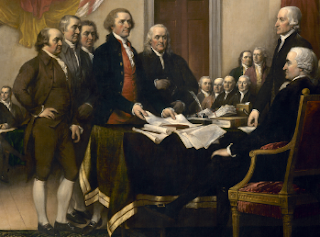
Dialect Dissection: Founding Fathers

"What did the Founding Fathers sound like?" Plenty of Americans have Googled this question, and there have been more than a few attempts to explain what they sounded like to a general audience. However, these articles are usually of limited scope, pointing out only a handful of features, such as that Colonial English pronounced all its "r"s and therefore it sounded more like American English than British English. I can't blame them for not going more into detail. After all, Colonial English is more than two-hundred years old, and it's hard to document all of that when you have a strict deadline and word count. Listening to "Hamilton" and "1776," I found myself wondering - what did the Founding Fathers sound like?

Much to my surprise, it's very difficult to find anything on the English of the 18th century! Perhaps it's because all the dramatic changes already happened around two centuries earlier and the modern dialectal changes only really become traceable a century afterward (Beal 2002). Due to my difficulty finding a straightforward explanation of Colonial American English, I conducted some research and gathered it all together here for your reading pleasure. As far as I am aware, this is the only non-paywalled article that discusses Colonial American English in depth and with a general audience in mind.

Sources Used

The way this article is organized is as follows: I will describe a difference between Colonial American English (CE) and Modern General American English (GA). I will then either show you an example (if available) or give you a citation. The examples come from Benjamin Franklin, Thomas Jefferson, John Adams, Alexander Hamilton, and (in exactly one instance) John Jay - these men are commonly considered to be "The Founding Fathers" of the United States. An example from the poet Phyllis Wheatley is also used as a supplement. All the citations in parentheses can be found in full at the bottom of the article; links to the texts have been provided where possible.

Benjamin Franklin's phonetic alphabet is one of the most important sources used here. Dissatisfied with the discrepancy between English spelling and pronunciation, he came up with a spelling - or orthography - that purported to represent speech as accurately as possible. There are no silent letters. New symbols were added for sounds. The values of old letters were changed. Some letters were removed altogether! His orthography is thus more predictable compared to our orthography. In his writings, he both described the value of each letter and gave samples of writing in the alphabet; this includes poetry and a letter exchange between him and a pupil of his. There are some minor inconsistencies between the poems and the letter exchange, but for the most part the alphabet is consistent. His alphabet was not used outside of his own writings. When quoting Franklin's writings in the phonetic alphabet, I will put his phonetic alphabet on the left and the modern orthography on the right.

Note that I did not describe every possible difference here. English in the 1700s was very diverse, and I am presenting a simplified picture here when the truth is that there were likely multiple competing forms at a time! Moreover, there are so many differences between Colonial American English and modern General American that this could easily become a fifteen page document if I described each and every one. This is not intended to be the most comprehensive source on Colonial American English - such a project would be beyond the scope of this blog and would require years of research, and this post has already been more than a year in the making! Instead, consider this a sampler, strongly influenced by Benjamin Franklin, of what a speaker of English might have sounded like had they lived in Colonial America from 1700 to 1750.

Table of Contents

Sounds (Phonetics and Phonology)

Consonants

Colonial English Consonants
Labial Dental Alveolar Post-alveolar Palatal Velar Glottal
Nasal m n ŋ
Stop/Plosive p b t d k g
Affricate tʃ dʒ
Fricative f v θ ð s z ʃ ʒ h
Approximant l j ʍ w
Trill r

Let's start with something simple - consonants. One of the remarkable traits about English is that the consonant inventory does not seem to have changed radically over time. Words may change, and vowels certainly will, but the actual list of consonants is not dramatically different between dialects, or even over time. Overall, the consonant inventory of Colonial American English is not too different from the consonant inventory of modern American English. Some of the more notable differences are elaborated on below.

Wine-Whine distinction

Words spelled with used to be pronounced differently in English from words spelled with . For example, "whine" was pronounced with a sort of 'h' sound at the beginning, resulting in /hwaɪn/. This means it was different from "wine," which was just /waɪn/. This distinction has been disappearing over the last hundred years, with only a few English dialects preserving it today. Most English speakers pronounce "wine" and "whine" as /waɪn/. In Colonial English, the distinction was robust, as evidenced by Franklin's spelling:

B. Franklin's Phonetic Alphabet Transcribed to modern English
So huen sɥm Endիel, bɥi divիin kcɩmand,
So when some angel, by divine command
Uiⱨ rɥiziŋ tempests իeeks e gilti Land; With rising tempests shakes a guilty land

Notice that Benjamin Franklin's Phonetic Alphabet gives different transcriptions for "when" and "with". "When" is "hwen", which suggests that 'wh' was still preserved.

T-flapping hadn't occurred

T-flapping (pronouncing the "t" in words like "kitty" as a flap sound, [ɾ]), does not appear to have started yet. This one is more proof by absence of evidence, as none of the contemporary sources of the 18th century I found described t-flapping. By the early 20th century we already have t-flapping in American English, so it must have been present during the 19th century, but I have not found any evidence that t-flapping happened in Colonial American English. Wells implies that t-flapping is a post-1750 phenomenon, saying that up until 1750, American and British English were more or less similar, and that after that point began the now-distinctive differences between the two to develop. He lists “Tapping and T Voicing” under “Some American innovations” and after “The Great Divide” (1982).

Value of /r/ sound

The 'r' sound is contentious. Benjamin Franklin describes the 'r' as alveolar and “vibrating”. Unlike New York English and most Southern England varieties, Colonial American English was generally rhotic - 'r's after vowels were pronounced (though see the “Regional Variations” section below to see how non-rhotic varieties existed even then). However, we don't know what this post-vocalic 'r' sounded like. In General American today, 'r' after a vowel is an r-colored vowel, but in Scottish English, it's a flap or a trill. It's possible the sound was in transition so that you would have heard both.

Per Beal, the trilled version of /r/ still existed in the 18th century, but already a weakening had begun to a continuant in the preconsonantal and final positions. (Beal 2002 p163-164)

Yod-dropping

Words like 'due' (/dju/), 'Tuesday' (/tjuzdeɪ/), and 'new' (/nju/) used to be pronounced with a 'y' sound, or "yod." Most American dialects nowadays pronounce these words without the yod, resulting in "do" /du/, "toosday" /tuzdeɪ/, and "noo" /nu/ (Krapp 155). Curiously, Benjamin Franklin's transcription of 'new' would be pronounced "noo" [nu], showing that the loss of this 'y' sound was already beginning.

B. Franklin's Phonetic Alphabet Transcribed to modern English
And e nu hev’n in its feer Bɥzɥm իoz. And a new heaven in its fair bosom shows.

Vowels

Colonial English Vowels
Front Central Back
Lax Tense Lax Tense
Close ɪ i ʊ u
Close-mid e ə o
Open-mid ɛ ʌ ɔ
Open æ ɒ
Diphthongs əɪ əʊ

Now it's getting interesting. Whereas the consonants remained mostly similar, the vowels changed quite a bit compared to General American. Vowels have been prone to mutation throughout the history of the English language, and it's no surprise to see that modern American vowels have gone through a lot of change from their colonial forebears. A lot of the differences between vowels aren't just a matter of substitution - some vowels are simply missing compared to General American, and some words had different vowels in them that Americans don't really distinguish today.

Here are some further comparisons of Colonial English (CE) vowels with British Received Pronunciation (RP) and General American (GA). The word on the left is an example word, and the sounds say the vowel that will be used in the word depending on the dialect.

Full Monophthongs
Lexical Set RP GA CA
TRAP æ
BATH ɑː æ æ
PALM ɑ
LOT ɒ ɒ
CLOTH ɔ,ɑ ɔ? ɒ?
THOUGHT ɔ: ɔ
KIT ɪ
DRESS e ɛ ɛ
STRUT ʌ
FOOT ʊ

Potential Diphthongs
Lexical Set RP GA CA
FACE e
GOAT əʊ o
FLEECE i: i i
GOOSE u: u u

Full dipthongs
Lexical Set RP GA CA
PRICE əɪ
CHOICE ɔɪ
MOUTH əʊ

Pre-R Vowels
Lexical Set RP GA CA
NURSE ɜː(r) ɜr ɜr?
START ɑː(r) ɑr ær
NORTH ɔː(r) ɔr ɔr
FORCE or
NEAR ɪə(r) ɪr ɪr
SQUARE eə(r) ɛr er
CURE ʊə(r),ɔː(r) ʊr,ɔr ʊr

Reduced Vowels
Lexical Set RP GA CA
COMMA ə
LETTER ə(r) ər ər
HAPPY i ɪ

All information here is supplemented by the evolution of English vowels throughout English language history.

/e/ and /o/ monophthongs

The vowels in "day" ([deɪ]) and "doe" ([doʊ]) are diphthongs in General American - they are composed of two sounds, gliding smoothly from the first to the second. This was not so in Colonial English, where these were "pure" vowels, or monophthongs (Beal 2002:97). To get the impression, imagine that the final element of the diphthongs in "day" and "doe" were chopped off. This would give us [de] and [do]. .

B. Franklin's Phonetic Alphabet Transcribed to modern English
So ˇⱨi piur limpid striim, huen fcɩul uiⱨ steens So the pure and limpid stream, when foul with stains
[...] Riflekts iitի flcɩur ˇⱨat cɩn its bcɩrdɥr groz, [...] Reflects each flower that on its border grows

Benjamin Franklin places and with the rest of the monophthongs. His description of these vowels does not mention any change in the tongue position while making the vowels, and his diphthongs are made with two different vowel letters. (Note that the use of "long/double vowels" is inconsistent in Franklin's orthography.)

o – the first vowel naturally, and deepest sound; requires only to open the mouth, and breathe through it.
cɩ - the next requiring the mouth opened a little, or hollower
a – the next, a little more.
e – The next requires the Tongue to be a little more elevated.

LOT-unrounding

In modern American English, words like "lot," "cot," "odd," "Ron," "bother," etc. have the same vowel as words like "spa," "palm," and "father:" /ɑ/ . This was not the case in Colonial American English, where words like "lot," "cot," "odd," etc. had a vowel that was made with rounded lips: /ɒ/. To try making it yourself, keep your lips round while saying 'spa'.

Words in the second set, such as "spa," "palm," "father", etc. had a different vowel entirely. This means 'father' and 'bother' wouldn't have rhymed! Most dialects of England still preserve this distinction, while old Boston and very old New York dialects are the only American dialects that pronounce them differently.

Krapp (141:144) suggests that turning /ɒ/ into /ɑ/, a process called LOT-unrounding, had already begun by the 18th century, though it was not common and was prescribed against.

We can see an example of this in Franklin's text. Franklin has his vowels in “short/long” pairs. “John” and “folly” have the “short” version of “awl” and “ball.”

Webster says “a in fall has its short sound in folly."

/ɑ/ sound

So what sound did they use in the second set of words above? The broad 'ah' /ɑ/ sound in words like "spa," "palm," "father", etc. does not appear to have existed yet (Grandgent 1899)! Franklin does not dedicate a sound to it in his alphabet, and uses the same symbol for "arm" that he does for "hat." This suggests that all these words had /æ/. This means "arm" would have sounded like [ærm] or [arm] (Krapp :50). Krapp notes that the broad 'ah' /ɑ/ sound was coming into existence and possibly existed as a variant at the time. This means that 'palm' and 'Pam' would have sounded the same in Colonial American English. By the mid 1700s, the /ɑ/ vowels appears to have finally appeared (Grandgent 1899, Wells 1982).

B. Franklin's Phonetic Alphabet Transcribed to modern English
Kalm and siriin hi drɥivs ˇⱨi feuriիs blast; Calm and serene he drives the furious blast.

Notice how Franklin uses same vowel for "calm" and "blast."

Unrounded /wa/

Consonants sometimes influence vowels. For example, in modern English, 'war' sounds like 'wore' [wɔr] . Historically, it wasn't always that way - 'war' used to sound like 'wahr' [war] (Beal 2002:127). Over time, the 'w' before the 'a' made people start to pronounce the 'a' lower and back in the mouth, which turned it into [wɔr]. You can see an example of this in Hamilton's poetry, where he rhymes 'arms' with 'warms'. We know this is supposed to be a rhyme because his poem uses AABB rhyme scheme:

If present love [unlegible] face
Deny you to my fond embrace
No joy unmixed my bosom warms
But when my angel’s in my arms.
- Alexander Hamilton

Similarly, the poet Phyllis Wheatley uses AABB rhyme scheme, rhymes "war" with "air". (More information on the pronunciation of "air" can be seen in the "Regional Differences" section below.)

Or thick as leaves in Autumn’s golden reign.
Such, and so many, moves the warrior’s train.
In bright array they seek the work of war,
Where high unfurl’d the ensign waves in air.
- Phillis Wheatley

/əi/ vowel

The "i" /aɪ/ sound as in "kite" had a lower starting vowel; Franklin equates it with the vowel in "about." It likely sounded like [əi]. Krapp suggests that there may have been some variability, so that there were some people saying [ai], some saying [ʌi], and some [ɑi] (p189). The last part of the diphthong was also higher than it is today. The colonial realization of this sound was closer to the sound that Shakespeare would have used.

Benjamin Franklin describes that the sound of “i” is actually a diphthong made of the sound he dedicates to ‘uh’ and ‘ee’, so ‘uh-ee’.

B. Franklin's Phonetic Alphabet Transcribed to modern English
So huen sɥm Endիel, bɥi divիin kcɩmand, So when some angel, by divine command
Uiⱨ rɥiziŋ tempests իeeks e gilti Land; With rising tempests shakes a guilty land

Notice the same symbol used for "some" and "rising."

/aʊ/ as /ɔu/

The 'au' /aʊ/ sound in 'bout' was formed further back in the mouth compared to today. Franklin uses the symbol that represents either /ɒ/ or /ɔ/ for it, meaning it may have sounded like /ɔu/. This means that 'bout' would have sounded a lot like General American 'boat'.

B. Franklin's Phonetic Alphabet Transcribed to modern English
So ˇⱨi piur limpid striim, huen fcɩul uiⱨ steens So the pure and limpid stream, when foul with stains
[...] Riflekts iitի flcɩur ˇⱨat cɩn its bcɩrdɥr groz, [...] Reflects each flower that on its border grows
[...] fcɩr it cɩluaz cɩkɥrz hwen eni refcɩrmeիɥn iz propozed; [...] for it always occurs when any reformation is proposed

The /ɔ/ vowel is used for "foul," "flour," "border," and "always."

LINE-LOIN merger?

Krapp (p197) suggests that the /ɔɪ/ vowel of "choice" was not yet its own distinct category, and would have sounded the same as the vowel of "price," /əi/ . This means "line" and "loin" would both be something like [ləin]. Franklin does not mention the diphthong that today is /ɔɪ/ in his sounds.

SQUARE vowel

Many of the examples shown above give the impression that colonial English was straightforward, but Eighteenth century English was wildly diverse. This can be seen in the fact that I did not assign a single value for the vowel in words like SQUARE /skwɛr/. What is now the modern SQUARE /ɛr/ vowel seems to have been in quite a bit of flux, and could have had a higher realization as /er/ (Krapp:106-107). Franklin does not describe this vowel, although he does provide a transcription for the word "fair" below.

B. Franklin's Phonetic Alphabet Transcribed to modern English
And e nu hev’n in its feer Bɥzɥm իoz. And a new heav'n in its fair bosom shows.

Franklin uses in his phonetic spelling, the same value he uses for the vowel of “stains”. This would suggest [er].

B. Franklin's Phonetic Alphabet Transcribed to modern English
So ˇⱨi piur limpid striim, huen fcɩul uiⱨ steens So the pure and limpid stream, when foul with stains

This is backed by Wells’s suggestion that the SQUARE vowel of English in both America and Britain was /er/ in 1750 (1982:212).

Note, however, that we have "air" and "war" rhyming in Phyllis Whealey's poem. "tears" and "cares" can be found rhyming in Thomas Jefferson's poem. More information on this pronunciation of SQUARE set words can be found in "Regional Variations."

Or thick as leaves in Autumn’s golden reign.
Such, and so many, moves the warrior’s train.
In bright array they seek the work of war, [wær]
Where high unfurl’d the ensign waves in air [ær].
- Phillis Wheatley
Life's visions are vanished, it's dreams are no more.
Dear friends of my bosom, why bathed in tears? [tærz]
I go to my fathers; I welcome the shore,
which crowns all my hopes, or which buries my cares [kærz]
- Thomas Jefferson

/ærV/

Most dialects of General American pronounce words such as "marry," "carrot," and "carriage" with the same vowel sound as in "merry" and "Kerry" - /ɛr/. In Colonial English, "marry," "carrot," "carriage" etc. would have had a different sound: the 'aa' vowel of 'cat'. Observe how Franklin uses the <a> for "carriages [kærɪdɪʒ].

B. Franklin's Phonetic Alphabet Transcribed to modern English
and iven dcɩun az lo az rods and huil karidիiz. And even down as low as roads and wheel carriages

CURE vowels

'ur' words like 'you're' and 'pure' consistently had the short 'u' /ʊr/, as in look, /jʊr/ and /pjʊr/. American English is in a process of pronouncing these words with /ɔr/

B. Franklin's Phonetic Alphabet Transcribed to modern English
So ˇⱨi piur limpid striim, huen fcɩul uiⱨ steens So the pure and limpid stream, when foul with stains

"pure" spelled 'ur'. Compare with "perform", spelled differently:

B. Franklin's Phonetic Alphabet Transcribed to modern English
And, pliiz’d ˇⱨ’ cɩlmɥitis cɩrdɥrs tu pɥrfcɩrm, And, pleas'd th'almighty's orders to perform

HORSE-HOARSE distinction

Words like 'horse' and 'hoarse' were distinct. 'horse' had a /ɔr/ sound, while 'hoarse' would have had a /or/ sound like in "oh" (Wells 1982:212). Nowadays this distinction is almost extinct in General American.

B. Franklin's Phonetic Alphabet Transcribed to modern English
Uɥrds in ˇⱨi kors cɩv tɥim Words in the course of time
And, pliiz’d ˇⱨ’ cɩlmɥitis cɩrdɥrs tu pɥrfcɩrm, And, pleas'd th'almighty's orders to perform

"course" with the mid-height vowel , "perform" with low height .

Lax HAPPY vowel

Nowadays, the final vowel in words like 'happy', 'baby', 'coffee,' etc. is pronounced with the same vowel as in fleece: [i]. In Colonial English, the final vowel in words like 'happy', 'baby', 'coffee', etc. is pronounced with the same vowel as in kit: [ɪ] (Wells 1982:165). Conservative varieties of Received Pronunciation and Southern American English still use this latter pronunciation. This phenomenon is also discussed in my article Oh Babih, Babay.

Example Audio

When you put all these changes together, the end result sounds a lot like how Shakespearean English does when pronounced! It also bears some resemblance to modern Irish English. As an example, I've prepared the following reading of a quote from the Declaration of Independence in Colonial English.

Text IPA
We hold these truths to be self-evident, that all men are created equal, that they are endowed by their Creator with certain unalienable Rights, that among these are Life, Liberty and the pursuit of Happiness.

wi hold ðiz truθs tu bi sɛlf ɛvɪdɛnt, ðæt ɔl mɛn ær krietɪd ikwəl, ðæt ðe er ɪndɔud bʌi ðer krietər wɪθ sərten ʌnelienəbl rəits, ðæt əməŋ ðiz er lʌif, libərtɪ, ænd ðə pərsut ɔv hæpɪnɛs.

For a little bit of fun, I've also covered the song "My Shot" from the musical "Hamilton," also done in Colonial English. I had originally also planned to do a Colonial English version of a song from the musical "1776," but I could not settle on a song. Perhaps it can be added in a future revision of the article...

I've also added the explicit version as a lyric video on YouTube. The IPA is included here!

Regional Variations

Although British visitors to the colonies noted its "purity" of speech and "lack of idiom or tone", it seems unlikely that everyone in the colonies spoke the same variety. We know that certain parts of the colonies were settled by certain groups. It makes sense that those groups would bring the features of their particular region of Britain to America. Wells (1982) estimates that British English and American English had shared developments until 1750, when both varieties started to develop apart from one another. It also makes sense that, since travel between the colonies was rather difficult and the distance between them rather large, that they would begin to develop separately from each other.

There is some evidence for dialectal division when you look at runaway slave advertisements, which often described slaves on the basis of their accents. We have instances of slaves being identified as being "from Maryland or Virginia," having a "New England accent," and a "West Indies" accent, which suggests that these were distinct and recognizable varieties. Due to the paucity of information on other Colonial English dialectal regions, we're going to be looking at New England and the South.

New England

New England is the best-documented region of the early colonial period with regards to early dialectal variation. There were a lot of documents written by semi-literate people, and their naive spellings show some divergent features (Bailey 2015:29). Such a tradition was not strong in the Middle or Southern colonies, where documents were written in the standard English of the time, so it's harder to determine dialectal variation there (Krapp 1925).

There's evidence for non-rhoticity. It seemed to have existed alongside rhotic pronunciations, with some variation: "horse" was often written "hoss," and "George" was sometimes written "Geoge" (Bailey 2015:40). Bostonian Benjamin Franklin seemed to have used a rhotic pronunciation; his description of the 'r' sound in English in particular suggests a trilled 'r', and he does not drop the 'r' in his transcriptions.

Franklin's transcription does not include a way to represent the sound we now have in "father"; words like "father" rhymed with "gather" and "rather" for him. However, there were signs of what is called TRAP-BATH split in Boston. This means that words like "trap" were pronounced with /æ/ and words like "bath" were pronounced with /ɑ/. It's possible that the broad 'ah' sound was in circulation, but it had not been established as a separate phoneme in all varieties of English (Krapp 1925).

The South

First of all, Southern American accents as we know them did not exist. Many of the features we associate with the South are actually rather recent. For example, pronouncing 'ride' like 'rad' was not something that happened in the 1700s - it probably began in the mid to late 1800s (Bailey 1997,Source 1,Source 2, Labov, 2016). Some other features, like rhyming "pen" and "pin," may have started in the early twentieth century (Brown, 1991). This means an eighteenth century Southern accent would not sound like a twenty-first century Southern accent.

Don't take this to mean that there weren't nascent difference between the South and the rest of the country, though! Many of these differences have simply disappeared since. For example, a lot of words that are pronounced -eer /ir/ in modern English were historically pronounced /ɛr/ or /ær/ (Primer, 1887:90). For example, Thomas Jefferson seemed to rhyme "tear" (salt water from our eyes) with "care," meaning "tear" was likely pronounced something like [tɛr].

Life's visions are vanished, it's dreams are no more.
Dear friends of my bosom, why bathed in tears? [tærz]
I go to my fathers; I welcome the shore,
which crowns all my hopes, or which buries my cares [kærz]
- Thomas Jefferson

It's possible that this feature was also present in some other regions of the colonies. The poet Phyllis Wheatley was born in Africa in 1753, and sold as a slave to Boston merchants. Although her variety of English was probably influenced by Boston, note how she rhymes "war" and "air" in the poem below. Knowing that "war" would have been /wær/ at the time, this means it's likely she pronounced "air" as /ær/.

Or thick as leaves in Autumn’s golden reign.
Such, and so many, moves the warrior’s train.
In bright array they seek the work of war, [wær]
Where high unfurl’d the ensign waves in air [ær].
- Phillis Wheatley

There's another phenomenon that is typical of very conservative Southern speech - palatal stops in words like "garden" and "cart" [kɑrt] so that they sound like "gyarden" and "cyart" [cart]. We may not have direct evidence for it in the 1700s, but it seems to have already existed by the 1800s, and is in decline by the 1900s.

We know at some point, big hub cities (most famously Charleston in South Carolina) in the south tended towards non-rhoticity (Mencken). Bailey (2015) reports that Virginians spoke non-rhotically. This feature later became emblematic of coastal Southern speech, and is moribund nowadays.

Words: Morphology, Lexicon, Spelling

Now let's look at everything other than pronunciation. For the most part the morphology, lexicon, and spelling of Colonial English should still be recognizable to the modern American. However, that doesn't mean that you won't find notable differences here! The differences here are a lot less systematic than the sound ones. Some of these differences are mostly used by a single Founding Father, while others are more varied. This simply reflects the fact that Colonial American English was fluctuating and, moreover, not yet standardized.

Negation without Do-Support

Most verbs in English need a "do" if you want to form a negative: "I do not/don't care," "I do not/don't know," "I did not/didn't need..." etc. Only a handful of verbs can form negatives without "do" such as "to be" ("I am not") and, in some varieties of English, "to have" ("I had not"). Making negatives without "do-support" is much more common in the past. "I know not" is still in common use, though now in variation with "I don't know." Occasionally other verbs are also negated with "not" directly.

“The rival you mentioned I know not whether to think formidable or not as there has been so great an opening for him during my absence.” - Thomas Jefferson
I cared not what I did if I could but get away from school, and confess to my shame that I sometimes play’d truant.” - John Adams
“What will be the consequence, I know not.” - John Adams “Yet I had not the same confidence…” - John Adams
"I think we need not fear geting a good price for his Mules when he arrives." - Alexander Hamilton

Non-standard Verb Forms

Standard verb forms are not set in stone (Krapp 261). You'll see the founding fathers use forms that nowadays would be considered non-standard. This is dialectal variation, not an "incorrect" form.

“The rats that had eat” – Thomas Jefferson
“Who told you that I reported you was courting Miss Dandridge and Miss Dangerfeild?” – Thomas Jefferson
“The language in which he sung” – Thomas Jefferson
"In a little more than a Year Mr. Marsh pronounced me fitted for Colledge"- John Adams
"About 10 the sun brake out." - John Adams
"I receiv’d your favour of Decr. 29.2 about 3 or 4 Days after it was wrote." - John Adams
"We cleaned ourselves (to get Rid of the Game we had catched the Night before)" - George Washington

V2 Word Order

V2 word order is a type of word order where the verb must come after the first constituent in a sentence. Modern English does not have V2 word order and instead has Subject-Verb-Object word order, meaning the verb must come after the subject. However, Old and Middle English had V2 word order, which began to disappear over time. There are remnants of this in Early Modern English and Colonial American English.

"At Colledge, a Clowdy morning, and in the afternoon, Came up a Clowd of thunder and lightning." - John Adams
"Whatever deficiencies there may be in them as to that matter, will I hope be supplied by the extract now enclosed." - John Jay

The Modern English versions would be "In the afternoon, a cloud came up of thunder and lightning" and "Whatever deficiencies there may be in them as to that matter, I hope will be supplied by the extract now enclosed."

Passive Ditransitive

A ditransitive verb is a verb that accepts a direct object and an indirect object. For example, in "She sent me a horse" the direct object is "horse," because that is the thing being sent, and the indirect object is "me," because it is the direction of the thing being sent. If we wanted to turn this into a passive construction, we would have to say "A horse was sent to me." However, this "to" does not seem necessary in 1700s English, as shown by John Adams's quote below.

"About three Weeks after commencement in 1755, when I was not yet twenty Years of Age, a horse was sent me from Worcester and a Man to attend me." - John Adams

Subject-to-Object Raising

In a sentence like "John wanted her to leave," it is interesting to note that "her" is not actually the semantic object of "wanted." What John wanted was not "her." What John wanted was her leaving. "Her" is actually the subject of "to leave." Some verbs in English allow for this sort of construction. Nowadays we don't really see this with the verb "to wish," but it seems to have existed in colonial American times.

He wished me to address the assembly” - Thomas Jefferson

Unergatives

One of the more interesting verb differences is that you can find examples of things like "I am come" instead of "I have come." This is preserving a distinction that used to exist in English - the difference between unergative and unaccusative verbs. Unergative verbs are verbs which describe actions that the speaker voluntarily started, like "I ran," "I jumped." Unaccusative verbs are verbs where the subject did not start the action themselves. These are verbs like "John died," "the vase broke," "Mary arrived." These are more like things that happen to the subject. In 1700s English, unaccusative verbs are marked by using "to be" as an auxiliary verb instead of "to have." This means you have examples like "I am fallen," "I am arrived" in the Founding Fathers' texts. This distinction still exists in French: je suis tombe vs j'ai travaille (I fell vs I worked). Nowadays most English speakers will only encounter this construction in the King James Version of the Bible with "Jesus is risen."

“Walker is just arrived.” - Thomas Jefferson
“I am become desirous” - Thomas Jefferson
are now become numerous” -John Adams

Subjunctive

The subjunctive form was used a lot more often, especially by Thomas Jefferson. It's worth noting that the founding fathers were learned men, and their writing likely was not an exact reflection of their speech.

“whether the story we read be truth” - Thomas Jefferson
“if the painting be lively” - Thomas Jefferson
“or whether the whole be not fiction” - Thomas Jefferson

Lexical Items

Some words that aren't in currency anymore are still being used at the time, such as methinks.

"It requiring methinks a steady continued Consideration for some Time to become a Master of your Doctrine in all its Parts." - Benjamin Franklin

Spelling

Spelling was also in flux. Honor vs honour, college vs colledge, public vs publick. This is clearest in the Constitution, where Pennsylvania is spelled "Pensylvania" (one n at the beginning). This isn't Hamilton making a typo - the spelling had not yet been settled. This is especially bad with commas and punctuation. Thomas Jefferson is fond of using commas where nowadays we would prefer a semi-colon or even just a period.

"Well I will shew you what it is to be a Farmer." - John Adams (pronounced ‘shoo’)
"in my own class at Collidge, there were several others," - John Adams
"His inattention to his Schollars was such as gave me a disgust to Schools, to books and to study and I spent my time as idle Children do in making and sailing boats and Ships upon the Ponds and Brooks, in making and flying Kites, in driving hoops, playing marbles, playing Quoits, Wrestling, Swimming, Skaiting and above all in shooting" - John Adams
"At Colledge, a Clowdy morning, and in the afternoon, Came up a Clowd of thunder and lightning." - John Adams

Conclusion

As was noted in the introduction, Colonial American English and eighteenth century English are woefully understudied. There were further points I was interested in researching, but was unable to find sufficient writings for. One was the extent to which dialectal differences from British English dialects affected the formation of Colonial American English. A paper I am unfortunately no longer able to locate suggested that almost all the settlers must have been from Southern England, since all American dialects have the PUT-STRUT split and most Northern English dialects do not. I wanted to include more comparisons to eighteenth century English English, but had to scrap this due to time concerns. A more in-depth study would mention that there were far too many lexical differences to include, and perhaps go more into detail about aspects beyond phonology. Finally, this article focused on just the first half of the 1700s. However, there is evidence that a distinct Colonial American English was already emerging in the 1600s. In other words, anyone interested in expanding on this field has plenty of room to look in.

Colonial American English represents a fascinating point in between Elizabethan English and our modern varieties of English. Although the primary point of this article is to note how American English has changed from colonial times to modern times, there are also many points of comparison with varieties of British English. Some of the distinctions that no longer exist in American English are still being made in Received Pronunciation, and some of the distinctions made in Colonial American English aren't being made at all anywhere! It's a wonderful example of how language is constantly changing. The change is not always radical, but over centuries it adds up so that we don't have an accurate understanding of what the American Founding Fathers would have sounded like in the popular imagination.

If you enjoyed this article and would like to see more long-form articles like this in the future, you can support me by buying me a coffee at Ko-Fi! ☕️

Works Cited

  • Bailey, Guy. 1997. When Did Southern American English Begin? In Englishes around the World: Vol.1: General Studies,British Isles,North America: Studies in Honour of Manfred Görlach, edited by Edgar W. Schneider. Amsterdam:John Benjamins.
  • Bailey, Richard W. 2015. Speaking American: a History of English in the United States. Oxford Univ. Press.
  • Beal, Joan C. English Pronunciation in the Eighteenth Century: Thomas Spences Grand Repository of the English Language. Oxford University Press, 2002.
  • Brown, Vivian R. 1991. "Evolution of the Merger of /I/ and /ε/ before Nasals in Tennessee" in American Speech Vol. 66, No. 3 (Autumn, 1991), pp. 303-315.
  • Labov, William. 2016. "The Beginnings of the Southern Shift" in Linguistic Variation: Confronting Fact and Theory edited by Rena Torres Cacoullos, Nathalie Dion, André Lapierre.
  • Franklin, Benjamin. 1907. The writings of Benjamin Franklin. New York: The Macmillan company.
  • Grandgent, Charles Hall. 1899. "From Franklin to Lowell. A Century of New England Pronunciation." PMLA. Vol. 14, No. 2 (1899), pp. 207-239
  • Krapp, George Philip. 1925. The English Language in America. Century Co.
  • Mencken, Henry Louis. 1919. The American Language.
  • Primer, Sylvester. 1887. Charleston Provincialisms. Transactions and Proceedings of the Modern Language Association of America.
  • Wells, John 1982. Accents of English. Cambridge: Cambridge University Press.

Founding Fathers Materials and Miscellania